
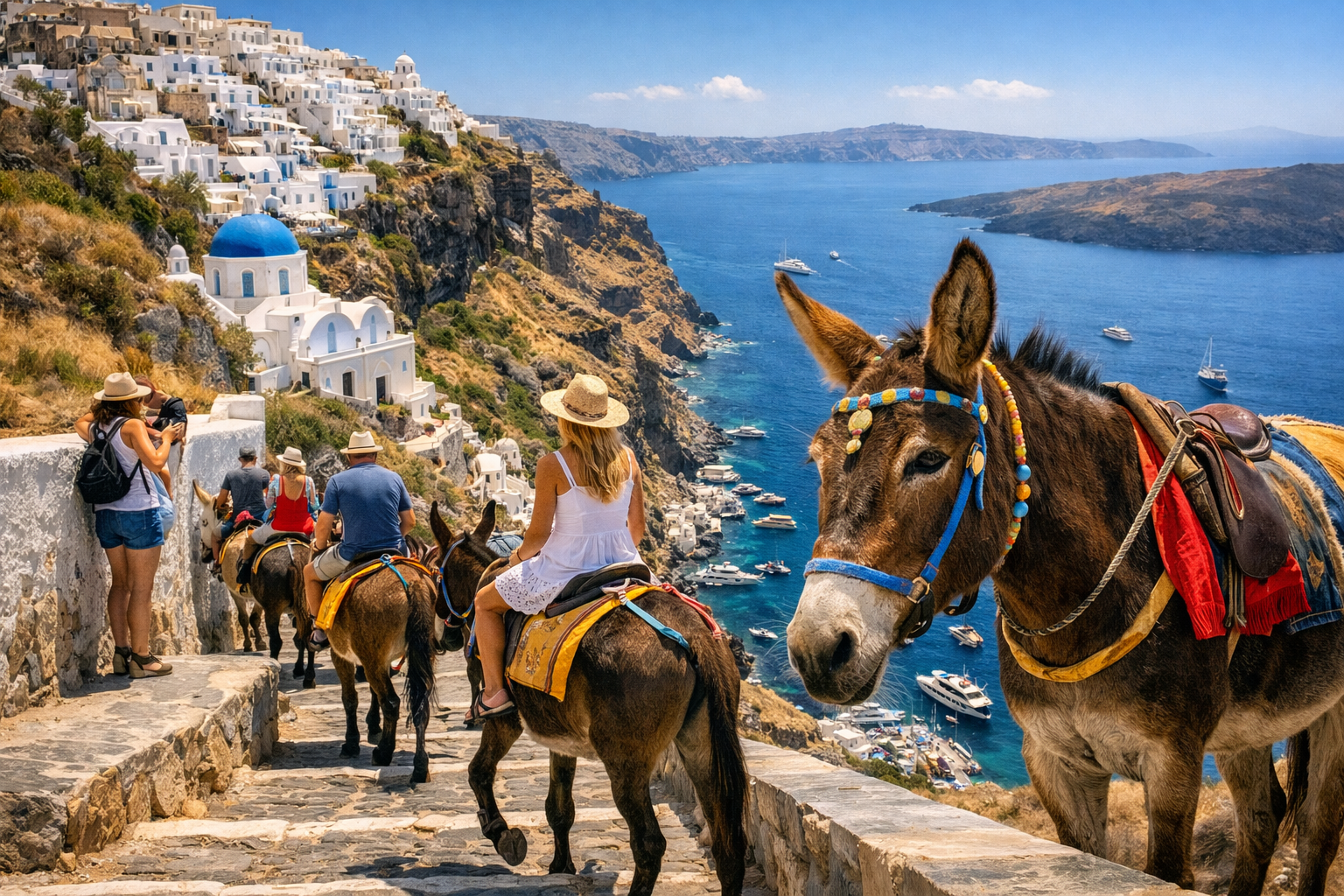
Santorini’s cliffside paths, whitewashed villages, and caldera views are unforgettable, but so is the ongoing conversation around animal welfare on the island. If you’ve heard about Santorini’s donkey weight limit and you’re wondering what it means for your trip in 2026, we’ve got you covered. The rule matters most for visitors arriving in Fira from the old port, especially cruise passengers, deciding how to get uphill. Santorini tour will walk through what the limit means, why it was introduced, how it affects your plans, and the smarter alternatives many travelers now choose instead.
What Santorini’s Donkey Weight Limit Rule Actually Says
Santorini’s donkey weight limit rule is tied to animal welfare protections introduced after years of criticism from activists, veterinarians, and international media. In practical terms, the rule states that animals used for transport should not carry loads heavier than a set share of their body weight. The figure most travelers see referenced is 20% of the animal’s body weight.
That sounds technical, but the takeaway is simple: not every visitor can or should ride a donkey in Santorini. The limit was created to reduce strain on animals climbing steep stone steps, often in hot weather.
It’s also worth knowing that enforcement and day-to-day practice can vary. Rules exist, but conditions on the ground may not always be perfectly transparent to travelers. That’s why we recommend treating the donkey ride as optional, not essential. If you’re unsure whether a ride is appropriate, the safest choice is to use an alternative route and enjoy the island without contributing to a situation that may put animals under stress.
Why The New Limit Was Introduced
The new limit wasn’t introduced in a vacuum. It came after growing concern about working conditions for donkeys and mules on Santorini, particularly on the steep route between the old port and Fira. Animal welfare groups had long argued that some animals were being overloaded, exposed to extreme summer heat, and worked too hard during peak tourism periods.
And honestly, it’s not difficult to see why this became a global issue. Santorini welcomes huge visitor numbers, especially from cruise ships, and that creates pressure on every transport system on the island, traditional ones included.
Greek authorities responded with welfare-focused regulations intended to protect pack and riding animals from excessive loads. The broader message was clear: tourism can’t come at the cost of basic animal care.
For travelers, this shift reflects a larger trend in responsible tourism. People increasingly want experiences that feel authentic without causing harm. The donkey weight limit is part of that change, and it has pushed more visitors to rethink how they move around Santorini.
How The Rule Affects Travelers Visiting Fira And The Caldera
For most travelers, the rule matters in one specific area: the ascent from Santorini’s old port up to Fira. If you arrive by cruise tender, you’ll typically have three ways up: walk the steps, take the cable car, or ride a donkey. Because of the Santorini donkey weight limit, that third option is now more restricted in principle and more sensitive in practice.
If you were picturing the donkey ride as a classic bucket-list experience, it’s worth resetting expectations. Many visitors now skip it entirely, either out of concern for animal welfare or because the ride itself is less charming than photos suggest. The path can be crowded, dusty, and shared with animals moving in both directions.
For travelers staying on the island and exploring the caldera, the rule has little effect on the rest of your itinerary. You can still visit Oia, Imerovigli, Pyrgos, wineries, beaches, and archaeological sites without relying on animal transport.
In fact, private touring often makes the whole experience smoother. On Santorini Impressive Tours, for example, many visitors choose guided transportation that avoids old-port confusion and helps maximize their limited time ashore.
Alternatives To Riding Donkeys In Santorini
The good news is that you don’t need to ride a donkey to enjoy Santorini fully. In most cases, there are better options.
Cable car
For travelers coming from the old port to Fira, the cable car is the most direct alternative. It’s fast, scenic, and far less physically demanding than climbing the steps. Lines can get long when multiple cruise ships arrive, so timing matters.
Walking the steps
Some visitors choose to walk. It’s doable if you’re fit, wearing proper shoes, and prepared for heat. But it’s not a casual stroll. The steps are steep, and the route can be slippery in places.
Private transfers and guided tours
If you’re starting from a hotel, villa, or arranged pickup point, a private vehicle is by far the easiest way to see the island. We often recommend pre-booked private tours for couples, families, and small groups who want comfort, flexibility, and local insight without transport stress.
That’s especially true for premium travelers who want to see more than just Fira in a short window.
What Cruise Passengers And Day Trippers Should Plan Ahead
Cruise passengers need to plan this more carefully than overnight visitors. Santorini can feel wonderfully cinematic, but on heavy port days, logistics become the real story. If your ship tends to the old port, assume there may be waits for the cable car and congestion in Fira, so prefer to book your private transfer ahead.
That means we should think ahead about timing, mobility, and backup options. If anyone in your group has limited mobility, heat sensitivity, or trouble with steep walking, don’t leave the decision until you’re standing at the port.
A few smart moves help:
- Check your ship’s arrival window and how many other vessels are scheduled
- Book tours early, especially private shore experiences
- Wear stable shoes if you might walk even part of the route
- Carry water and sun protection, particularly from late spring through early fall
- Build in buffer time for returning to the ship
For day trippers flying or ferrying in, the same principle applies: pre-planning turns Santorini from hectic to seamless. That’s one reason private local operators with flexible itineraries remain so popular.
How To Visit Santorini Responsibly And Respect Local Animal Welfare
Responsible travel in Santorini isn’t complicated, but it does require a little intention. The simplest approach is to avoid experiences that may place visible strain on animals, especially during hot, crowded parts of the day.
If you encounter donkeys or mules working on the island, treat them respectfully. Don’t crowd them for photos, don’t block narrow paths, and don’t assume every “traditional” activity is harmless just because it’s longstanding. Traditions evolve, and tourism should evolve with them.
We can also support businesses that prioritize ethical, modern travel experiences, guided cultural tours, village visits, local wine tastings, sailing trips, and curated island sightseeing. Those options spread visitor spending across the local economy without depending on animal rides.
A more responsible visit often ends up being a better one anyway. You move more comfortably, see more of the island, and leave knowing your choices matched the kind of destination Santorini is trying to become: beautiful, welcoming, and more sustainable under heavy tourism pressure.
Conclusion
Santorini’s donkey weight limit is more than a rule; it’s a sign of how travel on the island is changing. For most visitors, the best move in 2026 is simple: plan, choose practical alternatives, and experience Santorini in a way that respects both your time and local animal welfare. Done right, your visit will feel smoother, richer, and far more memorable than any rushed ride uphill.
FAQ: Santorini’s Donkey Weight Limit in 2026
1. What is the new donkey weight limit in Santorini?
The new regulation sets a maximum rider weight of 100 kg (220 lbs) to protect the health and welfare of Santorini’s working donkeys and mules.
2. Why did Santorini introduce this rule?
The rule was created to prevent injuries and exhaustion among donkeys that carry tourists up steep paths. It’s part of Greece’s broader effort to improve animal‑welfare standards in tourism.
3. When did the rule take effect?
The updated weight limit officially came into effect in 2026, following years of advocacy from animal‑rights organizations and local veterinarians.
4. How does this affect tourists visiting Santorini?
Visitors who exceed the weight limit are encouraged to use alternative transportation, such as the cable car, taxis, or walking paths. The goal is to make tourism more ethical while keeping the island accessible.
5. Are donkey rides still available?
Yes, donkey rides remain available, but operators must comply with the new regulations. Expect stricter monitoring and fewer rides during peak hours.
6. What are the alternatives to donkey rides?
Tourists can enjoy the Santorini Cable Car, scenic walking routes, or private transfers from the port to Fira and other destinations.
7. Does this rule apply to other Greek islands?
Currently, the rule applies only to Santorini, though similar measures may be adopted elsewhere in Greece in the future.
8. How has the rule changed tourism on the island?
The new limit has encouraged more sustainable and responsible tourism, improving Santorini’s reputation as a destination that values animal welfare and visitor experience.
Read More About Santorini Impressive Tours:
- 7 Instagrammable Spots in Santorini
- When Is the Best Time to Visit Santorini? A Month-by-Month Guide
- Santorini Impressive Tours – Discover Impressive Tour Experiences in Santorini
- Santorini Honeymoon: The Ultimate Guide for Honeymoon in Santorini for Honeymooners
- Best Santorini Sunset Tour: Explore Santorini Sunset Tours and Sunset Spots
- Santorini Travel Guide 2026: Best Tours & Insider Tips
- Best Beaches to Visit on Santorini: Discover the Best Beaches in Santorini
- Choosing a Santorini Photography Tour with a Private Santorini Tour
- Cultural Experiences in Santorini
- Exploring Santorini’s Cliffside Villages
What the Rules on Santorini Donkeys Actually Say
Greek animal welfare legislation sets working limits for equines used in tourism, and the provisions that matter for the Santorini donkeys are these.
A weight limit. An animal may not carry a load exceeding roughly a fifth of its own body weight, which in practice puts the ceiling around 100kg including tack. Operators are expected to refuse riders above it.
Rest and shade. Working animals must have shaded rest periods, access to water, and cannot be worked continuously through the hottest part of the day.
Fitness to work. Animals that are injured, lame, pregnant or in poor condition may not be used, and veterinary oversight is required.
Identification and record keeping. Owners must register animals and maintain records.
Tack standards. Saddles and harnesses must fit and must not cause wounds, which was a specific and repeated finding in welfare investigations.
Enforcement has historically been the weak point rather than the legislation. Campaign groups have documented gaps between what the rules require and what happens on the path, and that gap is the substance of the public argument about the Santorini donkeys.
Why There Are Donkeys on the Cliff at All
The 580-step path between the old port and Fira predates every other way up. Before the road and before the cable car, everything that arrived by sea — goods, luggage, people — came up that staircase on the back of a mule or a donkey. The Santorini donkeys are not a tourist invention; they are the remnant of the island’s only transport system, and families have worked the same animals on the same path for generations.
That history is why the issue is more complicated locally than it looks from outside. For some owners this is heritage and a livelihood. For the animals, a staircase carrying cruise passengers in July heat is a very different job from carrying sacks at a walking pace in 1950.
The Welfare Concerns, Stated Plainly
Investigations by welfare organisations, including PETA and The Donkey Sanctuary, have documented the recurring problems: animals carrying riders heavier than the legal limit, open sores from ill-fitting saddles, insufficient shade and water during long working days, animals kept tethered on hard surfaces, and continuous work in extreme summer heat.
Publicity around those findings drove the regulatory tightening, and it also changed visitor behaviour, which has probably had more effect than the law. Ride volumes have fallen substantially over the last decade.
It should be said that conditions vary by owner. Some animals on the Santorini donkeys path are visibly well kept, and some are not, and a visitor cannot reliably tell which operator is which from the queue.
How to Get Up the Cliff Instead
The cable car. Six cabins of six people, running continuously between the old port and Fira, and the option most passengers use. The catch is capacity: when several ships tender at once the queue can exceed an hour, and it is worst on the return leg when you have a sailing time.
Walking. The same 580 steps, on foot. Free, roughly twenty to thirty minutes upward for a reasonably fit person, considerably harder in summer heat. The steps are shared with the animals and are slippery in places as a result, so grip matters.
By road. A vehicle collects at the tender quay and drives up, which skips the cable car queue entirely in both directions. This is what our shore excursion does, and on a busy call day it is frequently the difference between seeing two things and seeing five.
We do not sell rides on the Santorini donkeys and we do not include them in any itinerary.
What Visitors Can Reasonably Do
Choose another way up. Demand is the only lever that moves quickly, and it has already moved.
If you do ride, weigh the rule. An operator who does not ask about weight is not applying the limit, which tells you what you need to know.
Look at the animal. Sores under the saddle, visible ribs, lameness, no water in reach and no shade at the standing point are the signs welfare groups list.
Report what you see. Photographs and locations sent to Greek animal welfare bodies and the municipality are what generated the last round of enforcement.
Do not lecture the owners. Nothing changes on the path from a confrontation, and the people working there are in a difficult economic position.
Our related pieces on the mayor’s warning on over-tourism and whether Santorini is a victim of its own success set this in the wider context, because the pressure on the Santorini donkeys and the pressure on the island are the same pressure.
Santorini Donkeys: Common Questions
Is there a weight limit for the Santorini donkeys?
Yes. Greek law limits the load to roughly a fifth of the animal’s body weight, which puts the practical ceiling around 100kg including the saddle.
Are donkey rides banned in Santorini?
No. They are regulated rather than banned, with limits on load, working hours, shade, water and fitness to work.
Is it cruel to ride the Santorini donkeys?
Welfare organisations have documented significant problems, including overloading, ill-fitting tack and heat exposure. Conditions vary by owner and a visitor cannot easily tell them apart, which is why many people choose another way up.
How many steps are on the Santorini donkey path?
Around 580, between the old port below Fira and the town on the rim.
What are the alternatives to riding?
The cable car, walking the steps, or a vehicle up the road from the tender quay.
How long does the cable car take?
The ride itself is about three minutes. The queue is the variable and can exceed an hour when several ships tender together.
Can you walk down instead of up?
Yes, and it is much easier than climbing. The steps are shared with animals and can be slippery, so wear shoes with grip.
Do the Santorini donkeys still carry goods?
Yes, in places. Some caldera properties with no vehicle access still use mules for building materials and luggage.
Has the number of donkey rides fallen?
Substantially over the last decade, driven more by visitor choice than by enforcement.
Do you offer donkey rides?
No. We do not sell or include rides on the Santorini donkeys in any tour or transfer.
Santorini Donkeys: Key Points
- The Santorini donkeys are regulated, not banned, under Greek animal welfare law.
- The weight limit for the Santorini donkeys is roughly a fifth of the animal’s body weight.
- That puts the practical ceiling for the Santorini donkeys near 100kg including tack.
- Shade, water and rest periods are legally required for the Santorini donkeys.
- Injured, lame or pregnant Santorini donkeys may not legally be worked.
- Enforcement, not legislation, has been the weak point for the Santorini donkeys.
- The path worked by the Santorini donkeys has 580 steps and predates the road.
- Welfare groups have documented overloading and ill-fitting tack on the Santorini donkeys.
- Conditions vary by owner, and visitors cannot easily tell which Santorini donkeys are well kept.
- The cable car, the steps or the road are the alternatives to the Santorini donkeys.
- Ride volumes for the Santorini donkeys have fallen sharply over the last decade.
- We do not sell or include rides on the Santorini donkeys in any itinerary.
Getting Around Without Them
Per vehicle, no deposit, free cancellation, 20% off 2026 direct bookings.
Tours
- full day tour
- half day tour
- north part and Oia tour
- south part and Akrotiri tour
- sightseeing tour
- historical tour
- wine tour
- food experience
- sunset tour
- shore excursion
- small group tour
- black sand beach tour
- horse riding tour
- custom tour
- coach tours
Transfers and chauffeur
- island transfers
- VIP chauffeur service
- transfer to Oia and Finikia
- transfer to Fira and the villages
- choosing a private transfer
Book directly
- Full Day Tour
- Half Day Tour
- North Part and Oia Tour
- South Part and Akrotiri Tour
- Sightseeing Tour
- Small Group Tour
- Wine Tour
- Food Experience
- Historical Tour
- Sunset Tour
- Shore Excursion
- Black Sand Beach Tour
- Horse Riding Tour
- Personalised Tour
Further reading
- The complete Santorini travel guide
- Every village on the island
- How many days you need
- The best time to visit, month by month
- The best beaches
- Cultural experiences
- The best photo spots
- Where to watch the sunset
- Choosing a photography tour
- Santorini with kids
- The honeymoon guide
- Weddings in Santorini
- Choosing a private transfer
- Seven tips for choosing a tour
- Our ten most booked tours
More from this site
- All tours and prices
- About Santorini Impressive Tours
- Photo gallery
- Pictures from our private tours
- Useful links for travellers
- Full site map
- All our Santorini articles
- Terms of use
- Privacy policy
Write to us with your ship or your dates and we will sort the transport. Usually the same day.
Where This Leaves Visitors in 2026
The short position on the Santorini donkeys is that the law is reasonable and the enforcement has been patchy, and that visitor choice has changed the picture faster than either. Ride numbers have fallen sharply, several owners have left the trade, and the animals remaining on the path are worked less than they were a decade ago.
That does not resolve the argument. The Santorini donkeys are simultaneously a genuine piece of the island’s working heritage and a set of animals doing a hard job in summer heat on a staircase built for goods. Both of those things are true, and anyone who tells you the question is simple is selling something.
What we would say to a visitor is narrow and practical. You do not need the Santorini donkeys to get up the cliff: there is a cable car, a staircase and a road. If you take one of those three, the decision is made and nothing further is required of you. If you do choose to ride, weigh yourself honestly against the limit, look at the animal before you get on, and walk away if what you see is wrong.
For cruise passengers in particular, being collected by vehicle at the tender quay removes the question entirely and saves the cable car queue in both directions, which is the practical reason most of our guests never encounter the Santorini donkeys at all.
Our position as an operator is simply stated: we do not sell rides on the Santorini donkeys, we do not include them in any itinerary, and we will always tell you the alternatives when you ask.
Santorini Donkeys: Quick Answers
- Legal status of the Santorini donkeys: regulated under Greek animal welfare law, not banned.
- Load limit for the Santorini donkeys: about a fifth of the animal’s body weight.
- Practical ceiling for the Santorini donkeys: roughly 100kg including the saddle.
- Required for the Santorini donkeys: shade, water, rest periods and veterinary oversight.
- Prohibited: working injured, lame or pregnant Santorini donkeys.
- Steps on the path worked by the Santorini donkeys: around 580.
- Main documented concerns about the Santorini donkeys: overloading, tack sores and heat.
- Fastest alternative to the Santorini donkeys: a vehicle up the road from the tender quay.
- Cheapest alternative to the Santorini donkeys: walking the steps, free and slippery.
- Most used alternative to the Santorini donkeys: the cable car, three minutes plus the queue.
- Trend: ride numbers for the Santorini donkeys have fallen sharply in a decade.
- Our policy: we sell no rides on the Santorini donkeys and include none in any tour.