
SANTORINI PRIVATE WINE TOURS
Santorini Wine Tour – Private, Guided, Volcanic Vineyards
A private Santorini wine tour through the oldest continuously worked vineyard in Europe: ungrafted vines coiled on volcanic ash, Assyrtiko that tastes of the rock it grew in, and Vinsanto the island has exported for six hundred years. Part of our full range of Santorini tours, priced per vehicle with hotel pickup included.
Best Tour Experience
OVERVIEW
Embark on a journey of unlocking the old secrets of local winemaking. Thanks to its distinctive volcanic soil conditions, Santorini is world-renowned for its exquisite wine varieties.Wineries on the island are deeply rooted in century-old tradition and, in fact,local winemakers extend to visitors an open invitation to experience their art.
TOUR INFORMATION
Duration: 4.5 Hours Private Tours
Pick up Point: Cable Car in Fira Town , Your Hotel & Airbnb, Port, Airport.
Tour Languages: English
Transportation: Mercedes Minibus fully A/C
Highlights: Visit 3 of the best traditional wineries
SANTORINI PRIVATE WINE TOUR DESCRIPTION
 With over 18 wineries on the island, there is definitely no shortage of places to visit. Striving to make your experience truly unforgettable, we will provide the necessary information so that you can plan your itinerary according to your personal tastes and preferences.
With a history of over 3000 years of winemaking and a wide range of indigenous grape varieties (such as Assyrtiko,Aidani, Athiri, Mavrotragano, Mantilaria), it is no surprise that the wines of Santorini are highly celebrated.
Some wines that you should definitely try, but not be limited to, are the following:
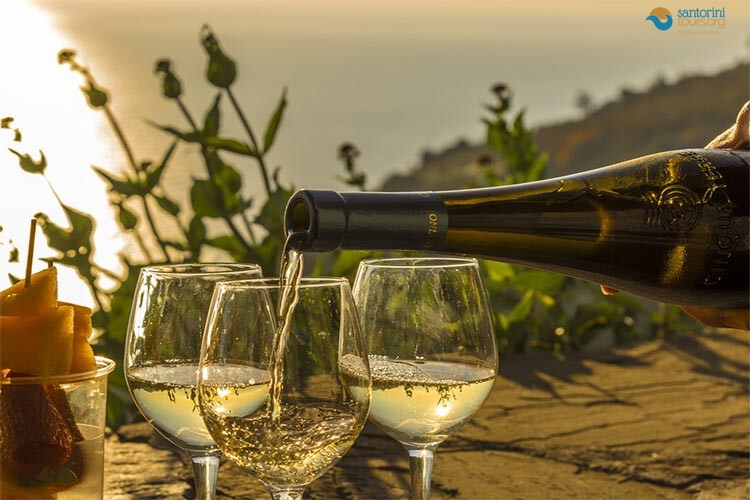
- Assyrtiko, the popular dry white wine known for its texture and balance, certainly deservingof the praise and acclaim it receives.
- Vinsanto, a rich sweet wine that can be served as an aperitif.
- Nykteri, which ages and ferments in wooden barrels for months.
- Mavrotragano, a rich and aromatic red wine.
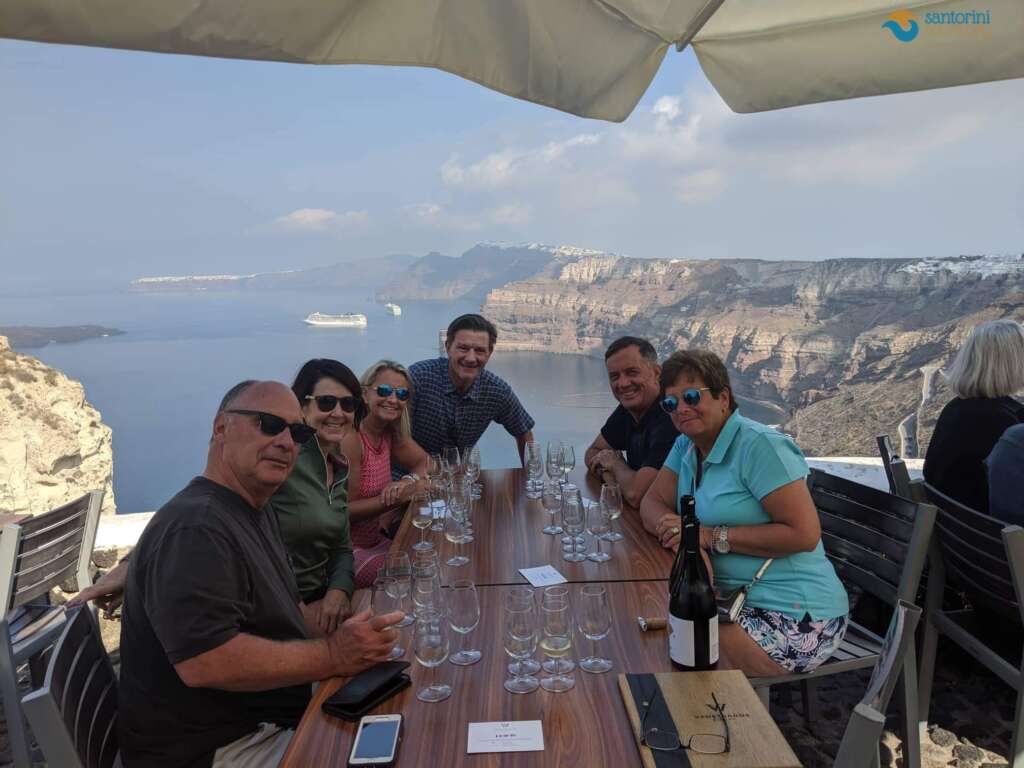 A friendly and welcoming atmosphere awaits visitors at the wineries where they will be provided with a wine expert (sommelier) that will guide them through their winetasting endeavors and give them insight into the ancient tradition of local wine.
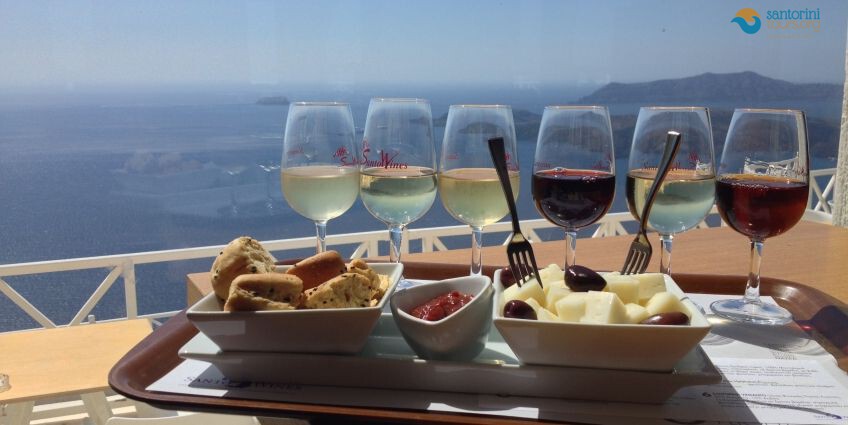
Taste 12 different glasses of Santorini Wines. The wines are usually accompanied with local specialties and visitors may make purchases if they wish.
Tour Included
- Private Tour
- Pickup and drop-off from designated meeting points
- Bottled water
- Transport by air-conditioned minivan
- Entrance fees and all taxes
- 3 Winery visits
- Wine testing ( 12 different wines )
- Snacks
Tour NOT Included
- Gratuities (optional)
PRICING
| 2 Guests | 650€ |
| 3 Guests | 725€ |
| 4 Guests | 800€ |
| 5 Guests | 875€ |
| 6 Guests | 950€ |
| 7 Guests | 1025€ |
| 8 Guests | 1100€ |
| 9 Guests | 1175€ |
| 10 Guests | 1250€ |
| 11 Guests | 1350€ |
| 12 Guests | 1400€ |
| 13 Guests | 1475€ |
| 14 Guests | 1550€ |
ADDITIONAL INFORMATION ABOUT SANTORINI PRIVATE WINE TOUR
Cruise passenger pick-up:
All cruise passengers with individual programs are taken to the old Port of Fira, by tender boats. From the port, you will take the cable car up to Fira town.
The journey on a cable car takes 2-3 minutes. The tour should approximately starts 90 minutes after the scheduled arrival of the cruise ship.
The meeting point for the tour is at the cable car’s exit in Fira town. Your guide will wait for you there, holding a sign with your name.
Please include the name and arrival time of your ship, your full name and mobile phone number when booking the tour in order for your pick-up to be arranged.
Hotel pick-up:
Your guide will meet you at the hotel entrance door
Drop-off / End Point:
Same as the meeting point
A deposit of € 80 Euros is required at the time of booking to secure your day with us.
You will pay off the balance in cash at the end of the tour. Confirmation will be received at the time of booking by e-mail.
CANCELLATION POLICY
Cancel free of charge up to 24 hours before your tour.
Cancellations made within 24 hours of the scheduled departure are charged at 100%.
SEE MORE BREATHTAKING PHOTOS OF SANTORINI FULL DAY PRIVATE TOUR
REVIEWS

From 650 EURO
DETAILS
- 4.5 Hours
- Local Expertise
- Multilanguage
- Flexible Cancellation
- Honest Price
- 100% Satisfaction Guarantee

🌍 Available in Multiple Languages
This tour is also available with a French or Spanish-speaking guide.
✔ Private language upgrade available
✔ Extra charge applies
To arrange your preferred language, please contact us on WhatsApp before booking.
Contact us on WhatsAppRELATED SANTORINI PRIVATE TOURS


Table of Contents
- What Happens on a Santorini Wine Tour?
- Why Is Santorini Wine Different From Anywhere Else?
- What Is the Kouloura and Why Does It Matter?
- Which Grapes Will You Taste on a Santorini Wine Tour?
- What Wine Styles Does Santorini Make?
- Which Wineries Might a Santorini Wine Tour Visit?
- How Does the Tasting Actually Work?
- When Is the Best Time for a Santorini Wine Tour?
- Is the Santorini Wine Tour Suitable for Cruise Passengers?
- Do You Need to Know About Wine to Enjoy This?
- What Should You Eat With Santorini Wine?
- How Long Has Santorini Been Making Wine?
- What Does a Santorini Wine Tour Cost?
- The Vineyard Year on Santorini
- How Is the Wine Actually Made Here?
- What Is a Canava?
- What Do the Labels and Appellation Rules Mean?
- Who Is the Santorini Wine Tour For?
- What Should You Wear and Bring?
- Can You Do a Santorini Wine Tour by Yourself?
- Buying and Shipping Wine Home
- Photographing a Santorini Wine Tour
- How Does the Santorini Wine Tour Compare With Our Other Itineraries?
- Can You Combine the Wine Tour With Something Else?
- Where Do the Wineries Sit on the Island?
- Booking Your Santorini Wine Tour
- Santorini Wine Tour: Full Question List
- Why Book Your Santorini Wine Tour With Us?
- Does Terroir Really Vary Across an Island This Small?
- Do Santorini Vintages Vary?
- Can Santorini Wine Age?
- What Are the Wine Villages Worth Knowing?
- Is Santorini Wine Under Threat?
- How Does Santorini Compare With Other Wine Regions?
- A Short Glossary for Your Santorini Wine Tour
- What Will You Take Away From a Santorini Wine Tour?
- What Does the Santorini Wine Tour Look Like Hour by Hour?
- What Does a Tasting Flight Actually Taste Like?
- How Do You Get the Most Out of the Day?
- What Makes a Good Wine Guide?
- Wine as a Gift or Souvenir
- Drinking Responsibly on a Santorini Wine Tour
- Frequently Asked Practical Questions
- Ready to Book Your Santorini Wine Tour?
- Where Else Can You Drink Santorini Wine on the Island?
- Is There a Wine Festival on Santorini?
- Why Has Assyrtiko Become Famous Abroad?
- The Santorini Wine Tour in One Paragraph
What Happens on a Santorini Wine Tour?
You visit two or three wineries with a licensed guide, taste through a structured flight at each, and see the vineyards between them. The Santorini wine tour runs four and a half hours in a private vehicle with hotel or villa pickup anywhere on the island, and it is built so the tasting makes sense rather than being a sequence of glasses.
The order matters. We start with the vineyard itself, because nothing about the wine is explicable until you have seen how the vines grow here. Then dry whites, then the aged styles, then Vinsanto at the end. Along the way your guide covers the geology, the harvest, the appellation rules and why a grape almost nobody outside Greece could name twenty years ago now appears on wine lists in every major city.
This is a private Santorini wine tour, not a shared minibus. The group is yours, the pace is yours, and if you want to spend forty minutes at one estate and skip another, that is your call on the day.
Why Is Santorini Wine Different From Anywhere Else?
Because the growing conditions here are close to impossible, and the vines adapted rather than died. Four things separate this island from every other wine region.
There is almost no rain
Santorini receives very little rainfall between spring and autumn, and there is no river, no lake and no meaningful groundwater. Vines survive on humidity: sea mist rolls in overnight, condenses on the leaves and drips into the ash. That is the water supply. It is why the yields here are among the lowest in the world and why the flavour concentration is so high.
The soil is volcanic ash, not soil
What the island calls aspa is a layer of pumice and volcanic ash left by the eruption around 1600 BC, sitting over older lava. It holds almost no organic matter, drains instantly and reflects heat. Nothing about it should grow good grapes. What it does do is force the roots down a long way and give the finished wine the saline, flinty character that people describe as minerality on a Santorini wine tour and then argue about afterwards.
Phylloxera never arrived
The louse that destroyed almost every vineyard in Europe in the nineteenth century could not survive in this ash. Santorini’s vines were never grafted onto American rootstock. They are own-rooted, and because the island propagates by layering rather than replanting, some root systems are extremely old — considerably older than the visible plant above them. You are drinking from vines with a continuity almost nowhere else in Europe can claim.
The wind shapes the vine
The meltemi blows hard across the island through the summer. A vine trained upright would be stripped. So growers coil the canes into a low basket on the ground, and the fruit hangs inside the basket, shaded and sheltered. That shape is the single most photographed thing on any Santorini wine tour, and it is the reason the island’s viticulture is on the UNESCO intangible heritage radar.
What Is the Kouloura and Why Does It Matter?
The kouloura is the basket. Growers take the long canes of the vine and wind them into a circular nest, low to the ground, and the grapes grow on the inside face of that nest. It is done by hand, it takes years to establish, and it is retrained continuously as the plant ages.
Three things it achieves at once. It shields the fruit from the meltemi, which would otherwise scour the skins. It shades the grapes from a sun that would cook them. And it traps the night humidity inside the basket, giving the plant the only water it will see for months. Nothing about it is decorative. It is a solution to a specific problem, arrived at over centuries.
The cost is labour. A kouloura vineyard cannot be machine-harvested and barely tolerates a tractor, so every stage is done by hand, and yields per hectare are a fraction of what a trellised vineyard on the mainland produces. That is a large part of why Santorini wine costs what it does, and it is worth understanding before you look at a price list on the Santorini wine tour.
Which Grapes Will You Taste on a Santorini Wine Tour?
Assyrtiko
The reason the island matters. Assyrtiko is a white grape with an unusual property: it holds its acidity even in extreme heat, where almost every other variety flabbily loses it. The result is bone dry, high acid, low aromatic, with citrus and salt rather than tropical fruit. The appellation requires it to dominate any wine labelled PDO Santorini, and on the Santorini wine tour you will taste it in at least three treatments.
Aidani
Aromatic, floral, softer. Usually blended with Assyrtiko to lift the nose, occasionally bottled alone. If Assyrtiko is the structure, Aidani is the perfume.
Athiri
The third white of the traditional blend. Gentler acidity, rounder body, used to soften Assyrtiko’s edge.
Mavrotragano
A red that was nearly lost. It was down to a handful of vines before a small group of producers propagated it back from the brink in recent decades. Dark, structured, firmly tannic. Production is tiny and not every winery on a Santorini wine tour will have it open, which is exactly why it is worth asking.
Mandilaria
The other red, deeply coloured and tannic, often blended to give backbone. Grown across the Aegean but distinct here.
There are older, rarer varieties still on the island in small plots, and your guide will point them out in the vineyard if they are in view.
What Wine Styles Does Santorini Make?
PDO Santorini – the dry white
The benchmark. Assyrtiko-dominated, fermented dry, usually in steel, bottled young. Pale, tight, high in acid, with lemon, green apple and a saline finish. This is the wine that put the island on international lists and it is the first thing you will taste on the Santorini wine tour. Serve it cold, but not so cold you kill the texture.
Nykteri
The name comes from the Greek for night. Grapes were traditionally picked and pressed overnight, partly to protect them from the heat of the day, and the style that survives is a richer, fuller Assyrtiko, usually with some oak and longer ageing, higher in alcohol than the standard dry white. If the entry-level PDO is a razor, Nykteri is a blade with weight behind it. Most estates on a Santorini wine tour will pour one.
Vinsanto
The island’s historic export and, for many people, the highlight of the tasting. Grapes are laid out in the sun for days after picking, concentrating the sugar as they shrivel, then pressed and fermented very slowly. The wine is aged in oak for years — often a decade or more for the serious bottlings. What comes out is amber, intensely sweet, but with the Assyrtiko acidity still running underneath, which stops it being cloying. Notes of dried fig, raisin, caramel, orange peel and coffee.
Vinsanto was shipped in quantity to the Russian Empire and used as communion wine by the Orthodox Church for centuries, and that trade is the reason the island’s wine industry existed at the scale it did long before tourism. Your guide will cover this properly on the Santorini wine tour, because it explains the architecture as much as the wine.
Reds
A small but serious category. Mavrotragano and Mandilaria, sometimes blended, sometimes solo, usually oaked. Volumes are low and prices are not low. If you like structured Mediterranean reds, ask specifically whether anything red is open.
Retsina and the everyday wines
The island also makes simpler wines that never leave it, and some canavas keep a barrel of something rough and honest for locals. If your guide offers you a taste of the house wine at a family estate, take it. It will not be the best thing you drink that day and it will probably be the most memorable.
Which Wineries Might a Santorini Wine Tour Visit?
We build the route around what is open, what is quiet and what you want to drink. These are the estates that most often appear on a Santorini wine tour, and what distinguishes each.
Venetsanos
Built into the cliff above Athinios port, and the first industrial-scale winery on the island. It was designed to use gravity: grapes went in at the top, and the finished wine ran downhill to a pipe that loaded it straight onto ships below. The terrace has what is probably the best view of any winery on Santorini, straight down the caldera. It is our most frequent first stop.
Santo Wines
The island’s growers’ cooperative and the largest producer here, sitting on the caldera rim near Pyrgos. It is the most commercial stop on any Santorini wine tour and it earns its place: the range covers everything from entry-level Assyrtiko to serious Vinsanto, the terrace at sunset is genuinely spectacular, and for a first-time visitor it gives the clearest overview of the island’s styles in one sitting. It is also the busiest, which is why we time it carefully.
Domaine Sigalas
In the north near Oia, and one of the estates most responsible for Assyrtiko’s international reputation. Serious, quality-focused, with single-vineyard bottlings and a strong Vinsanto. If you already know Greek wine and want depth rather than breadth, this is the stop to ask for.
Estate Argyros
Near Episkopi, working some of the oldest vine material on the island. The Vinsanto here is regarded as among the best made anywhere in Greece, and the old-vine Assyrtiko bottlings are the ones collectors chase.
Gaia Wines
On the beach at Exo Gonia, in a converted tomato processing plant. The setting is unusual — you taste with the sea a few metres away — and the wines, including their submarine-aged bottling, are among the most talked about on the island.
Art Space
A canava, the traditional underground winery, in Exo Gonia, doubling as a contemporary art gallery. Small production, hand-worked, and the most atmospheric stop on any Santorini wine tour. The tunnels were dug into the pumice by hand generations ago.
Boutari, Vassaltis, Karamolegos, Canava Roussos and others
Boutari at Megalochori is a large, well-organised operation with a strong visitor programme. Vassaltis at Vourvoulos is one of the newer estates and has built a reputation quickly. Karamolegos and Canava Roussos both sit in the eastern half of the island, the latter among the oldest continuously operating canavas here. Any of them can be built into your Santorini wine tour if you ask.
We do not have a fixed contract with any single estate, which matters more than it sounds. Tours sold through marketplaces are frequently routed to whoever pays the commission. Ours are routed to whoever is pouring well that season.
How Does the Tasting Actually Work?
At each winery you sit down to a structured flight, usually three to five wines, poured in order from lightest to richest and finishing with Vinsanto. Someone from the estate talks you through each pour. Most stops include something to eat alongside — bread, local cheese, tomato, capers — because Assyrtiko’s acidity is built for food and tastes different with it.
Tasting fees are paid at each winery rather than bundled into the Santorini wine tour price. We keep them separate deliberately: flights range from modest to expensive depending on whether you want the entry range or the old-vine and reserve bottles, and bundling would mean charging everyone for the top flight. Your guide will tell you the options and the prices before you commit at each stop.
How much wine will you actually drink?
Across three stops, expect somewhere between nine and fifteen small pours. That is a real amount of alcohol, which is the practical argument for a private Santorini wine tour with a driver rather than a hire car. Spittoons are available at every estate and using one is normal, not rude.
Can you buy wine at the wineries?
Yes, and prices at the estate are usually better than in the shops in Fira. Most will pack bottles for air travel and several ship internationally. The vehicle carries your purchases for the rest of the day, so buy at the first stop if you want to rather than waiting until the last.
When Is the Best Time for a Santorini Wine Tour?
September, narrowly, but every month has an argument.
April and May
The vines are waking up and the island is still green from winter rain. Wineries are calm, tasting rooms are unhurried, and you get the undivided attention of the person pouring. The vineyards look sparse at this stage — the baskets are bare or barely leafed — so photographs are less impressive than the wine.
June and July
Full canopy, fruit setting and swelling inside the kouloura, and the vineyards at their most photogenic. Hot, and the tasting rooms are busier. An early start on the Santorini wine tour is worth asking for.
August – harvest
Santorini harvests earlier than almost anywhere in Europe, often beginning in the first half of August. If you are here then, a Santorini wine tour is a completely different experience: trucks and crates at the winery gates, the smell of fermentation, and everyone at the estate doing three jobs at once. Less time for visitors, far more to see.
September and early October
The best balance. Harvest has just finished, the new vintage is in tank, the crowds are thinning and the wineries have time to talk again. If you are choosing dates purely for the wine, choose these.
November to March
Quiet. Some estates close or shorten hours and we confirm before booking. What you get in exchange is an empty island and, at a few of the smaller canavas, a conversation with the person who actually made the wine. The Santorini wine tour runs year round.
Our month by month guide to Santorini covers weather and crowds in more detail.
Is the Santorini Wine Tour Suitable for Cruise Passengers?
Yes, and it is one of the better shore options because it does not depend on beating traffic to a viewpoint. At four and a half hours it fits comfortably inside a six hour port window with margin.
We collect from the old port below Fira and return you there. Venetsanos sits directly above Athinios, so a wine route from the port is geographically efficient in a way a village-hopping itinerary is not. If your window is tight, tell us the all-aboard time when you enquire and we will build backwards from it. Where the window is genuinely too short we will say so and point you at the five hour shore tour instead.
Do You Need to Know About Wine to Enjoy This?
No. The Santorini wine tour is built to work for someone who has never thought about acidity in their life, and it holds up for someone who has. The wines here are unusual enough that expertise is not the entry requirement — curiosity is.
If you do know wine, say so when you book and we will route you toward the estates with the deeper lists and the single-vineyard bottlings, and away from the ones geared to volume. If you do not, you will not be patronised at any stop we use.
What Should You Eat With Santorini Wine?
The island’s food and the island’s wine grew up together, which is why they work. Assyrtiko’s high acidity and salinity make it one of the great seafood whites — grilled octopus, sea bream, anything from the boat that morning. It also cuts through fried food, which is why it sits so well with tomatokeftedes.
Fava, the island’s yellow split pea puree, is rich and needs the acid. Chloro, the fresh unsalted goat cheese, is a natural partner. Capers and caper leaves, which grow wild on the cliffs, echo the saline note in the wine directly.
Vinsanto goes with dried fruit, hard aged cheese, or nothing at all. It does not need dessert and arguably it is dessert.
If food is the main event rather than the accompaniment, our private tour and food experience builds tastings into a six hour route, and our piece on where Greek food ranks is worth reading first.
How Long Has Santorini Been Making Wine?
Longer than almost anywhere. There is evidence of viticulture on this island going back thousands of years, and grape material has been recovered from the Bronze Age settlement at Akrotiri buried by the eruption around 1600 BC. Wine was being made here before the eruption, and it resumed afterwards.
The industry that shaped the modern island, though, is more recent. Under Venetian and then Ottoman rule Santorini exported wine in serious volume, and Vinsanto in particular travelled — to the Orthodox churches of the Russian Empire above all. The canavas, the underground barrel cellars dug into the pumice, date from that trade. So do the merchant houses in Oia and Megalochori, built on shipping the stuff.
Phylloxera devastated European vineyards in the nineteenth century and never reached here, so Santorini’s plant material carried on unbroken while France and Italy replanted from scratch. That continuity is the single most valuable thing the island’s growers own.
The threat now is not disease but land. Vineyard area has been shrinking for decades as hotels and villas take the flat ground, and a hectare of vines earns a fraction of what a hectare of accommodation does. Every serious conversation on a Santorini wine tour comes back to this eventually. Our article on Santorini and over-tourism covers the wider version of the same argument.
What Does a Santorini Wine Tour Cost?
Our four and a half hour private Santorini wine tour is priced per vehicle rather than per person, so the figure is the same whether two of you travel or six. Tasting fees at each estate are paid separately, which typically adds a modest amount per person for standard flights and more if you want the reserve and old-vine bottles.
Every 2026 booking made direct through this site takes 20% off. The full rate card for this and every other itinerary is published on our Santorini tours prices page, with no deposit taken to hold a date.
Compared with a shared minibus wine tour sold per seat, a private Santorini wine tour is more expensive for one or two people and cheaper for four or more, before you count the fact that the route and the pace are yours.
The Vineyard Year on Santorini
What you see on a Santorini wine tour depends entirely on when you come, and the cycle here runs earlier and harder than mainland Europe.
Winter: pruning and rebuilding the basket
Between December and February the vines are dormant and the growers are in the field doing the most skilled work of the year. Each kouloura is opened, the old wood assessed, and the canes rewound into the basket for the coming season. A vine may be retrained slightly differently every year for decades. This is hand work with no mechanical substitute and it is the reason labour costs here are what they are.
Spring: budburst and the first anxiety
March and April bring budburst. The risk is wind rather than frost — a hard blow at the wrong moment strips new shoots. Rain in spring is welcome and increasingly unreliable. By May the baskets are green and the vineyard begins to look like the photographs.
Early summer: flowering and set
June is flowering and fruit set. Bunches form inside the basket where you cannot see them from the path, which surprises visitors who expect grapes hanging in the open. Your guide will open a basket carefully on the Santorini wine tour so you can see how the fruit actually sits.
High summer: the drought
July is the test. No rain, relentless sun, constant wind. Everything the plant gets comes from night humidity condensing inside the basket. Berries stay small, skins thicken, and sugar and acid concentrate together in a way that almost no other climate manages.
August: harvest
Picking usually begins in the first half of August, among the earliest harvests in Europe, and it is done entirely by hand into small crates. Vinsanto grapes are picked and then laid out in the sun on flat ground or mats for a week or more to shrivel. If your Santorini wine tour falls in August you will see this happening.
Autumn: fermentation and rest
September and October are fermentation, racking and the first tastings from tank. The island exhales. This is the best month to talk to a winemaker because they finally have twenty minutes.
How Is the Wine Actually Made Here?
The broad process is the same as anywhere; the constraints are not.
Picking. By hand, in small crates, early in the day to keep the fruit cool. Machine harvesting is impossible in a kouloura vineyard.
Pressing. Gentle, usually whole-bunch or lightly crushed for the whites, to avoid extracting hard phenolics from thick sun-toughened skins.
Fermentation. Temperature-controlled stainless steel for the fresh PDO whites, preserving the citrus and the acid. Nykteri and the reserve bottlings see oak, either fermented or aged in it, which adds weight and a nutty edge without burying the fruit.
Vinsanto. The sun-dried grapes are pressed to a syrup so concentrated that fermentation crawls, sometimes for months or longer, and stops naturally while a great deal of sugar remains. Then years in oak, often in old barrels in an underground canava where the temperature is stable. The result is not fortified; the alcohol is all fermented.
Ageing and bottling. Whites are bottled young to preserve freshness, though good Assyrtiko ages remarkably well and estates will often open an older bottle on a Santorini wine tour to prove the point. Vinsanto is released after many years and continues to develop for decades.
What Is a Canava?
A canava is the traditional Santorini winery: a barrel cellar dug horizontally into the soft pumice, with the working areas above or in front of it. The pumice is easy to excavate and, once cut, holds a stable cool temperature all year without any energy input — which mattered enormously before refrigeration and still matters now.
Canavas were built into the villages themselves, and many of the buildings now serving as boutique hotels in Oia, Megalochori and Pyrgos began as wine cellars. On the Santorini wine tour we make a point of visiting at least one working canava rather than only modern facilities, because the architecture explains the trade better than any display board.
Look for the vaulted ceilings, the channels cut into the floor for moving must by gravity, and the small high openings that ventilate without letting in heat. None of it is decorative.
What Do the Labels and Appellation Rules Mean?
Santorini has a Protected Designation of Origin, and the rules are worth understanding before you buy.
PDO Santorini covers the dry whites and requires Assyrtiko to dominate the blend, with Aidani and Athiri permitted in a minority share. If a bottle says PDO Santorini, Assyrtiko is the backbone.
Nykteri is a designated style within the appellation, with its own minimum requirements including a higher alcohol level and a period of ageing.
Vinsanto is likewise defined: sun-dried grapes, minimum ageing in wood, and specified varieties. The long-aged bottlings state their years on the label.
PGI Cyclades appears on wines that fall outside the PDO rules, often the reds, since Mavrotragano and Mandilaria bottlings frequently sit here. A PGI label is not a quality downgrade — some of the island’s most expensive and most sought-after reds carry it.
Your guide will walk you through a label at the first stop of the Santorini wine tour so the rest of the day makes sense.
Who Is the Santorini Wine Tour For?
Couples, small groups of friends, and anyone who would rather understand a place through what it makes than through a viewpoint. It suits complete beginners and it suits people with a cellar at home, for different reasons.
It also works unusually well as a second-visit itinerary. If you have already done Oia, the caldera and Akrotiri on a previous trip, a Santorini wine tour takes you inland to parts of the island most visitors never see.
Is it suitable for children?
Children are welcome in the vehicle and at most estates, and several have gardens or terraces where they can sit. That said, four and a half hours structured around tasting is a long stretch for a young child, and we would usually steer families with under-tens toward the kid friendly itineraries or the full day tour, which has beaches and archaeology to break up the day.
Is it suitable if someone in the group does not drink?
Yes, and it happens often. Non-drinkers are not charged tasting fees, every estate serves water, coffee and soft drinks, and the vineyard walk, the canava and the history are the same experience either way. Several stops also sell food, and one of the better outcomes we see is the non-drinker enjoying the Santorini wine tour more than the drinkers.
Is it accessible?
Partly, and honestly it depends which estates. Modern facilities like Santo Wines are largely level and have accessible facilities. Traditional canavas involve steps down into the cellar and uneven stone floors. Vineyard paths are loose volcanic gravel, which is difficult for wheels and awkward with a stick.
Tell us what you need when you book and we will build the Santorini wine tour from the accessible stops rather than improvise on the day. We can also arrange a larger vehicle where required.
What Should You Wear and Bring?
Closed shoes with grip. Vineyard ground is loose pumice and gravel, and canava floors are worn stone that can be slick. Sun protection between May and October, because there is no shade in a vineyard by design — the shade is inside the basket, not above it.
A light layer for the canava, which stays cool year round and can feel genuinely cold after twenty minutes in August. Water. And, if you intend to buy, something to carry bottles in, although every estate will pack them properly.
Leave strong perfume or aftershave at the hotel. It sounds fussy and it is not: in a small tasting room it interferes with everyone else’s glass, and any winemaker will quietly wish you had not.
Can You Do a Santorini Wine Tour by Yourself?
You can, and there are two problems with it.
The first is driving. A meaningful tasting across three estates puts you well over any sensible limit, and Greek drink-driving law is strict and enforced. The roads here are narrow, badly lit at night and busy with quad bikes in summer. This is the single strongest practical argument for a private Santorini wine tour with a driver.
The second is access and timing. Several of the better estates take booked visits only, some close in the middle of the day, and a few of the small canavas are genuinely hard to find without local knowledge. A self-guided route tends to end up at whichever two wineries are easiest to park at, which are not necessarily the two you would have chosen.
Public buses do not serve the wineries usefully. If you want the freedom of your own vehicle for the rest of your stay but not on tasting day, our private island transfers cover the airport, the ports and the villages separately.
Buying and Shipping Wine Home
Buy at the estate. Prices at the cellar door are generally better than the shops in Fira and Oia, the range is wider, and older vintages that never reach retail are often available.
Most wineries will pack bottles in polystyrene shippers rated for airline hold luggage, and several ship internationally, though shipping costs to some countries exceed the value of the wine. Check your own customs allowance before you commit — travellers within the EU have generous limits, travellers to the US, UK, Australia and elsewhere considerably less.
If you are flying with hand luggage only, the estate can arrange shipping instead. Tell your guide early on the Santorini wine tour rather than at the last stop, so it can be organised while you taste.
One practical note on Vinsanto: it is the bottle most people wish they had bought more of, it keeps for decades, and it is the single best-value souvenir on this island.
Photographing a Santorini Wine Tour
The kouloura is the shot, and it is harder than it looks. A basket vine photographed from standing height reads as a bush. Get low, shoot along the row rather than down at it, and the geometry appears.
The vineyards are best in late spring and summer when the canopy is full, and the light is best early or late — the middle of the day flattens the volcanic ground to a grey blank. Venetsanos has the caldera view; Gaia has the sea; Art Space has the tunnels, which need a fast lens or a steady hand as flash is usually unwelcome.
Ask before photographing people working, particularly during harvest. Everyone is busy and most will say yes anyway.
If photography is the main purpose of your trip, our guide to choosing a Santorini photography tour and our list of the island’s most photogenic spots are both worth reading.
How Does the Santorini Wine Tour Compare With Our Other Itineraries?
We run fourteen tours. This is the only one built entirely around the island’s wine, and the choice between it and the others is mostly about how much wine you want relative to everything else.
Against the full day tour. The eight hour full day tour includes one winery stop among nine, alongside Oia, Akrotiri, the beaches and the caldera villages. If you want the island broadly and wine as one thread, take that. If you want three estates and time to actually taste, take the Santorini wine tour.
Against the food experience. The six hour food tour includes wine with the meals but is organised around the table rather than the cellar. Wine people should take this one; food people should take that one; people who want both should ask us to build a combination.
Against the sightseeing tours. The six hour sightseeing tour and the north part tour are landscape and village itineraries with a winery stop available. They cover more ground and taste less.
Against a shared wine tour. Group wine tours run at eight to sixteen people and follow a fixed route on a fixed clock. A private Santorini wine tour changes route on the day, waits while you talk to the winemaker, and carries only your party.
If you want something else entirely, the personalised tour is built from scratch, and can be four wineries, or two wineries and a beach, or whatever you actually want.
Can You Combine the Wine Tour With Something Else?
Yes, and it is the most common request we get. Three combinations work particularly well.
Wine and sunset. Time the last estate for the late afternoon and finish on a west-facing terrace. Several wineries have caldera views built for exactly this. It extends the Santorini wine tour by an hour or so and it is worth every minute.
Wine and archaeology. Akrotiri sits close to the southern wineries, and the Bronze Age settlement produced evidence of winemaking on this island thousands of years ago, so the two genuinely inform each other. Our historical tour covers the archaeology in depth if you want it as the main event.
Wine and the villages. Pyrgos and Megalochori are both wine villages with canavas built into them, so a walk through either slots naturally into the route between estates.
Tell us what you want when you book and we will build it rather than sell you the standard route.
Where Do the Wineries Sit on the Island?
Roughly, the vineyards occupy the flatter central and southeastern part of the island, away from the caldera cliff. That is where the ash is deepest and where the land was never valuable enough for hotels — until recently.
The caldera rim, near Pyrgos and above Athinios, holds the two estates with the biggest views.
The centre, around Megalochori, Exo Gonia and Vothonas, holds most of the historic canavas and the highest concentration of vineyards.
The north, near Oia and Vourvoulos, holds several of the estates that drove Assyrtiko’s international reputation.
The east, around Episkopi, Mesa Gonia and Kamari, holds some of the oldest vine material and several family operations.
A four and a half hour Santorini wine tour realistically covers two of these areas properly. Trying to cover all four is how you end up rushing, and we would rather do two well.
Booking Your Santorini Wine Tour
Send us your dates, your party size, where you are staying, and anything you already know about what you like to drink. We confirm availability and the exact figure, usually the same day. No deposit is taken and cancellation is free.
Book further ahead than you think for August and September. Harvest is the busiest period for the estates themselves and visitor slots at the smaller producers close early. Outside those months a week is usually enough notice.
To start, contact our team with your dates. Rates for this and every other itinerary are on the Santorini tours prices page.
Santorini Wine Tour: Full Question List
How long is the Santorini wine tour?
Four and a half hours door to door from your pickup point, covering two to three wineries with tastings at each.
How many wineries do you visit?
Two or three, depending on how long you want at each. Three is standard; two suits people who prefer depth over breadth.
Are tasting fees included in the price?
No. The Santorini wine tour price covers the vehicle, the guide and the pickup. Tastings are paid at each estate so you can choose between the standard flight and the reserve bottles rather than being charged for one flat option.
Is the tour priced per person or per vehicle?
Per vehicle. Two travellers and six travellers pay the same figure for the tour itself.
Do you collect from the hotel?
Yes, from anywhere on Santorini, and from the old port for cruise arrivals, at no extra charge.
Can non-drinkers join?
Yes, and they are not charged tasting fees. Water, coffee and soft drinks are available at every stop.
What if I do not know anything about wine?
That is the normal starting point. Nothing on the Santorini wine tour assumes prior knowledge.
What if I know a lot about wine?
Say so when booking and we will route you to the estates with the deeper lists, the single-vineyard bottlings and the older Vinsanto.
Can you visit a specific winery?
Usually yes. Name it when you book and we will confirm whether it takes visits on your date.
Is there food on the tour?
Most estates serve something alongside the tasting — bread, cheese, tomato, capers. A full meal is not included but can be added.
What is Assyrtiko?
The island’s principal white grape: bone dry, high acid, mineral and saline, and unusual in holding its acidity through extreme heat.
What is Vinsanto?
Santorini’s sweet wine, made from sun-dried grapes and aged for years in oak. Amber, intense, and balanced by the acidity that survives the drying.
What is Nykteri?
A richer, usually oaked Assyrtiko with higher alcohol and a period of ageing, named for the tradition of pressing at night.
Why are the vines shaped like baskets?
The kouloura shields the fruit from the meltemi wind, shades it from the sun and traps night humidity, which is effectively the vineyard’s only water.
Why did phylloxera never reach Santorini?
The louse cannot survive in the island’s volcanic ash, so the vines were never grafted and the plant material is continuous.
When is the harvest?
Usually the first half of August, among the earliest in Europe.
Can I buy wine on the tour?
Yes, at every estate, generally cheaper than retail in Fira. The vehicle carries your purchases for the rest of the day.
Can wine be shipped home?
Several estates ship internationally and most will pack for hold luggage. Check your own customs allowance first.
Is the Santorini wine tour accessible?
Partly. Modern facilities are largely level; traditional canavas involve steps and uneven stone. Tell us your requirements and we will build the route from accessible stops.
Can children come?
Yes, though four and a half hours structured around tasting suits older children better than young ones.
Does it run in winter?
Yes, year round. Some estates shorten hours between November and March and we confirm before booking.
Can it be done as a cruise excursion?
Yes, comfortably inside a six hour port window. We collect from and return to the old port.
How much wine will I drink?
Across three stops, roughly nine to fifteen small pours. Spittoons are available and using them is normal.
Should I drive myself instead?
No. A real tasting puts you over the limit, Greek enforcement is strict, and several estates are hard to find without local knowledge.
Do I need to book in advance?
A week is usually enough, longer for August and September.
Is a deposit required?
No deposit, and cancellation is free.
Why Book Your Santorini Wine Tour With Us?
We are a licensed operator registered with the Greek Ministry of Tourism, based at Karterados on the island. The guide who collects you is ours, licensed, and lives here. We do not subcontract and we are not tied to any single estate, so the route is chosen on what is pouring well rather than on who pays commission.
Pricing is per vehicle and published openly. There is no deposit, no cancellation fee and no marketplace margin. Every 2026 booking made direct takes 20% off.
Planning the rest of your stay? Read our 2026 travel guide, how many days you need, the cliffside villages, the best beaches, cultural experiences, and our ten most booked tours. Couples should also see the honeymoon guide and five reasons to marry here. Also worth a look: seven tips for choosing a tour, a guide to what we run, our signature experiences, private tours and sunsets, where to watch the sunset, the sunset tour, the south part tour, the famous sights tour, the semi private tour, the black sand beach tour, horse riding, coach tours, transfer services, the gallery and tour pictures.
Does Terroir Really Vary Across an Island This Small?
It does, more than the size suggests, and it is one of the more interesting threads to pull on a Santorini wine tour. The island is roughly seventy square kilometres and the differences across it are legible in the glass.
Depth of ash
The eruption did not distribute its material evenly. Some parts of the island carry many metres of pumice; others have far less over the older rock. Deeper ash means roots travel further and the vine has more buffer against drought. Growers will tell you which of their parcels suffer first in a dry year, and it is always the shallow ones.
Distance from the sea
Vineyards close to the coast get more salt in the air and more humidity at night. Whether that salinity transfers literally into the wine is argued about, but the wines from the seaward parcels do read differently, and every Santorini wine tour that visits both will let you test the claim yourself.
Altitude and aspect
The land rises toward Profitis Ilias in the southeast and toward the caldera rim in the west. Higher parcels ripen later and hold acidity longer. West-facing sites on the rim get the afternoon sun full on.
Vine age
Because the island layers rather than replants, parcels differ enormously in the age of their root systems. Old-vine parcels give tiny yields of intensely concentrated fruit, and the bottles from them are labelled and priced accordingly. If a winery on your Santorini wine tour opens an old-vine Assyrtiko next to a standard one, take the comparison seriously — it is the clearest lesson of the day.
Do Santorini Vintages Vary?
Yes, and mostly through wind and water rather than heat. A year with a hard meltemi at flowering loses crop. A year with no spring rain at all produces less again, with even greater concentration. Growers here talk about volume swings that would be catastrophic elsewhere and are simply normal on this island.
Because Assyrtiko holds acidity so reliably, the vintage variation shows more in weight and intensity than in balance. A low-yield year gives denser, more powerful wines; a kinder year gives more of them and slightly less concentration. Neither is worse. Your guide will tell you which recent years the estates are proud of and which they are quiet about, and a good Santorini wine tour includes that honesty.
Can Santorini Wine Age?
Better than almost anyone expects from a Mediterranean white. The acidity that makes young Assyrtiko so bracing also preserves it, and good examples develop for a decade or more, moving from citrus and salt toward wax, honey, nuts and something almost like aged Chablis or Riesling without ever becoming soft.
Nykteri, with its oak and its extra weight, ages on a similar curve. Vinsanto is on another scale entirely: the long-aged bottlings are released after many years already and continue to evolve for decades in bottle.
If you take one lesson home from the Santorini wine tour, make it this: buy two bottles of the dry white, drink one now and forget the other for five years. Very few people do it and everyone who does is surprised.
How should you store and serve it?
Cool, dark, on its side. Serve the dry whites cold but not frozen — around ten to twelve degrees, warmer than most people pour them, because ice-cold mutes the texture that makes them interesting. Nykteri wants a little warmer still. Vinsanto is served cool, in small glasses, and an open bottle keeps for weeks in the fridge.
What Are the Wine Villages Worth Knowing?
Megalochori
Arched lanes, bell towers and captains’ houses built on the wine trade, with canavas under a good number of the buildings. It is one of the most atmospheric villages on the island and it appears on many of our itineraries, not only the Santorini wine tour.
Pyrgos
The old capital, built in rings up to a Venetian castle, with wineries on the slopes below. The combination of a village walk and a tasting nearby makes for one of the better half-day shapes available here.
Exo Gonia and Vothonas
Inland, agricultural, and where several of the more interesting small producers sit. Vothonas in particular is built into a ravine with houses and cellars cut directly into the rock.
Episkopi Gonias and Mesa Gonia
The eastern villages, holding some of the oldest vine material and the oldest continuously working canavas. Mesa Gonia was largely abandoned after the 1956 earthquake and has been slowly reoccupied, which gives it an unusual half-ruined character.
Vourvoulos and the north
Quieter, closer to Oia, and home to some of the newer estates that have made a name quickly.
Our guide to exploring Santorini’s villages covers these and the caldera settlements in more detail.
Is Santorini Wine Under Threat?
Yes, and every grower you meet on a Santorini wine tour will raise it before you do.
Land. A hectare of vines produces a very small crop and a modest income. The same hectare with villas on it produces vastly more. Vineyard area on the island has been declining for decades and the pressure is not easing.
Water and heat. The system depends on night humidity. Hotter, drier summers reduce the dew that the baskets rely on, and growers report yields trending down over time.
Labour. Kouloura training and hand harvest are skilled, physical and seasonal, competing directly with a tourism industry that pays better for easier work. Finding people who can prune a basket vine properly is a real constraint.
Price. Santorini wine is not cheap and cannot be, given the yields. That limits the market and pushes producers toward export and toward the visitor economy — which is part of why a Santorini wine tour matters commercially to the estates, not just to the visitor.
None of this is doom. Prices for the best bottles have risen sharply, international attention is at an all-time high, and several producers are actively expanding plantings. But the island’s viticulture is genuinely fragile in a way that a Bordeaux or a Rioja is not, and it is worth knowing while you drink it.
How Does Santorini Compare With Other Wine Regions?
Against the rest of Greece, Santorini is the most internationally recognised appellation the country has, though Naoussa’s Xinomavro reds and Nemea’s Agiorgitiko have their own strong cases. Assyrtiko has now been planted on the mainland and elsewhere, which tells you what the market thinks of the grape.
Against other volcanic regions — Etna, the Canaries, Tokaj’s volcanic soils — the parallels are real. Etna in particular shares the altitude, the ash and the old ungrafted vines. What Santorini has that they do not is the near-total absence of rain and the basket training that follows from it.
Against the great white regions of the world, the comparison people reach for is Chablis: dry, mineral, high acid, food-driven. It is a reasonable starting point and it breaks down quickly, because Chablis has rain, limestone and cool temperatures, and Santorini has none of those and gets to a similar place anyway.
That contradiction — Mediterranean heat producing a wine with northern acidity — is the single most interesting thing about the island’s wine, and it is the thing a Santorini wine tour exists to explain.
A Short Glossary for Your Santorini Wine Tour
Aspa — the local term for the island’s volcanic ash and pumice soil.
Canava — a traditional winery, typically with barrel cellars cut into the pumice.
Kouloura — the basket shape into which the vines are trained.
Assyrtiko — the island’s principal white grape.
Aidani, Athiri — the two other permitted whites in the traditional blend.
Mavrotragano, Mandilaria — the island’s red varieties.
Nykteri — a richer, aged, usually oaked Assyrtiko style.
Vinsanto — the sun-dried sweet wine, aged for years in oak.
Meltemi — the strong summer wind that dictates how the vines are trained.
PDO Santorini — the protected appellation, requiring Assyrtiko to dominate.
PGI Cyclades — the wider regional designation used for wines outside the PDO rules, including most reds.
What Will You Take Away From a Santorini Wine Tour?
Three things, usually.
The first is that you will never look at a photograph of Santorini the same way again. Once you know what a kouloura is, you start seeing them in every wide shot of the island, in ground that most visitors read as empty scrubland.
The second is a recalibration of what a hot climate can produce. Almost everyone arrives expecting soft, ripe, tropical whites and leaves having drunk something taut and saline that tastes like it came from somewhere far cooler.
The third is Vinsanto, which almost nobody has tried before the tour and almost everybody buys after it.
A Santorini wine tour is four and a half hours and it changes how you read the island for the rest of your stay — the walls, the terraces, the cellars under the villages, the reason the flat ground looks the way it does. That is a better return than most half-days here deliver.
To book your Santorini wine tour, send us your dates. No deposit, free cancellation, and 20% off every 2026 booking made direct.
What Does the Santorini Wine Tour Look Like Hour by Hour?
Timings shift with your start time and how long you linger, but this is the realistic shape of the four and a half hours.
The first twenty minutes. Pickup from your hotel, villa or the old port, and the drive out of the caldera villages toward the vineyards. Your guide uses this time to set up the day: the eruption, the ash, the absence of water, and why any of that produces good wine. Nothing about the Santorini wine tour makes sense without that fifteen-minute foundation.
Hour one. First estate. Usually a vineyard walk before anything is poured, so you see a kouloura up close, understand how the fruit sits inside it, and can put your hand in the ash. Then the first flight, generally the dry PDO whites, poured lightest first.
Hour two. Still at the first estate or moving to the second. If the first stop had a canava, this is where you go underground and the temperature drops ten degrees.
Hour three. Second estate, and the shift to the richer styles. Nykteri, oaked Assyrtiko, possibly a red if anything is open. This is normally the longest tasting of the Santorini wine tour because it is where the questions start.
Hour four. Third estate, or a longer stay at the second if you would rather. Vinsanto belongs here, at the end, with something to eat alongside it.
The last half hour. Purchases loaded, and the drive back. If you have asked us to finish on a caldera terrace for the sunset, this is where the Santorini wine tour extends and becomes something else entirely.
What Does a Tasting Flight Actually Taste Like?
Descriptions are personal, but there is a consistent shape to what people find, and knowing it in advance makes the Santorini wine tour easier to follow.
The young dry Assyrtiko
Very pale, almost water-white with a green edge. The nose is restrained — lemon peel, unripe pear, sometimes a struck-match flintiness. In the mouth it is dry and the acidity arrives immediately and stays. The finish is where the island shows up: a dry, salty, almost mineral pull that people describe as tasting of stone or of the sea. Low in obvious fruit and high in structure, which is why it divides people on the first sip and converts most of them by the third.
The oaked or old-vine white
Deeper in colour, gold rather than green. Nuts, beeswax, lemon curd, a little smoke from the barrel. The acidity is still there but wrapped in weight now. This is the wine on the Santorini wine tour that makes people reassess what they thought Greek white wine was.
The red
If one is open, expect dark colour, firm tannin, dried herb and black fruit, and a savoury finish. Mavrotragano in particular is structured enough to surprise people expecting something soft and southern.
Vinsanto
Amber to deep mahogany depending on age. Dried fig, raisin, caramel, orange peel, coffee, sometimes a note like walnut. Intensely sweet, and then the acidity arrives and cuts straight through it, which is the whole trick. A long, long finish. This is where a Santorini wine tour usually goes quiet for a moment.
How Do You Get the Most Out of the Day?
Eat breakfast. The most common mistake is arriving on an empty stomach for a morning Santorini wine tour.
Use the spittoon at the first stop. Nobody minds, and it means you are still tasting properly at the third estate rather than merely drinking.
Drink the water. It is on every table for a reason.
Ask the obvious questions. Why is it shaped like that, why does it taste salty, why is this bottle four times the price of that one. Guides and winemakers here would far rather answer those than perform at you.
Buy at the estate you liked most, not the last one you visited. Fatigue makes the final tasting seem the best. It rarely is.
Take a note of what you drank. A photograph of each label takes two seconds and is worth a great deal three months later when you are trying to find the bottle at home.
What Makes a Good Wine Guide?
The difference between a competent Santorini wine tour and a memorable one is almost entirely the person in the vehicle. What we look for, and what you should expect, is someone who can move between registers: geology for the vineyard, history for the canava, and plain language for the glass.
They should also know when to stop talking. A tasting is not a lecture, and the best moments on a Santorini wine tour tend to happen when the guide steps back and lets you talk to the person who made the wine.
All our guides are licensed and registered with the Greek Ministry of Tourism, live on the island, and have relationships with the estates that go beyond a booking form. That last part is what gets you into the smaller producers at all.
Wine as a Gift or Souvenir
If you are buying to take home rather than to drink tonight, a few things are worth knowing before the Santorini wine tour.
Vinsanto travels best. High sugar and high alcohol make it robust, it keeps for decades, and it is genuinely difficult to buy outside Greece. It is the single best bottle to carry home from this island.
Old-vine Assyrtiko is the connoisseur’s gift. Limited production, and a bottle most wine-literate people will not have tried.
Half bottles exist for Vinsanto at most estates, which solves the luggage problem.
Buy the glassware question early. Several wineries sell branded glasses and they do not survive hold luggage unless properly packed. Ask at the first stop, not the last.
If you would rather not carry anything, most estates ship, and your guide can arrange it while you are still tasting.
Drinking Responsibly on a Santorini Wine Tour
Nine to fifteen pours across a morning is a real quantity of alcohol even in small measures. A few practical points.
Spittoons are provided at every estate and using them is standard practice, not a signal that you dislike the wine. Water and bread are always available and both help. Pace yourself against the last stop rather than the first — Vinsanto at the end is stronger than it tastes.
Nobody should be driving after this, which is the reason a private Santorini wine tour includes a driver. If a member of your party is pregnant, not drinking, or driving later, tell us and we will make sure the estates know so they are not repeatedly offered a glass.
If anyone in the group has had enough, say so. Every estate we use will happily serve coffee instead, and the tour continues normally.
Frequently Asked Practical Questions
What time does the Santorini wine tour start?
We agree it with you. Mid-morning is the most common, which puts Vinsanto in the early afternoon. A later start works if you want to finish near sunset.
Can we start earlier or later?
Yes, at no extra charge, subject to what the estates have available on the day.
How big is the vehicle?
Standard vehicles take up to six passengers comfortably. Larger parties are quoted with a minibus.
Do the wineries need booking in advance?
Several do, and we handle it. This is one of the practical advantages of a guided Santorini wine tour over driving yourself.
What happens if a winery is closed unexpectedly?
We reroute on the day. Because we are not contracted to any single estate, there is always an alternative.
Can we visit four or five wineries instead?
You can, by extending the tour. Four and a half hours realistically covers three well; pushing to five means rushing each one.
Is smoking allowed?
Not in the vehicle. Estates have outdoor areas.
What languages are available?
English as standard, others on request if arranged in advance.
Do you run the Santorini wine tour for larger groups?
Yes, with a minibus and advance notice to the estates, since tasting rooms are small.
Can we combine it with a transfer?
Yes. We regularly finish a Santorini wine tour at the airport or the port for guests leaving that evening, and luggage travels with you.
Ready to Book Your Santorini Wine Tour?
Four and a half hours, two or three estates, a licensed local guide, hotel pickup included and no deposit to reserve. Every 2026 booking made direct through this site takes 20% off, and cancellation is free because nothing is held.
Send us your dates and party size and we will confirm availability, usually the same day. If you want the Santorini wine tour built around specific estates, a sunset finish, a food stop or an accessible route, say so in the same message and we will design it around that rather than around a standard itinerary.
Where Else Can You Drink Santorini Wine on the Island?
The Santorini wine tour is the structured version, but the island rewards drinking attentively for the rest of your stay too.
In tavernas. Order the house Assyrtiko in an inland village and you will often get something local, unlabelled and very good for the money. On the caldera rim you will pay several times more for a bottle you could buy at the estate for a fraction of it.
At the wineries themselves. Most estates are open to walk-ins outside peak hours, though the better ones prefer a booking. If you loved somewhere on the Santorini wine tour, going back independently for a longer sit is entirely normal.
At the wine museum. Koutsoyannopoulos runs a wine museum in a cave near Vothonas that covers the island’s winemaking history with equipment and reconstructions. It is a different proposition from a working estate — more exhibition than tasting — and it complements rather than replaces a Santorini wine tour.
At the sunset spots. Several caldera-facing wineries and bars pour good local wine by the glass at sunset, which is the cheapest way to combine the two things people come here for.
Is There a Wine Festival on Santorini?
The island’s wine calendar revolves around the August harvest rather than around a single fixed festival, and events shift year to year. Individual estates run harvest events, tastings and occasional dinners, and there are periodic wine gatherings across the Cyclades.
If your trip is built around an event rather than around a date, tell us when you enquire about the Santorini wine tour and we will tell you honestly what is confirmed for your window rather than what is rumoured.
Why Has Assyrtiko Become Famous Abroad?
Three reasons, and they compound.
The first is that it does something nothing else does: high acidity in a hot climate. Winemakers everywhere are dealing with rising temperatures and flabby whites, and a grape that holds structure in heat is commercially interesting far beyond one Greek island. Assyrtiko has now been planted in Australia, California, South Africa and elsewhere.
The second is sommelier advocacy. Assyrtiko is a wine list favourite because it is distinctive, food-friendly and still relatively good value against Burgundy or Chablis. Once it appeared on lists in London and New York, demand followed.
The third is the story. The vines are ungrafted, the training is unique, the soil is volcanic ash and the island is one of the most recognisable places on earth. That is a lot of narrative in one bottle, and it is exactly what a Santorini wine tour unpacks in person.
The consequence for visitors is that prices at the top end have risen sharply. The consequence for growers is that vineyards are, for the first time in decades, worth defending against development.
The Santorini Wine Tour in One Paragraph
Four and a half hours, two or three working estates, a licensed local guide who lives on the island, hotel or port pickup included, priced per vehicle rather than per person, tasting fees paid at each winery so you choose your own flight, no deposit, free cancellation, and 20% off every 2026 booking made direct. You will see ungrafted vines coiled into baskets on volcanic ash, go underground into a canava, taste dry Assyrtiko, an aged or oaked white, possibly a red, and finish on Vinsanto. It is the single best way to understand why this island tastes the way it does, and it is the itinerary our guests most often say they wish they had booked earlier in their stay.