
Akrotiri Santorini means two different places, and confusing them is the most common mistake visitors make here. One is an archaeological site on the south coast where a Bronze Age town lies preserved under volcanic ash and a modern roof. The other is a quiet hilltop village of the same name a kilometre away, with a Venetian castle and almost nobody in it. Most people come for the first, and the ones who find the second usually say it was the better hour. Our Santorini Tours visit both, because they are ten minutes apart and they explain each other.
The site is the reason this island is more than a view. A town of two or three storey houses with drainage, plumbing, painted walls and imported goods, buried around 1600 BC by the eruption that created the caldera, and excavated well enough that you walk through streets rather than foundations. Nothing else in Greece is quite like it, and it costs less than a cocktail on the rim.
The Short Answer
Go to the archaeological site. It is the single best thing to do on Santorini and it takes an hour and a half.
Go early or late. The site is roofed and shaded, but the coaches arrive mid-morning and it becomes a slow procession.
Check the opening day. Hours change by season and it has historically closed one day a week. Check before you drive down.
See the village too. Ten minutes away, with a castle, a view across the whole south of the island, and tavernas with local prices.
The frescoes are in Fira. The wall paintings from Akrotiri Santorini are at the Museum of Prehistoric Thera, not at the site.
The South of the Island
What There Is to See Around Akrotiri
| Where | Time needed | What it is | Why go | Catch |
|---|---|---|---|---|
| The archaeological site | 1 to 2 hours | A Bronze Age town under a roof | The most remarkable thing on the island | Closed Tuesdays in some seasons; check before you go |
| The modern village | 30 minutes | A quiet hilltop village with a Venetian castle | Almost no visitors, real tavernas | Nothing is signposted |
| The lighthouse | 30 minutes plus the drive | The southwestern tip of the island | The best road on Santorini and an empty view | Sunset is busier than it used to be |
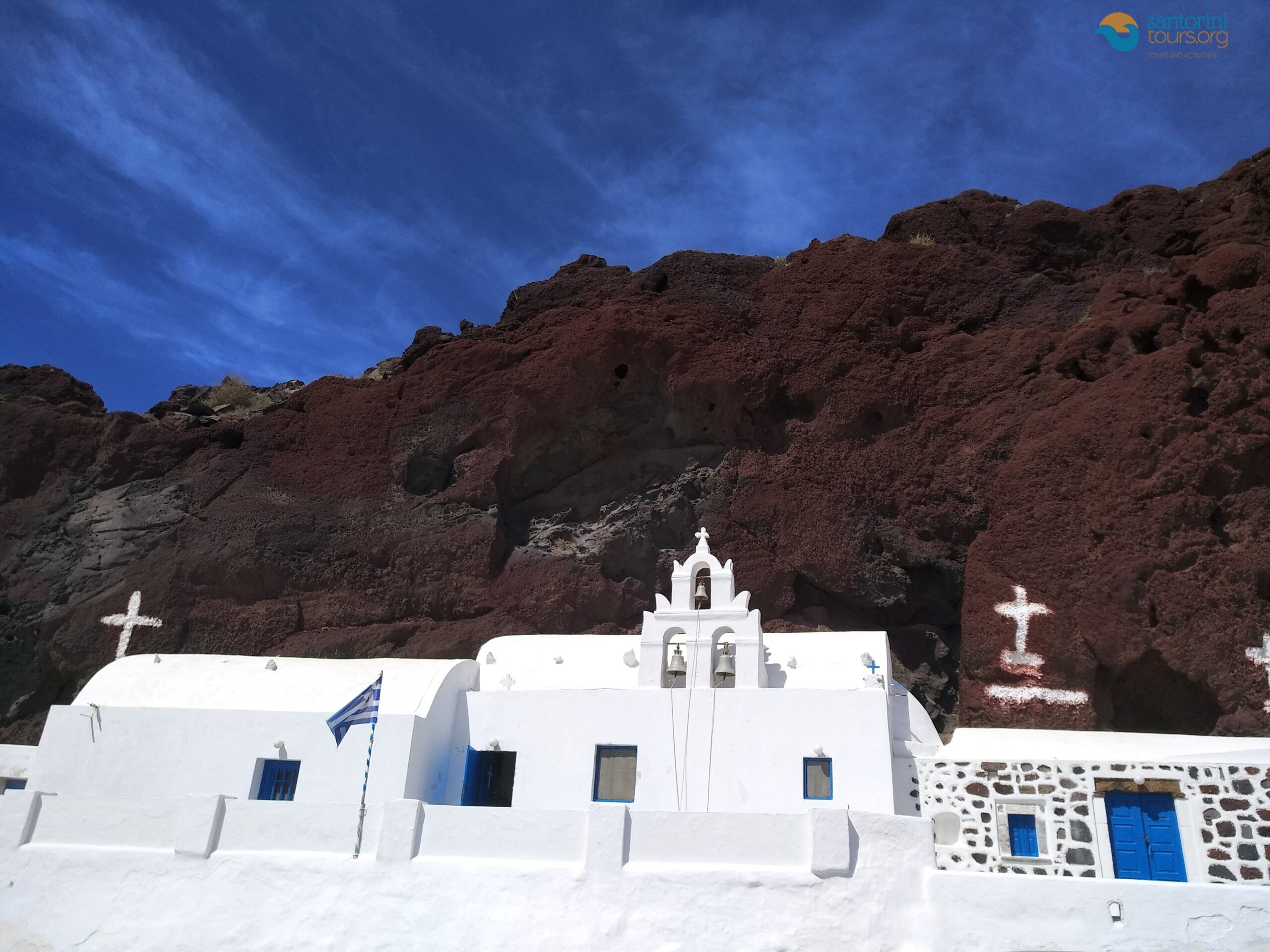
| Red Beach | 1 to 2 hours | Red scoria cliffs above a small bay | Extraordinary to look at | Rockfall closures; check the current access |
| White Beach | 1 hour | Pumice cliffs, reached by boat | Quiet and strange | Boat only, from Akrotiri harbour |
| Caldera Beach and the harbour | 1 hour | Small fishing harbour and tavernas | Fresh fish with the caldera in front of you | Not a swimming beach |
| The wineries nearby | 1 to 2 hours | Vines grown in the eruption ash | Assyrtiko where the volcano made it possible | Book tastings in season |
| Faros and the south coast road | Half a day | Villages, cliffs and open sea | The half of the island most visitors miss | Needs a car or a driver |
A half day covers the whole of that list comfortably, which is why Akrotiri Santorini is the natural anchor for a southern itinerary rather than a single stop squeezed between two villages on the rim.
The Akrotiri Santorini Archaeological Site
What survived. Streets, squares, and houses standing two and three storeys high, with staircases, doorways and window frames intact. The ash sealed everything and preserved the shape of the town rather than flattening it.
The scale. Only a fraction has been excavated. What you walk through is a few blocks of what was a substantial port town trading across the Aegean and with Minoan Crete.
Drainage and plumbing. Clay pipes under the streets, drains from upper floors, and evidence of hot and cold water. This is 3,600 years old and it is more sophisticated than a great deal of what came after.
The pithoi. Huge storage jars still standing in the rooms where they were used, some with residues that told excavators what was stored in them.
No bodies. Unlike Pompeii, no human remains have been found, and no jewellery or valuables. The evidence suggests the town was evacuated after earthquakes before the eruption itself.
The roof. A modern bioclimatic structure covers the whole site, so it is shaded and walkable in August, which makes Akrotiri Santorini one of the few comfortable middays on the island.
The walkways. Raised platforms and ramps carry you over and through the streets, with the excavation continuing below and beside you.
Akrotiri Santorini Hours, Tickets and Practicalities
Opening hours change by season. Longer in summer, shorter in winter, and the site has historically closed one day a week. Check the current times on the day you plan to go rather than relying on a guidebook.
Tickets. Modest, and among the best value of anything on the island. A combined ticket covering the site, Ancient Thera and the museums in Fira is usually available and is worth taking if you plan to see more than one.
How long to allow. An hour is enough to walk it. Ninety minutes to two hours if you read the panels or have a guide.
Best time to arrive. Opening time, or after four in the afternoon. Between ten and two the coach groups and the cruise excursions overlap and the walkways move slowly.
Guides. Licensed guides work at the entrance and the difference between reading panels and having the town explained is substantial. If you visit Akrotiri Santorini once, this is the place to pay for the explanation.
Facilities. Toilets and a small shop at the entrance, and shade throughout. Bring water anyway.
Photography. Permitted without flash. The light through the roof is soft and even, which makes it easier than it looks.
Accessibility. Unusually good for a Greek archaeological site. The walkways are level and ramped, and a wheelchair can cover most of the route. Our accessible Santorini guide goes into detail.
Getting to Akrotiri Santorini
By car. Around 25 minutes from Fira, 45 from Oia, 15 from Perissa. There is a proper car park at the site, which is a relief after Fira and Oia.
By bus. A public service runs from Fira to Akrotiri Santorini, less frequently than the beach routes, and everything routes through Fira. It works, but it makes an afternoon into a whole day.
By quad or scooter. The southern roads are quiet and the ride is one of the better ones on the island. Our ATV rental guide covers what that involves.
By tour. The most common way, and the one that solves the parking, the timing and the explanation together. Our south part and Akrotiri tour is built around this corner of the island.
From the cruise port. Roughly 30 minutes from the old port including the cable car, which is why so many shore excursions include it.
From Athinios ferry port. Twelve minutes. If you arrive on the boat from Crete or Athens with a few hours to spare, Akrotiri Santorini is the closest thing worth seeing. Our Crete to Santorini page explains that timing.
The Village of Akrotiri Santorini
A kilometre inland and uphill from the site, and almost entirely ignored.
The Venetian castle. Goulas, the ruined fortress at the top of the village, built in the thirteenth century and still standing in parts. You can walk up into it.
The view. From the castle the whole south of the island lays out beneath you, with the caldera on one side and the open Aegean on the other. It is one of the best free viewpoints on Santorini and there is rarely anyone there.
The churches. Several, including a Byzantine one below the village, and the usual blue domes without the crowd photographing them.
The tavernas. Two or three, cooking for people who live here, at prices that bear no relation to the caldera rim.
Sunset. Akrotiri village is one of the free alternatives to the Oia crush, and the light across the water from here is arguably better. Our guide to where to watch the sunset compares them all.
Why bother. Because Akrotiri Santorini as a village is what the island looked like before, and half an hour there changes how the rest of the trip reads.
The History of Akrotiri Santorini, Briefly
A Bronze Age port. By 2000 BC there was a substantial settlement here, trading with Crete, the Cyclades, Egypt and the Levant. The town was wealthy, literate in some form, and closely tied to Minoan civilisation.
The warnings came first. Earthquakes damaged the town before the eruption, and there is evidence of repairs underway and of the population leaving. That is why no bodies and no valuables have been found.
The eruption. Around 1600 BC, one of the largest in human history. Ash and pumice buried the town under metres of material and the volcano’s centre collapsed into the sea, creating the caldera.
The consequences. The tsunami and the ash fall are widely argued to have contributed to the decline of Minoan Crete, and the whole event sits behind more than one legend, Atlantis among them.
Rediscovery. Systematic excavation began in the 1960s under Spyridon Marinatos, and it continues today. Much of the town is still underground.
Why it matters. Akrotiri Santorini is the best preserved Bronze Age settlement in the Aegean, and the reason the island appears in every account of Mediterranean prehistory.
The connection to the caldera. The eruption that buried this town is the same eruption that made the view from Oia. Seeing both in one trip is what makes the island coherent, and our volcano tour guide covers the other half.
The Frescoes and Where to See Them
This trips people up constantly, so it is worth being direct.
The famous wall paintings are not at the site. The Boxing Boys, the Fisherman, the Spring fresco with the swallows and the extraordinary Ship Procession were lifted from Akrotiri Santorini and conserved elsewhere.
The Museum of Prehistoric Thera in Fira holds most of what remains on the island, including frescoes, pottery, tools and the gold ibex figurine. It is small, air conditioned, inexpensive and half empty.
The National Archaeological Museum in Athens holds the largest and best known of the wall paintings.
Do both if you can. The site gives you the shape of the town; the museum gives you what was inside it. Seeing only one leaves the story half told.
The museum takes an hour and sits in the middle of Fira, so it fits either side of anything else you are doing there.
Order matters slightly. Site first, museum afterwards, is the more satisfying sequence.
The Beaches Below Akrotiri Santorini
Red Beach. The best known beach in the south, under cliffs of red volcanic scoria that look like nothing else in Greece. Access has been affected by rockfall and has been restricted at times, so check the current situation before walking down; it can also be viewed safely from the path above and reached by boat.
White Beach. Reached by small boat from Akrotiri harbour, below pale pumice cliffs, and much quieter.
Black Beach and Caldera Beach. Small dark shingle bays near the harbour, with tavernas and no crowds.
Vlychada. A few minutes east, beneath extraordinary wind-carved cliffs that look like a lunar landscape, with a marina and good fish tavernas.
What to expect. These are volcanic beaches: dark sand or shingle that gets very hot, deep water close in, and little natural shade.
Best combined with the site in a single southern day. Our page on the best beaches on Santorini covers the rest of the coast.
A Day Around Akrotiri Santorini That Works
09:00. Arrive at the archaeological site as it opens, ahead of the coaches. Ninety minutes inside, shaded and quiet.
10:45. Up to the village. The castle, the view, and ten minutes in a square where nothing is for sale.
11:30. Down to the harbour or across to the Red Beach viewpoint.
12:30. Lunch at a fish taverna by the water, or inland in Megalochori.
14:00. A winery. The vines here grow directly in the ash the eruption laid down, which is the most direct connection between the two halves of the day.
15:30. The lighthouse road to the southwestern tip, which is the best stretch of tarmac on the island and almost always empty.
17:00. Vlychada and the wind-carved cliffs, or back for a swim.
That sequence gives Akrotiri Santorini the day it deserves rather than the forty minutes most itineraries allow, and it covers the half of the island the caldera crowd never sees.
Akrotiri Santorini Mistakes People Make
Confusing the site with the village. They are a kilometre apart and a taxi driver told to go to Akrotiri may deliver you to either.
Arriving at midday in August. The site is shaded, but the walkways are single file and the groups overlap.
Not checking the closing day. A wasted drive to the far end of the island is a bad afternoon.
Expecting the frescoes. They are in Fira and Athens, not at Akrotiri Santorini itself.
Allowing thirty minutes. It is a town, not a monument. An hour is the minimum.
Skipping the guide. Without one the site is a beautiful set of walls. With one it is a functioning Bronze Age town.
Assuming the Red Beach is open. Access has been restricted by rockfall more than once; check before making it the plan.
Doing it as a rushed cruise stop. Four hours ashore, the cable car twice and the drive south leaves very little in the middle.
Missing the museum. The Museum of Prehistoric Thera completes the story and takes an hour.
Who Gets the Most Out of It
Anyone with an interest in history. Obvious, and worth saying: this is one of the two or three most significant Bronze Age sites in Europe.
Families. Children respond to Akrotiri Santorini far better than to most ruins, because the houses still look like houses. The roof and the level walkways help.
Visitors in July and August. A shaded, cool site in the middle of a very hot island is worth something in itself.
Older travellers. The flattest and most manageable major sight on Santorini, with none of the steps that make the caldera villages hard work. See our seniors guide.
Wheelchair users. The most accessible archaeological site on the island by a distance.
Anyone who has been to Knossos. The two sites belong to the same world and each makes more sense after the other.
Cruise passengers with a full day. Yes, with a driver. Our shore excursion is built around the timings.
Anyone tired of the crowds. The village, the castle and the southern roads are the quietest part of Santorini in high season.
Staying in the South
Most visitors sleep on the caldera rim, and the south is a genuine alternative worth knowing about.
What it is like. Quiet, low rise, agricultural, with the sea on two sides and none of the coach traffic.
What you give up. The caldera view from your balcony, and the walk to a rim restaurant.
What you gain. Space, parking, prices that are not set by the view, and Akrotiri Santorini on your doorstep.
Who it suits. Repeat visitors, families, anyone with a car, and anyone who found Oia overwhelming on a previous trip.
Nearby villages. Megalochori and Emporio are both a short drive inland and both are lovely places to be based.
The catch. You need transport. The bus service south is thinner than the beach routes and it will shape your evenings. Our guide to the island’s villages compares the bases properly.
When to Visit Akrotiri Santorini
April and May. Green, mild, and the site almost empty. The best months to see Akrotiri Santorini without a crowd.
June. Warm and busy, but the roofed site is comfortable at any hour.
July and August. The coach groups and cruise excursions overlap between ten and two. Come at opening or after four.
September and October. Excellent. Warm sea, thinning crowds, and full opening hours still in place.
Winter. Shorter hours and far fewer visitors, with the whole southern end of the island to yourself.
The weather rarely stops it. Because the site is roofed, Akrotiri Santorini is the obvious plan on the one wet or windy day of a trip when the boats are cancelled and the rim is unpleasant.
Akrotiri Santorini: Common Questions
What is Akrotiri in Santorini?
A Bronze Age town buried by the eruption around 1600 BC and now excavated under a modern roof, on the south coast of the island. There is also a modern village of the same name a kilometre away.
Is Akrotiri worth visiting?
Yes. It is the most remarkable thing on Santorini, it is shaded and comfortable in summer, and it costs very little.
How long do you need at Akrotiri?
An hour to walk it, ninety minutes to two hours with a guide or if you read the panels.
How do you get to Akrotiri from Fira?
About 25 minutes by car, longer by public bus, and there is a proper car park at the site.
Where are the Akrotiri frescoes?
At the Museum of Prehistoric Thera in Fira and at the National Archaeological Museum in Athens, not at the site itself.
Is Akrotiri the same as Pompeii?
Similar in being buried by an eruption, different in that no bodies or valuables were found. The town appears to have been evacuated after earthquake warnings.
Is Akrotiri wheelchair accessible?
Largely yes. The raised walkways are level and ramped, which makes it the most accessible major site on the island.
What else is there to see nearby?
The village and its Venetian castle, the Red and White beaches, Vlychada, the lighthouse road and several wineries.
Is the Red Beach open?
Access has been restricted at times because of rockfall. Check the current situation, and note that it can be viewed from the path or reached by boat.
When is the best time to visit Akrotiri?
At opening time or after four in the afternoon, and in May, June, September or October if you can choose the month.
Is there a bus to Akrotiri?
Yes, from Fira, though less frequent than the beach routes and routed through Fira like everything else.
Can you see Akrotiri and the volcano in one day?
Yes, and it is the best day on the island, though it is a long one. The site tells you what the eruption destroyed and the boat shows you what it left.
Akrotiri Santorini: Key Points
- Akrotiri Santorini is both an archaeological site and a modern village a kilometre apart.
- The town was buried by the eruption of around 1600 BC and preserved by the ash.
- Houses stand two and three storeys high with streets, drains and staircases intact.
- No bodies or valuables have been found; the town appears to have been evacuated.
- The whole site is roofed, so it is shaded and comfortable in August.
- An hour to walk it, ninety minutes with a guide.
- The famous frescoes are in Fira and Athens, not at the site.
- Opening hours change by season and it has closed one day a week.
- It is the most wheelchair accessible major sight on Santorini.
- The village above has a Venetian castle and one of the island’s best free views.
- Akrotiri Santorini is 25 minutes from Fira and 12 from Athinios port.
- Red Beach access has been restricted by rockfall at times.
- The wineries nearby grow their vines in the ash from the same eruption.
- Combining the site with a volcano boat is the best single day on the island.
- It is the right plan for the one windy day when the boats are cancelled.
Walking Through Akrotiri Santorini
A short orientation, because Akrotiri Santorini rewards knowing what you are looking at.
Telchines Road. The main street, running through the excavated area with houses on both sides. Standing in it is the moment the place stops being ruins and becomes a town.
The West House. One of the best preserved buildings, where the Fisherman and the Ship Procession frescoes were found. The rooms upstairs had windows and painted walls.
Xeste 3. A large public or ceremonial building over three floors, with a lustral basin and some of the most important paintings from the site.
The Mill House Square. Where the storage jars and grinding equipment were found in place.
The drainage system. Look down at the street level and the clay pipes are still visible under the paving.
The plaster casts. Furniture that rotted away left voids in the ash, and pouring plaster into them recovered the shapes of wooden beds and tables.
The unexcavated edge. The site simply stops where the digging has reached. Most of Akrotiri Santorini is still under the hill you are standing beside.
Combining It With the Rest of the Island
With a winery. Ten minutes inland, and the connection between the ash and the wine is the best single explanation of what the eruption left behind. Our wine tour covers the estates.
With the Museum of Prehistoric Thera. The other half of the story, in Fira, and an hour well spent.
With Ancient Thera. The later Greek and Roman city on the ridge above Kamari, which shows what came after. A combined ticket usually covers both.
With the volcano boat. The eruption that buried Akrotiri Santorini and the crater it left, in one day.
With the beaches. Red, White and Vlychada are all within a few minutes.
With the villages. Megalochori, Emporio and Pyrgos are on the way back towards Fira and none of them takes long.
With the sunset. The lighthouse and the village castle are both far quieter than Oia and both are free. Our full day tour ends this way when the timing works.
One Last Note
Akrotiri Santorini is open on days when the boats are not, shaded on days when the rim is unbearable, and quiet at hours when Oia is not. Whatever else the week does, there is almost always an hour that suits it.
If It Is Your First Visit
You are walking through a town, not past a monument. That is what makes Akrotiri Santorini different from most ruins, and it takes a few minutes to register.
Look up as well as down. The second and third storeys are what survived here and what did not survive anywhere else.
The panels are decent but a guide is better, and Akrotiri Santorini is the one place on the island where we would always say so.
Go quietly. It is roofed and enclosed, and the acoustics carry.
Leave time for the museum. Half of Akrotiri Santorini is in Fira, in glass cases, and the two halves need each other.
Akrotiri Santorini in One Paragraph
Akrotiri Santorini is a Bronze Age port town on the island’s south coast, buried by the eruption of around 1600 BC and now excavated under a roof, with streets, staircases and two and three storey houses still standing. It opens most days, costs very little, takes about ninety minutes, and sits 25 minutes from Fira and twelve from the ferry port. A kilometre uphill, the modern village of Akrotiri Santorini has a ruined Venetian castle, a wide free view and tavernas at local prices.
Why Akrotiri Santorini Matters
It predates classical Greece by a thousand years. What you walk through was already old when the Parthenon was built.
It changed how the Bronze Age Aegean is understood. The scale of the trade, the plumbing and the art at Akrotiri Santorini forced a rethink of what island societies of that period were capable of.
It is the origin of the view. The eruption that sealed this town is the one that made the caldera, so the island’s most photographed landscape and its most important ruin are the same event.
It is still being excavated. Most of Akrotiri Santorini remains buried, and what is on display is a fraction of what is there.
It is under-visited relative to its importance. More people photograph the blue domes in a morning than walk through Akrotiri Santorini in a week.
The Short Version
Go at opening time, allow ninety minutes, take a guide if you take one anywhere, and walk up to the village afterwards for the castle and the view. See the Museum of Prehistoric Thera in Fira the same trip.
Akrotiri Santorini is the one thing here that would still be worth the journey if the caldera did not exist, and it is the cheapest ticket on the island.
Booking With Us
Our south part tour is built around this corner of the island: the site, the village, the beaches, a winery and the lighthouse road. Per vehicle rather than per person, no deposit, free cancellation.
Tours
- full day tour
- half day tour
- north part and Oia tour
- south part and Akrotiri tour
- sightseeing tour
- historical tour
- wine tour
- food experience
- sunset tour
- shore excursion
- small group tour
- black sand beach tour
- horse riding tour
- custom tour
- coach tours
Transfers
- island transfers
- VIP chauffeur service
- transfer to Oia and Finikia
- transfer to Fira and the villages
- choosing a private transfer
Book directly
- Full Day Tour
- Half Day Tour
- North Part and Oia Tour
- South Part and Akrotiri Tour
- Sightseeing Tour
- Small Group Tour
- Wine Tour
- Food Experience
- Historical Tour
- Sunset Tour
- Shore Excursion
- Black Sand Beach Tour
- Horse Riding Tour
- Personalised Tour
Further reading
- The complete Santorini travel guide
- Santorini volcano tour
- The best time to visit, month by month
- How many days you need
- Cultural experiences
- Santorini hiking
- Santorini shopping
- Santorini nightlife
- Santorini on a budget
- Athens to Santorini
- Day trips from Santorini
- Should you hire a car?
- Santorini for large families
- Santorini solo travel
More from this site
- All tours and prices
- About Santorini Impressive Tours
- Photo gallery
- Pictures from our private tours
- Useful links for travellers
- Full site map
- All our Santorini articles
- Terms of use
- Privacy policy
Tell us your dates and we will time the visit for the hour the coaches are not there.
