
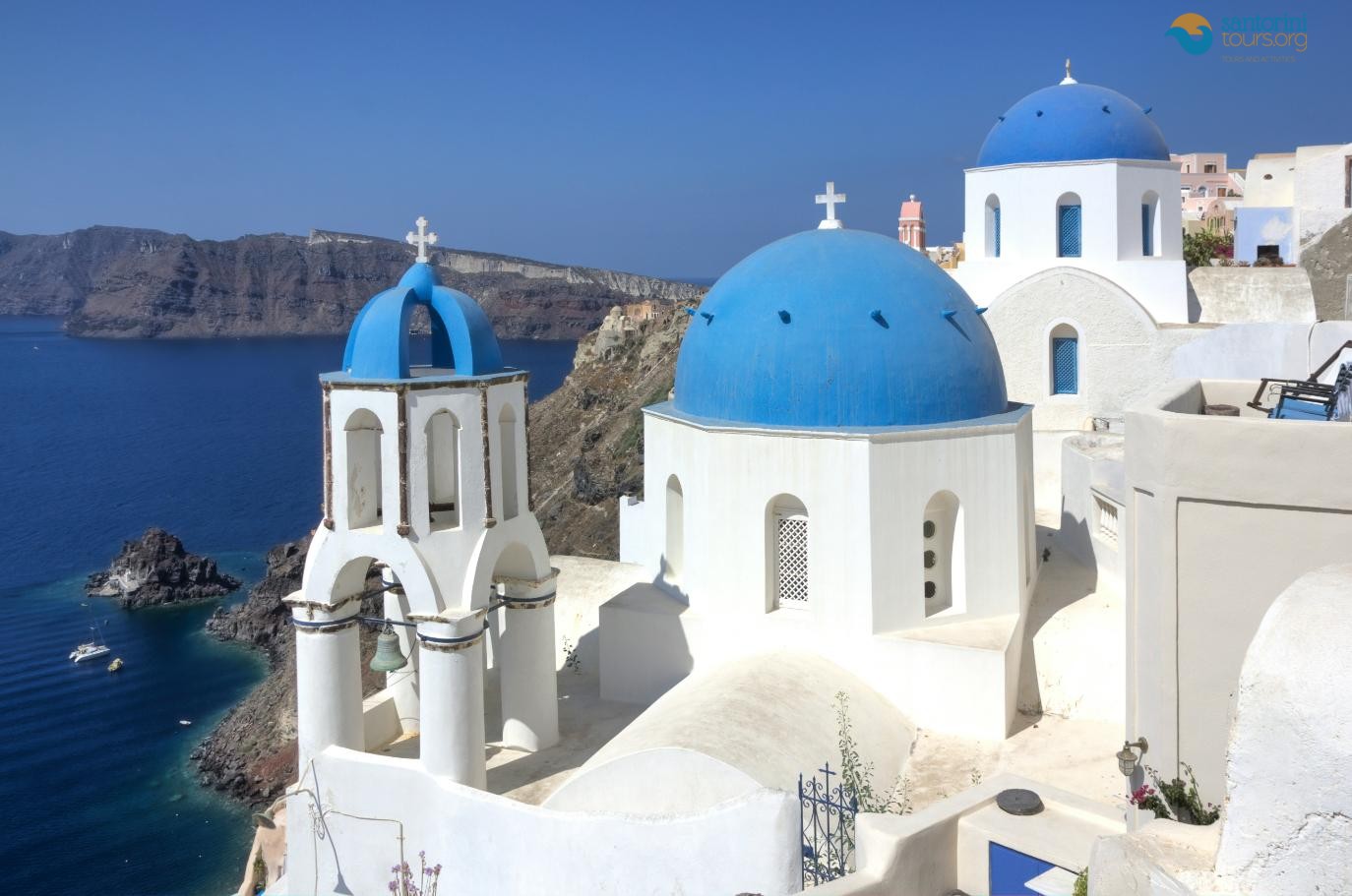
The Santorini cruise port is unlike any other in the Mediterranean, and almost everything that goes wrong on a call here traces back to one fact: there is no dock. The caldera is a flooded volcanic crater with water three hundred metres deep a few metres from the cliff, so ships anchor and send passengers ashore by tender to a small quay at the bottom of a five hundred foot wall of rock. Getting up that wall is the whole logistical problem of the day. We meet those tenders every morning of the season, and our Santorini Tours are built around the timings below.
This page explains how the Santorini cruise port actually works, hour by hour: where the tenders land, how to get to the top, how long each option really takes when four ships are in, what fits into six or eight hours ashore, and how to be back at the quay without a panic. It is written from the quayside rather than from a brochure.
The Short Answer
Ships anchor; they do not dock. You come ashore by tender at the old port of Fira, at the foot of the cliff.
Three ways up: cable car, 588 steps, or donkey. We recommend the cable car up and the steps down, and we ask you not to use the donkeys.
The queue is the risk. On a four-ship day the cable car queue can exceed an hour in each direction, and it is worse going down in the afternoon than coming up in the morning.
Book something that meets you at the tender. The single most useful decision at the Santorini cruise port, because it removes the queue from the start of your day and guarantees the finish of it.
Leave a real margin for the return. Two hours before all-aboard is not excessive on a busy afternoon.
The Island Above the Port
Getting Off the Quay: Every Option
| Option | Time | Why choose it | Catch | Best for |
|---|---|---|---|---|
| Cable car | 3 minutes | Fastest when the queue is short | Queues of 45 to 90 minutes when several ships tender together | Going up, if you arrive early |
| Walk the steps | 20 to 35 minutes | Free, and the view is superb | 588 steps, full sun, and donkey traffic | Coming down, and only coming down |
| Donkey | 20 minutes | None that we would offer | Animal welfare, and the ride is unpleasant | Nobody, in our view |
| Ship excursion | All day | Booked, guaranteed, ship waits for it | Large coaches, fixed pace, the busiest hours | Nervous first-timers |
| Private tour from the old port | 4 to 8 hours | Meets you at the tender, no queue at either end | Costs more than the bus | Anyone with limited hours |
| Public bus from Fira | Frequent | Very cheap | You must first get up the cliff, which is the hard part | Independent travellers with time |
| Taxi from Fira | On demand | No planning needed | Very few taxis on the island | Short hops only |
| Athinios port | N/A | Where ferries dock, not cruise ships | Some smaller ships berth here instead | Check your ticket carefully |
Everything else on this page follows from that table. The Santorini cruise port is not a place you pass through; it is a bottleneck you plan around, and the visitors who enjoy their day here are the ones who decided in advance how they were getting up and down.
Where the Santorini Cruise Port Actually Is
The anchorage. Ships lie at anchor in the caldera basin, off Fira, in water far too deep for conventional mooring. The view from the deck as you come in is one of the great arrivals in cruising, and it is worth being up early for.
The old port, Skala. A narrow concrete quay at the foot of the cliff directly below Fira, with a handful of shops and cafes and no road connection to the rest of the island worth the name.
The cliff. Roughly 260 metres from the water to the town, near vertical, crossed by a zig-zag mule path and a cable car.
Athinios, the new port. Six kilometres south, where the ferries dock. It has a road, no cable car, and no town. Some smaller expedition ships berth here instead, and the day looks completely different if yours does, so check your ticket.
Ammoudi, below Oia. A third harbour at the north end, used by small boats and a few excursions. Occasionally a tender port for very small vessels.
Why it matters. Nearly every guide to the Santorini cruise port describes the Fira arrangement, and a minority of passengers arrive somewhere else entirely.
The Tender Process, Step by Step
Understanding the tender sequence is the difference between being ashore at eight and ashore at eleven, and at the Santorini cruise port those three hours are most of your day.
Arrival and anchoring. Most ships drop anchor between six and eight in the morning. The caldera approach at that hour is spectacular and worth setting an alarm for even before you think about the day ashore.
Tender tickets. On busy days ships issue numbered tickets and call groups in order. Passengers on ship-organised excursions are called first, always. This is the mechanism that makes ship tours attractive to nervous travellers and slow for everyone else.
Priority tiers. Suite guests and high-tier loyalty members usually board tenders ahead of general queues. Independent travellers on a large ship are frequently the last group called.
The crossing. Ten to fifteen minutes from anchorage to the old port, in a lifeboat-tender or a hired local launch, depending on the line.
Landing. You step onto a narrow quay, often into a crowd from two or three other ships doing the same thing. The Santorini cruise port has no terminal building, no seating area and very limited shade.
The last tender. Published in the daily programme and taken seriously. Ships have left passengers here; this is not a port where a taxi to the next stop is an option.
In rough weather. Tendering can be curtailed or cancelled altogether, and calls at the Santorini cruise port are dropped more often than at most Mediterranean ports for exactly this reason. It is nobody’s fault and there is no appeal.
The Cable Car in Detail
What it is. Six cabins carrying six people each, running continuously between the old port and the top of the cliff at Fira. The ride itself takes about three minutes and the view is superb.
Capacity is the problem. The system moves a few hundred people an hour. A single large ship can put three thousand ashore. The arithmetic explains every queue photograph you have ever seen of the Santorini cruise port.
Morning queues are usually manageable for the first hour after tendering starts, then build sharply.
Afternoon queues are worse, because everybody wants to descend in the last two hours before all-aboard. Ninety minutes is not unusual on a four-ship day.
Tickets. Bought at the booth at either end, cash and card, per journey rather than return.
Operating hours extend through the cruise day in season, but the service pauses occasionally for maintenance or high wind.
Our advice. Cable car up in the morning, steps down in the afternoon, or a private transfer that removes the question entirely.
The 588 Steps
The path zig-zags up the cliff face between the old port and Fira, paved in worn stone, with low walls and superb views.
Going down takes twenty to thirty-five minutes at a comfortable pace and is genuinely enjoyable in the late afternoon when the sun is off the face.
Going up is a serious climb in full sun, and we do not recommend it for anyone arriving at the Santorini cruise port in July or August.
The surface is polished by two centuries of use and by the donkeys, which means it is slippery and, in places, unpleasant underfoot.
Shoes matter. Grip is not optional on this path.
Donkey traffic. The animals have right of way in practice. Stand on the inside wall as they pass.
Water and a hat. There is no shade for the entire ascent.
About the Donkeys
We are asked constantly, so we will answer plainly rather than diplomatically.
We ask guests not to ride them. The animals work in extreme heat on a steep stone path, often with inadequate rest, water or shade, and often carrying weights beyond what is reasonable.
Greek law sets weight limits, and enforcement has improved, but conditions at the Santorini cruise port remain difficult for the animals during peak calls.
The ride is not pleasant either. It is jolting, it smells, and it is slower than the cable car.
Our pages on this. See why we ask you to reconsider and the current weight limit rules.
What to do instead. Cable car up, walk down, or arrange a vehicle that meets your tender.
What Fits Into Your Hours From the Santorini Cruise Port
Most calls give six to nine hours from first tender to last. Subtract the tender queues at both ends and the realistic figure is often five to seven. Here is what each budget buys at the Santorini cruise port.
Four hours or less. Fira only. The cable car up, the caldera walkway north towards Firostefani, the Museum of Prehistoric Thera, lunch, and back down. It sounds thin and it is a genuinely good half day.
Five to six hours. Oia and Fira, with transport arranged. Twenty-five minutes each way to Oia, ninety minutes in the village, and the remainder on the rim at Fira.
Six to seven hours. Oia, a winery, and Fira. This is the sweet spot, and the shape most of our shore excursions take.
Seven to nine hours. Add Akrotiri or a beach. With eight hours and a private vehicle you can see the caldera villages, the Bronze Age site and the wine country in one day, which is more of the island than many three-day visitors manage.
What never fits. The volcano boat as a separate excursion, Ancient Thira, and any serious beach time alongside Oia. Attempting them from the Santorini cruise port is how people miss tenders.
Getting to Oia and Back
Oia is what most passengers want, and it is the part of the day that most often goes wrong.
Distance. Roughly eleven kilometres from Fira, twenty-five minutes by road in normal traffic, longer at midday in August.
By bus. Frequent from Fira’s central station, very cheap, and standing room only during cruise hours. You must first get up the cliff, which is the real cost.
By taxi. Possible, if you find one. The island’s fleet is small enough that this is not a plan.
By private vehicle. Straightforward, and the only version that guarantees you are back at the Santorini cruise port with time in hand.
What to see in ninety minutes. The main street from the bus stop to the castle at the western tip, the blue domes on the north side, the view down over Ammoudi.
What not to do. The three hundred steps down to Ammoudi. They are lovely and they will eat an hour and a half, and the climb back is brutal.
Crowding. Between eleven and four in season Oia is extremely busy, largely with cruise passengers doing exactly what you are doing.
Fira: The Village Above the Santorini Cruise Port
Fira sits directly above the Santorini cruise port and is therefore the default destination, which does not make it the wrong one.
The caldera walkway. Paved, level in stretches, and running north from the cable car station past hotels and chapels towards Firostefani. Fifteen minutes gets you clear of the densest crowds.
The Museum of Prehistoric Thera. Air conditioned, compact, and holding the frescoes and finds from Akrotiri. The best hour in Fira if the sun is fierce.
The Archaeological Museum. Smaller, covering the classical period.
The Catholic quarter. The northern lanes above the main square, quieter than the shopping streets and architecturally the most interesting corner of the town.
Shopping. Jewellery, leather, wine and ceramics, with the usual gap between the tourist lanes and the honest shops. Our shopping guide covers what is worth buying.
Lunch. One street back from the rim, always. The price difference is roughly a third for the same food.
Where to sit with a view. Anywhere along the walkway north. The further you walk, the cheaper the coffee and the better the outlook.
Beyond Fira and Oia
Passengers with a full day and their own transport can reach the half of the island that no cruise coach visits.
Akrotiri. Twenty minutes from Fira. A Bronze Age town under a roof, streets and three-storey buildings preserved under volcanic ash. The most remarkable thing on Santorini and shaded throughout, which matters in August. See our full Akrotiri guide.
A winery. Vines grown in low baskets on ash, and a wine unlike anything else in Greece. Forty-five minutes including a tasting. Our wine tour covers the estates.
Pyrgos. A hill village under a Venetian castle with the best all-round view on the island.
Profitis Ilias. The summit monastery, and the one viewpoint that makes the island’s geography make sense.
Megalochori and Emporio. Village squares and a medieval fortified quarter almost no cruise passenger ever sees.
The beaches. Perissa and Perivolos on black sand, Red Beach near Akrotiri, Vlychada under white cliffs. Reachable, but they compete directly with the villages for your hours.
Our honest recommendation for a long call at the Santorini cruise port: Oia early, Akrotiri or a winery in the middle, Fira at the end. It uses the crowd pattern rather than fighting it.
Ship Excursion or Independent?
The honest comparison, from an operator who obviously has an interest, stated openly.
What the ship’s excursion gives you. Priority on the tender, a guaranteed return, and the ship’s obligation to wait if the coach is late. For anxious travellers that is worth real money.
What it costs you. Group size, a fixed pace, coach parking constraints, and arrival at Oia during the busiest hours because every ship schedules the same way.
What independent travel gives you. Freedom, better hours, and a much lower price by bus.
What it costs you. The tender queue, the cable car queue, and full responsibility for being back on time.
The middle option. A private tour that meets your tender at the Santorini cruise port quay, sets its own hours, and returns you with a margin. It removes both queues and keeps the flexibility.
Our own promise on this. We track the ships in the caldera, we know when the last tender is, and we build the day backwards from it. See our shore excursion.
The risk everyone worries about. Independent passengers are responsible for reaching the ship. In practice the problem is almost never the tour; it is the afternoon cable car queue, which is precisely what a private vehicle and the steps solve.
Timing a Santorini Cruise Port Day Backwards
Every good plan at the Santorini cruise port is built from the last tender backwards, not from the first one forwards.
All-aboard time. Usually thirty minutes before sailing, published in the daily programme.
Last tender. Typically thirty to sixty minutes before all-aboard, and the queue for it starts long before that.
Cable car descent. Allow up to ninety minutes on a busy afternoon. This is the number people underestimate.
Walking down. Twenty to thirty-five minutes, and no queue at all, which is why we recommend it.
Road time back to Fira. Twenty-five minutes from Oia, twenty from Akrotiri, thirty-five from Perissa.
So work it out. If all-aboard is at six, be leaving Oia by half past three. That is not over-cautious at the Santorini cruise port in August; it is the standard margin.
The one exception. If you are on a private tour that returns you to the quay directly, you can cut that margin substantially, because the cable car is out of the equation entirely.
When Four Ships Are In
The island receives multiple calls on many summer days, and the difference between a one-ship day and a four-ship day at the Santorini cruise port is dramatic.
What changes. Tender queues lengthen at both ends, the cable car becomes the day’s main constraint, Oia’s main street becomes single file, and every restaurant on the rim fills at once.
How to check. Port schedules are published in advance and most cruise forums track them. It is worth looking a week before.
What to do on a busy day. Go early, go north, and eat late. Oia at nine is manageable; Oia at one is not.
Consider the interior instead. Akrotiri, the wineries and the inland villages absorb crowds far better than the caldera rim does, and on a four-ship day they are a much better use of your hours.
Descend early or walk. The afternoon cable car queue on a four-ship day is the single most common reason passengers feel they wasted their call here.
Accessibility at the Santorini Cruise Port
The Santorini cruise port is one of the more difficult ports in the Mediterranean for anyone with limited mobility, and it is better to know that in advance.
The tender itself involves stepping between two moving vessels, sometimes with a swell. Ships assess this individually and may decline to land passengers who cannot manage it unaided.
The quay is uneven, crowded and without seating.
The cable car has steps at both stations and cabins that are not wheelchair accessible in any practical sense.
The steps are out of the question for most.
What does work. Fira’s caldera walkway is level for long stretches, Akrotiri is largely flat with ramps and a roof, and the wineries and villages are manageable by vehicle.
Our accessible options. See our accessibility guide and our guide for older travellers, both written with this port in mind.
Four Worked Plans for a Day Ashore
Each of these assumes tendering starts around eight and all-aboard is at six, the most common shape of a call at the Santorini cruise port.
Plan A: the classic, with a vehicle
08:15 Ashore, met at the quay, straight up by road.
09:00 Oia, before the coaches. Main street, castle, blue domes.
10:45 A winery in the interior, tasting and vineyard.
12:15 Lunch in Megalochori or Pyrgos, inland prices.
14:00 Akrotiri archaeological site, shaded and quiet by then.
15:45 Fira, caldera walkway, coffee on the rim.
16:45 Down to the quay with a margin.
Plan B: the independent day
08:30 Ashore, cable car up before the queue builds.
09:15 Bus to Oia from Fira’s central station.
10:00 Oia on foot for ninety minutes.
11:45 Bus back to Fira.
12:30 Museum of Prehistoric Thera, then lunch off the rim.
14:30 The caldera walkway north towards Imerovigli.
16:00 Walk down the steps rather than queue for the cable car.
Plan C: the short call
Five hours or less at the Santorini cruise port. Forget Oia.
Cable car up, walkway north, museum, lunch, steps down. Unhurried, cheap, and you will have seen the caldera properly rather than a coach park.
Plan D: the second visit
Skip Fira and Oia entirely. Akrotiri, two wineries, Emporio’s medieval quarter and a black sand beach.
Why. Returning passengers consistently tell us this is the better day, and almost nobody at the Santorini cruise port does it.
Money, Food and Practicalities
Currency. Euro. Cards are accepted almost everywhere, though small village tavernas may prefer cash.
ATMs are in Fira and Oia, not at the old port.
Water. Tap water is not for drinking. Buy large bottles at a supermarket rather than singles at a kiosk.
Toilets. Limited at the quay, better in Fira. Cafes expect a purchase.
Wi-fi and phone. Coverage is good across the island; most cafes offer wi-fi.
Sun. There is almost no shade at the Santorini cruise port, on the steps, or in Oia’s main street. Hat, water, sunscreen.
Shoes. Repeated deliberately: polished marble lanes, volcanic gravel and stone steps.
Luggage and shopping. Anything you buy has to come down the cliff with you. Wine is heavy.
Tipping. Modest and appreciated; rounding up is normal.
Opening hours. Shops in Fira open early on cruise days and stay open late.
The Port Through the Season
April and May. Calls begin, ships are fewer, queues are short. One of the best times to be a cruise passenger here.
June. Busy but manageable, long daylight, everything open.
July and August. Peak. Multiple ships most days, cable car queues at their worst, Oia crowded from mid-morning, and the heat a genuine factor on the steps.
September. Still busy, slightly cooler, and the sea at its warmest.
October. Calls thin out and the island relaxes. Excellent conditions for walking the rim.
November to March. Very few calls. Those that come find a quiet, windy island with the cable car running and most of the rim restaurants shut.
Wind, all year. The meltemi in high summer and winter northerlies both interfere with tendering. Cancelled calls at the Santorini cruise port are a normal part of Aegean cruising.
Mistakes People Make at the Santorini Cruise Port
Underestimating the afternoon cable car queue. The defining error. It is the reason most passengers who miss things miss them.
Walking up the steps in August. A 260 metre climb in full sun on polished stone.
Assuming there is a dock. There is not, and the tender process changes every timing on your day.
Booking nothing and hoping for a taxi. The island’s taxi fleet is small enough to count.
Going to Oia at midday. The busiest place in the Cyclades at the busiest hour, largely with other cruise passengers.
Attempting the volcano boat. It needs four to five hours of its own and does not fit a call.
Ignoring the ship count. A four-ship day at the Santorini cruise port needs a different plan from a one-ship day.
Buying wine early. You carry it all day and down a cliff.
Descending at the same moment as everyone else. Leave the rim thirty minutes earlier than feels necessary.
Riding the donkeys. On welfare grounds, and because it is slower and less pleasant than the alternatives.
Wearing new sandals. The stone here is polished and slippery.
Treating the last tender as a suggestion. Ships do sail without passengers, and from an island this is expensive to fix.
First Call Here? Read This Part Twice
If this is your first time at the Santorini cruise port, four facts explain nearly everything you will encounter.
One. The ship anchors, so everything begins with a tender and a queue.
Two. The town is directly above you and there is no road from the quay, only the cable car, the steps and the donkeys.
Three. The cable car cannot move a shipload of people quickly, so timing matters more than distance.
Four. Everything worth seeing is within thirty minutes of Fira by road, so the island is not the constraint. The cliff is.
Passengers who internalise those four points enjoy the Santorini cruise port. Passengers who expect a normal Mediterranean port with a gangway and a taxi rank do not.
If Your Ship Uses Athinios
Smaller vessels and some expedition ships berth alongside at Athinios rather than tendering to Fira, and the day is entirely different.
You walk off onto a quay, which is far easier than tendering.
There is no town, no cable car and no steps. There is a road, a car park and some ticket offices.
Fira is twenty to thirty minutes away up a single switchback road, and Oia around forty-five.
Buses meet the ferries but not reliably the ships, so arranged transport matters more here than at the Fira anchorage.
The advantage. No queue at either end, and you can be at Akrotiri in twelve minutes, which makes Athinios arguably the better arrival if you plan for it.
The disadvantage. No stroll ashore. Without transport you are stuck at a concrete quay.
Our Crete to Santorini page describes the same port from the ferry passenger’s side.
Is the Call Worth It?
Occasionally people ask whether Santorini is overrated as a cruise stop, and it is a fair question given the queues.
The arrival alone justifies it. Sailing into a flooded volcanic caldera with villages balanced on the rim is one of the great sights in cruising, and you get it whether or not you go ashore.
The island rewards a plan. Passengers who arrange transport and go early consistently rate this among their best calls.
The island punishes improvisation. Passengers who tender late, queue twice and reach Oia at one o’clock frequently rate it among their worst.
The difference is entirely logistical, which is unusual, and it is why we have written this page about the mechanics of the Santorini cruise port rather than about the scenery.
Which Plan Suits Which Passenger
First-time cruisers. Either a ship excursion or a private tour that meets the tender. The Santorini cruise port is not the place to learn independent shore travel.
Experienced independent travellers. The bus works, the walk down works, and the saving is real. Go early and watch the clock.
Families with young children. A vehicle, and a plan that includes a beach or the flat interior rather than three villages and a queue.
Older passengers. Cable car up, vehicle at the top, no steps at all, and Akrotiri rather than Oia’s lanes if the day is hot.
Passengers with limited mobility. Read the accessibility section above carefully before booking anything at all.
Photographers. Be on deck for the caldera approach at dawn, ashore on the first tender, and in Oia by nine.
Wine drinkers. One estate, unhurried, and buy at the end of the day rather than the start.
Returning visitors. The interior. Nobody at the Santorini cruise port goes there and it is the better half of the island.
Santorini Cruise Port: Common Questions
Do cruise ships dock in Santorini?
No. The caldera is too deep for conventional mooring, so ships anchor and passengers come ashore by tender to the old port below Fira.
How do you get from the Santorini cruise port to Fira?
Cable car, 588 steps, or donkey. The cable car takes three minutes plus the queue, the steps take twenty to thirty-five minutes, and we ask guests not to use the donkeys.
How long is the cable car queue?
Short in the first hour after tendering starts, and frequently forty-five to ninety minutes in the afternoon when several ships are in.
Is it safe to walk up the steps?
Physically yes, but it is a 260 metre climb in full sun on polished, slippery stone shared with donkeys. We recommend walking down rather than up.
Can you get to Oia from the cruise port?
Yes, about twenty-five minutes by road from Fira once you are at the top. Allow ninety minutes in the village and build the return around the cable car queue.
Is a ship excursion better than an independent tour?
The ship guarantees your return and gives you tender priority. A private tour that meets your tender gives you better hours and a smaller group. The bus is cheapest and slowest.
How many hours do you get in Santorini?
Most calls run six to nine hours, of which five to seven are realistically usable once tender and cable car queues are subtracted.
What can you see in one day?
Comfortably: Oia, a winery and Fira. With a full day and transport, add Akrotiri. The volcano boat does not fit.
Are calls at Santorini ever cancelled?
Yes, more often than at most Mediterranean ports, because strong winds make tendering unsafe.
Is there anything to do at the old port itself?
A few shops and cafes, and that is all. There is no beach, no town and very little shade.
What should I bring ashore?
Shoes with grip, a hat, water, sunscreen, and a card plus some cash. Leave heavy purchases for the end of the day.
What happens if I miss the last tender?
You are responsible for reaching the ship at its next port, which from an island is expensive. Treat the published time as absolute.
Does the cable car ever stop running?
Occasionally, for maintenance or high wind. It is one more reason to keep a margin.
Where do the smaller ships dock?
Some berth alongside at Athinios, six kilometres south, which has a road but no cable car, no steps and no town.
Santorini Cruise Port: Key Points
- Ships anchor in the caldera; the Santorini cruise port has no dock for large vessels.
- Tenders land at the old port of Fira, at the foot of a 260 metre cliff.
- The cable car, 588 steps and the donkeys are the only ways up.
- Cable car queues at the Santorini cruise port are worst in the afternoon.
- We recommend the cable car up and the steps down.
- We ask guests not to ride the donkeys on welfare grounds.
- A private tour meeting the tender removes both queues from the day.
- Plan backwards from the last tender, not forwards from the first.
- Allow up to ninety minutes for the afternoon descent on a four-ship day.
- Oia is twenty-five minutes from Fira and best seen before ten in the morning.
- Akrotiri is roofed, flat and twenty minutes away, which suits a hot day.
- The volcano boat does not fit inside a normal call.
- Some smaller ships berth at Athinios instead, where the day works differently.
- Calls at the Santorini cruise port are cancelled by wind more often than at most ports.
- The caldera approach at dawn is worth being on deck for regardless of your plans ashore.
How Different Lines Handle the Santorini Cruise Port
The Santorini cruise port is operated the same way for everyone, but the passenger experience varies with the size of the ship rather than the brand on the funnel.
Very large ships. Three thousand passengers and more. Tendering takes hours, priority tiers matter, and independent travellers are often called late. Going ashore early requires either an excursion booking or an early ticket.
Mid-size ships. The common case. Tendering is brisk, and by mid-morning most people who want to be ashore are ashore.
Small ships and expedition vessels. Sometimes berth alongside at Athinios, occasionally tender to Ammoudi below Oia. Both change the day completely.
Overnight calls. A handful of itineraries stay late or overnight, which is the best possible way to experience this island from a ship: you get the caldera villages in the evening, after the day fleet has sailed.
Late departures. Increasingly common, and worth checking. An all-aboard at eight rather than six transforms what fits at the Santorini cruise port.
What never varies. The cliff, the cable car capacity, and the fact that everybody wants to come down at the same time.
If Your Ship Stays Late at the Santorini Cruise Port
The island changes at six. Day trippers leave, the coaches stop, and the rim villages become genuinely pleasant.
Sunset. Oia is the famous option and it is crowded. Imerovigli and Firostefani have the same view with a fraction of the people, and both are a short drive from Fira.
Dinner. Book the rim in advance or eat inland, where the food is better and cheaper.
The descent after dark. The cable car runs into the evening but confirm the last car; walking down 588 steps in the dark is not advisable.
Our sunset options. The sunset tour and our guide to the viewpoints both avoid the Oia crush.
Nightlife, if you have it. Fira has bars that run late; see our nightlife guide. Most passengers are back aboard long before any of it starts.
Why the Santorini Cruise Port Is Like This
A short digression, because it explains the whole day and it is genuinely interesting.
The island is the rim of a volcano. A catastrophic eruption in the Bronze Age emptied the magma chamber and the centre collapsed into the sea, leaving a ring of cliffs around a flooded basin.
The basin is extremely deep. Several hundred metres in places, which is why ships anchor where the shelf allows rather than tying up alongside.
The old port existed long before tourism. Everything the island imported came up that mule path, which is why the steps are there at all.
The cable car arrived in 1979, donated by a shipowner, and it has been the pinch point of the Santorini cruise port ever since.
The same eruption buried the town at Akrotiri that you can visit twenty minutes away, which is the connection most passengers miss entirely.
The wine, too. Vines grow in woven baskets on volcanic ash, an adaptation to the same geology that makes the harbour impossible.
Understanding that sequence turns a queue at the Santorini cruise port into the most interesting geological site you will visit all cruise.
Compared With Other Aegean Ports
Mykonos. Ships dock at Tourlos, a short shuttle from town. No cliff, no cable car, no tender on most calls. Logistically far easier and a less dramatic arrival.
Rhodes. Alongside, and the old town is at the gate. The easiest major Greek call.
Crete, at Heraklion. Alongside, with Knossos twenty minutes away.
Katakolon for Olympia. Alongside, quiet, and entirely about the excursion.
Santorini. The most spectacular arrival of the group and the most demanding logistics of the group, by a wide margin. That trade is the essence of the Santorini cruise port.
The Santorini Cruise Port Checklist
Ten items. Work through them the night before and the Santorini cruise port becomes a straightforward day.
Check the ship count. A four-ship day needs a different plan from a one-ship day.
Note the all-aboard and last tender times. Write them down rather than remembering them.
Decide how you are getting up. Cable car, steps, or a vehicle that meets your tender at the Santorini cruise port.
Decide how you are getting down. This is the one people forget, and it is the harder direction.
Book anything you care about. Tours and rim restaurants both fill in season.
Get an early tender ticket. Whatever priority your fare gives you, use it.
Pack for sun and stone. Hat, water, sunscreen, and shoes with grip.
Take cash as well as a card. Small village tavernas prefer it.
Set a turnaround alarm. One that tells you to start heading back, not one that tells you you are late.
Have a wet-weather plan. Akrotiri and the museums both work when the wind does not.
With Children, and With Teenagers
Families make up a large share of arrivals at the Santorini cruise port in July and August, and the day needs adjusting.
The tender. Young children need to be carried across the gap between vessels. Do it calmly and early rather than in the last rush.
The cable car. Fine, and children usually enjoy it. The queue is the problem, not the ride.
The steps. Not with small children, in either direction, and not with a pushchair at all.
What works. A vehicle at the top, one village, one beach and an early lunch. Trying to do Oia and Fira and a viewpoint from the Santorini cruise port with a four-year-old is a plan for a difficult afternoon.
Teenagers generally want the black sand beaches and a swim rather than another lane of white houses, and Perissa is thirty-five minutes away.
Shade and water. Both are scarce on the rim. Akrotiri, under its roof, is the coolest place on the island in August.
Our family options. See our family tours and our guide for large families.
Photographs From a Cruise Day
The approach. Be on deck for the caldera entrance. This is the best photograph of your whole cruise and it costs an early alarm.
From the tender. Looking up at the cliff with Fira along the top of it, and the ships at anchor behind you.
From the cable car. The old port shrinking below, and the whole caldera opening out.
Oia before ten. Blue domes with nobody in front of them.
The walkway north from Fira. The classic layered view of the villages along the rim.
The steps. Looking back down the zig-zag from halfway is the shot nobody takes.
From the ship as it sails. The cliff in evening light, which is when the Santorini cruise port looks its very best.
Our photography tour guide covers the light and the locations in more detail.
Eating and Drinking on a Cruise Day
Lunch ashore is one of the few genuine pleasures the Santorini cruise port timetable leaves room for, and it is worth not wasting it.
On the rim in Fira. Expensive, busy on cruise days, and you are paying for the view. Do it if the view is the point.
One lane back. The same kitchens at roughly a third less, and the tables are free at one o’clock when the rim is not.
Inland villages. Megalochori, Pyrgos, Emporio, Exo Gonia. If you have a vehicle this is where to eat, and it is one of the few things at the Santorini cruise port that costs less rather than more.
Ammoudi, below Oia. Fish at the water’s edge, and three hundred steps back up. Only with transport waiting at the top.
What to order. Fava, tomatokeftedes, white aubergine, capers, chloro cheese, and whatever is fresh from the boats.
What to drink. Assyrtiko, cold. It grows here and it tastes of the ash it grows in.
Buying wine. At a winery rather than a shop, and at the end of the day rather than the start, because everything you buy at the Santorini cruise port comes down the cliff on your shoulder.
Timing. Greek lunch runs late. A restaurant empty at noon is not a bad restaurant; it is simply noon.
Our food experience and food article both go further into what to eat here.
Wind, Heat and the Plan That Survives Them
The meltemi. A dry northerly through July and August that builds a short steep sea. It is the reason tenders stop and calls get cancelled.
How you find out. Usually the same morning, from the bridge. There is no appeal and no compensation beyond what your line offers.
What survives wind. Everything on land. Akrotiri is roofed, the museums are indoors, the wineries and villages are unbothered.
What does not. Tendering itself, and any boat excursion.
Heat. August afternoons on unshaded stone are draining. Move the walking into the morning and the interior into the middle of the day.
The practical rule at the Santorini cruise port. Have a shaded option, a level option and an indoor option in your plan, and you will never lose the day entirely.
The Vocabulary of a Call Here
Cruise language is specific, and at the Santorini cruise port the words carry real consequences.
Tender. The small boat that carries you between ship and shore. At the Santorini cruise port every large ship tenders.
Tender ticket. The numbered card that determines when you may board. Excursion passengers and higher fare tiers go first.
All aboard. The time by which you must be on the ship, typically thirty minutes before sailing.
Last tender. Earlier than all aboard, sometimes considerably. This is the time that actually governs your day ashore.
Skala. The local name for the old port beneath Fira, where the tenders land.
Athinios. The commercial port to the south, used by ferries and by some smaller ships.
Caldera. The flooded crater your ship is anchored in, and the reason the Santorini cruise port works the way it does.
Meltemi. The summer northerly that cancels tenders.
Cable car station. There are two, one at the quay and one at the top in Fira, and both have steps.
Everything in One Paragraph
Your ship anchors in a flooded volcano. A tender takes you to a quay at the foot of a cliff with a town on top of it. You get up by cable car in three minutes plus a queue, or on foot in half an hour, or on a donkey we would rather you did not use. Everything worth seeing is within half an hour of the top by road, so the island is never the constraint. The constraint is the cliff, and specifically the afternoon queue to come back down it. Solve that one problem, ideally by arranging a vehicle that meets your tender, and the Santorini cruise port stops being a logistical exercise and becomes what it should be: the most beautiful call in the Aegean.
Things People Believe That Are Not True
“The ship will wait.” It will wait for its own excursions. It will not wait for you.
“There will be taxis.” The island has one of the smallest taxi fleets in the Cyclades. Plan without them.
“The cable car is quick.” The ride is three minutes. The queue at the Santorini cruise port is the part that matters, and in the afternoon it can be twenty times that.
“Oia is a short walk from Fira.” It is eleven kilometres. The cliff path takes three to four hours on foot.
“You can do the volcano in a call.” Not alongside anything else, and not reliably at all.
“The donkeys are fine, everyone uses them.” Fewer people do every year, and for good reason.
“The steps are easier than they look.” Downhill, yes. Uphill in August, emphatically not.
“All the ships go to the same port.” Most tender to Fira; some berth at Athinios, which is a different day entirely.
“You need the whole day for Oia.” Ninety minutes is enough, and ninety early minutes are worth three late ones.
“Booking independently is risky.” It is risky only if you ignore the descent. A private tour at the Santorini cruise port returns you to the quay directly and removes the risk entirely.
Our Standing Advice
After many seasons of meeting tenders, the advice we give every guest arriving at the Santorini cruise port comes down to five sentences.
Be on deck for the arrival. It is free and it is unforgettable.
Get ashore on an early tender. The whole day compounds from that one decision.
Go north to Oia first, or go inland. Either way, avoid the rim between eleven and three.
Decide your descent before you go up. This is the sentence we would underline twice.
Then stop worrying and look at it. You are standing on the rim of a volcano that changed the Bronze Age, and the Santorini cruise port is the strangest and most beautiful gateway in the Mediterranean.
Buying Something to Take Home
Shopping at the Santorini cruise port divides sharply between the quay, the tourist lanes and the places worth your money.
At the quay itself. A handful of stalls selling the same things as everywhere else, at prices set for people with an hour to kill.
Fira’s main lanes. Jewellery, leather and souvenirs, with wide variation in quality. The gold and silver workshops here are genuinely good; the fridge magnets are not.
Wine. Buy at the estate, not in town, and carry it down the cliff at the end of the day rather than the beginning.
Food to take back. Capers, caper leaves, fava, dried tomatoes and thyme honey all travel well and all come from the island itself.
Ceramics. Made here in the villages rather than imported, if you buy inland.
What to skip. Anything sold identically in Mykonos and Rhodes.
The practical constraint. Everything you buy has to come back through the Santorini cruise port on your own shoulder, down a cable car queue or 588 steps. Buy light, buy late.
Our shopping guide covers the workshops and the markets in detail.
Second and Third Calls Here
Aegean itineraries repeat, and a surprising number of passengers reach the Santorini cruise port more than once.
Second call. Skip Oia entirely. You have seen it, and the interior is better. Akrotiri, a winery and a village lunch.
Third call. A beach. Perissa or Perivolos, black sand, a taverna, and a swim. It is the most relaxing day available from the Santorini cruise port and almost nobody chooses it.
If the ship stays late. Save the rim for the evening, when the day fleet has sailed and the villages empty.
If you love the geology. Nea Kameni in the middle of the caldera, if and only if your call is long enough to give it the four hours it needs.
What never gets old. The approach, the cliff, and the first sight of the villages from the water. Every visit to the Santorini cruise port starts with the same view and it never becomes ordinary.
Going Ashore Alone at the Santorini Cruise Port
Solo passengers have an easier day here than most, and one specific problem.
The advantage. One person moves fast. You will clear the tender queue quicker, walk at your own pace, and get a table anywhere.
The problem. Private transport at the Santorini cruise port is priced per vehicle, which is superb for four and poor for one.
The answer. A small group tour, or the bus plus the cable car, or sharing a vehicle with people you meet on the tender, which happens more often than you would think.
Safety. The island is very safe. The hazards are the steps, the cliff edges and the sun rather than anything else.
Eating alone. Meze at a taverna bar is normal here and nobody will make anything of it.
Our page on this. See Santorini solo travel, which covers the island beyond a cruise call.
The Arrival Itself
One last thing, because it is the part of the Santorini cruise port that nobody plans and everybody remembers.
Set an alarm for the approach. Ships enter the caldera in the early morning, usually between six and eight, through the gap between Thirassia and the northern tip of the island.
What you see. A wall of layered rock rising three hundred metres from the water, striped in black, red and white, with Oia strung along the top of it like snow.
Then the turn south. The whole caldera opens: the volcanic islets in the middle, Fira along the eastern rim, and the anchorage below it.
Where to stand. Port side on the way in, starboard on the way out, or the forward deck if your ship has one open. Arriving at the Santorini cruise port from the north gives the better light in the morning.
It costs nothing and it is the single best hour of any call at the Santorini cruise port, whatever you do afterwards.
The Santorini Cruise Port, Answered Directly
Is the Santorini cruise port difficult? Logistically, yes, and uniquely so. Scenically it is the finest arrival in the Mediterranean. Both things are true at once.
What single decision matters most at the Santorini cruise port? How you get back down the cliff. Everything else can be improvised.
Do you need a tour? No, but a private vehicle meeting the tender at the Santorini cruise port converts a queue-managed day into a proper one.
Is Oia essential? No. On a short call the Santorini cruise port sits directly beneath a village that is itself worth the whole day, and Fira with the walkway north is a better use of four hours than a rushed run to Oia.
Is the cable car worth the queue? Going up, yes. Coming down, usually not.
What do most passengers regret? Reaching Oia at midday, and queueing twice at the Santorini cruise port instead of once.
What do most passengers remember? Sailing into the caldera at dawn, and the moment the cliff villages first come into view above the tender.
The Whole Call, Hour by Hour
One column, for a typical eight-hour call at the Santorini cruise port.
06:45. On deck for the caldera approach. This is free and it is the best thing all day.
07:45. Collect a tender ticket; join the first group you can.
08:15. Ashore at the old port.
08:25. Cable car up, or met at the quay by a vehicle.
09:00. Oia, before the coaches arrive.
10:30. Leave Oia while it is still pleasant.
11:00. A winery in the interior, or Akrotiri if the sun is fierce.
12:45. Lunch in a village square rather than on the rim.
14:15. Fira: the museum, then the caldera walkway north.
15:45. Start down. Steps if you are able, cable car if not.
16:30. At the quay, with an hour in hand.
18:00. All aboard, and the caldera astern.
That is a full day at the Santorini cruise port with no queueing crisis in it, and the only reason it works is that the descent was decided before breakfast.
The Short Version
Ships anchor rather than dock. Come ashore early, get up the cliff by cable car or by arranged vehicle, see Oia before ten and the interior in the middle of the day, and start back down well before you think you need to.
Do that and the Santorini cruise port is the best call on your itinerary. Do the opposite and it is two queues with a village in between.
Booking With Us
We meet tenders at the old port every day of the season and we watch the caldera to see how many ships are in before your day starts. Per vehicle rather than per person, no deposit, free cancellation, and a driver who knows exactly when your last tender leaves. Give us your ship and your all-aboard time and we will build the hours backwards from it.
Tours
- full day tour
- half day tour
- north part and Oia tour
- south part and Akrotiri tour
- sightseeing tour
- historical tour
- wine tour
- food experience
- sunset tour
- shore excursion
- small group tour
- black sand beach tour
- horse riding tour
- custom tour
- coach tours
Transfers
- island transfers
- VIP chauffeur service
- transfer to Oia and Finikia
- transfer to Fira and the villages
- choosing a private transfer
Book directly
- Full Day Tour
- Half Day Tour
- North Part and Oia Tour
- South Part and Akrotiri Tour
- Sightseeing Tour
- Small Group Tour
- Wine Tour
- Food Experience
- Historical Tour
- Sunset Tour
- Shore Excursion
- Black Sand Beach Tour
- Horse Riding Tour
- Personalised Tour
Further reading
- The complete Santorini travel guide
- A three day itinerary for the island
- The best time to visit, month by month
- How many days do you need?
- Akrotiri, the buried Bronze Age town
- The volcano and hot springs tour
- Every village on the island
- The best beaches
- Shopping on Santorini
- Santorini nightlife
- Santorini on a budget
- Santorini hiking
- Should you hire a car?
- ATV and quad rental
- Crete to Santorini
- Athens to Santorini
- Day trips from Santorini
- Cultural experiences
- Santorini for seniors
- Wheelchair accessible Santorini
- Santorini for large families
- Santorini vs Mykonos
More from this site
- All tours and prices
- About Santorini Impressive Tours
- Photo gallery
- Pictures from our private tours
- Useful links for travellers
- Full site map
- All our Santorini articles
- Terms of use
- Privacy policy
Send us your ship and your dates and we will tell you honestly what fits between the tenders, including when the answer is fewer stops.
