

Most people come to Santorini for the caldera and leave talking about the wine. That surprises them, and it should not. Santorini wineries make some of the most distinctive white wine in Europe from vines that are older than most of the houses in Oia, planted in volcanic ash that has never let a single phylloxera louse in. Our Santorini Tours drivers take guests to these cellars every week of the season, and the same questions come up every time: which wineries are worth it, how many can you fit in a day, do you need to book, and how do you get between them without driving.
This guide answers all of that. It explains what makes Santorini wine different, which grapes and styles to taste, the best Santorini wineries one by one with what each is genuinely good at, how to plan a route, when to go, what to eat with it and how to take bottles home. It is written by a licensed local operator, not by a winery, so it includes the parts the brochures leave out.
Top photo: vineyards between the crater rim and Megalochori. Photo by Norbert Nagel, CC BY-SA 3.0, via Wikimedia Commons.
Santorini Wineries in Short
If you only have a minute, this is what you need to know before you visit Santorini wineries.
- There are around twenty wineries on the island that receive visitors, from large modern estates with caldera terraces to one room family canavas cut into the rock.
- The main grape is Assyrtiko, a white variety that keeps sharp acidity even in fierce heat. Athiri and Aidani are the other whites; Mandilaria, Mavrotragano and Voudomato are the reds.
- The signature styles are dry Assyrtiko, oak aged Nykteri, and Vinsanto, a sweet wine made from grapes dried in the sun.
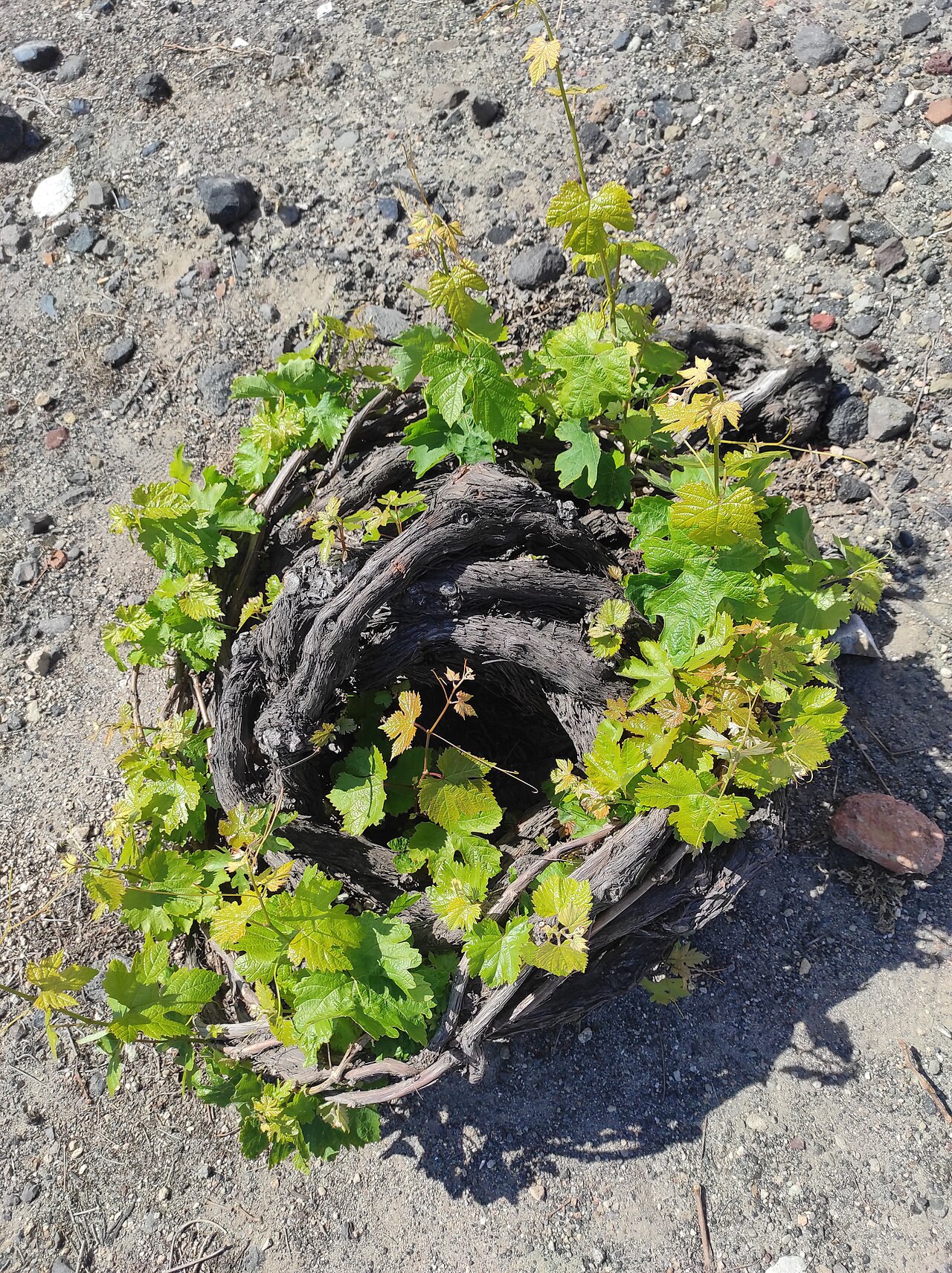
- The vines are ungrafted and many root systems are centuries old. The vines are trained low in baskets called kouloura to protect the fruit from wind and sun.
- Most wineries sit in the south and centre of the island, around Pyrgos, Megalochori, Episkopi Gonia, Exo Gonia, Vothonas and Akrotiri. Two of the best known, Domaine Sigalas and Vassaltis, are in the north near Oia and Imerovigli.
- Three wineries in one day is comfortable. Four is possible. Five is a mistake.
- Greece has a strict drink driving limit, so a driver, a taxi or a private wine tour is the sensible way to do it.
Why Santorini Wine Is Unlike Anything Else in Greece
Every wine region claims to be unique. Santorini is one of the few places where the claim is literally true, and the reasons are geological, botanical and historical all at once.
Volcanic soil called aspa
The island you are standing on is the rim of a collapsed volcano. The great Bronze Age eruption, the one that buried the town at Akrotiri, covered the land in metres of pumice, ash and lava fragments. Locals call the resulting soil aspa. It is almost entirely mineral, with very little organic matter, very little clay and almost no limestone.
For a vine this is a hard place to live. It drains instantly, holds little nutrition and reflects heat back up at the plant. The result is tiny yields of small, thick skinned berries with concentrated flavour and high natural acidity. That combination of ripeness and acidity, in a climate as hot as this one, is the thing wine writers mean when they call Santorini wine mineral or saline. Whatever word you prefer, you will taste it in the first glass.
No phylloxera, ever
In the late nineteenth century a tiny aphid called phylloxera destroyed most of the vineyards of Europe. The cure was to graft European vines onto resistant American rootstock, and almost every vine in Europe today is grafted as a result.
Santorini was spared. The louse cannot survive in the loose volcanic sand, so the island’s vines never needed grafting. Growers still propagate them the old way, by burying a cane from an existing plant until it roots. That is why you will hear that some Santorini root systems are several hundred years old. The part above ground is cut back and regrown every few decades, but the roots underneath can be very old indeed. Very few vineyards anywhere can say the same.
Almost no rain
Santorini receives very little rainfall, and almost none of it during the growing season. There is no irrigation in the traditional vineyards. The vines survive on winter rain stored deep in the pumice and on the moisture that rolls in from the sea at night. The porous soil absorbs that night humidity like a sponge and releases it to the roots. Ask a grower how the vines live through August without water and that is the answer you will get, usually with a shrug, because to them it is obvious.
Wind
The summer meltemi blows hard and steadily from the north. On an island with no trees to break it, it would strip leaves and shred grapes on a conventional trellis. The island’s answer is the kouloura.
The Kouloura: The Basket Vines You Will See Everywhere
Drive through the south of the island and you will see what look like low round baskets sitting in the fields, knee high and a little wider than a car tyre. Those are vines. The technique is called kouloura, from the Greek word for a ring, and it is unique to Santorini.
Each year the grower winds the new canes around and around in a circle, building a nest. The grapes grow on the inside of the basket, shaded from the sun and sheltered from the wind and from the sand the wind carries. The basket also traps the night moisture close to the fruit. When the plant becomes too old and woody to be productive, usually after several decades, the grower cuts it off at the ground and starts a new basket from the same root.
A kouloura is slow and expensive to work. Everything is done by hand and on your knees: pruning, weaving, harvesting. There is no machine that can do it. That is a large part of why Santorini wine costs more than most Greek wine, and why it is worth paying for. When you stand in a vineyard on a Santorini wine tour and look at the baskets, you are looking at the reason the bottle in your hand exists.
Some newer vineyards use a different system called klados or a low trellis, especially for red grapes, and a few use a version called kladeftiko. You will see these near the larger estates. The kouloura is still the classic and the one you should photograph.
The Grapes Behind Santorini Wine
Santorini grows more than forty native varieties, many of them in tiny amounts. You only need to know six to understand a tasting menu.
Assyrtiko
The star. Assyrtiko covers the large majority of the island’s vineyard and is the grape behind almost every famous Santorini bottle. It is a white grape with high acidity, firm structure and flavours of lemon, salt, flint and white flowers when young, moving towards honey, dried fruit and something like petrol as it ages. It is one of the very few white grapes in the world that keeps its acidity in a hot climate, which is why it is now being planted experimentally in Australia, South Africa and California. None of those versions taste like the original.
Good Santorini Assyrtiko ages remarkably well. A bottle from a serious producer will often be better at five or ten years old than on release. Several wineries sell older vintages at the cellar door, and they are the best thing to buy.
Athiri
A softer, more aromatic white with lower acidity. On its own it makes a light, citrus and stone fruit wine that is easy to drink on a hot afternoon. It is also a traditional blending partner for Assyrtiko.
Aidani
A floral, perfumed white grape with notes of jasmine and white peach. It is used in blends and, above all, in Vinsanto, where it adds aroma to Assyrtiko’s structure.
Mandilaria
The most common red grape on the island. It gives deep colour and firm tannin but can be rustic on its own, so it is often blended. Some wineries make a rosé or a sweet red from it.
Mavrotragano
A red grape that was close to extinction a few decades ago and was revived by a handful of Santorini producers. It makes dark, structured, serious red wine with black fruit, spice and a volcanic edge. It is not cheap and it is not made in large quantities, but if a winery offers it, taste it. It is the most exciting red on the island.
Voudomato
A light red grape used for rosé and fresh, pale red wines, and occasionally in sweet wine. Less common, but worth noticing on a menu.
Santorini Wine Styles You Will Taste
Every tasting at Santorini wineries follows roughly the same arc: from fresh dry whites, through oaked whites and reds, to sweet wine at the end. Knowing the names helps you choose a tasting flight that suits you.
Santorini PDO dry white
The island has been a protected designation of origin since 1971, one of the first in Greece. A bottle labelled Santorini PDO is a dry white made overwhelmingly from Assyrtiko grown on the island, with Athiri and Aidani allowed only in small amounts. It is the wine that built the island’s reputation. Expect bone dry, high acid, salty, lemon and flint, and a long finish.
Nykteri
Nykteri means something like “made at night”. Historically the grapes were picked very early in the day and pressed by night to avoid the heat. Today the name refers to a style: a richer, higher alcohol Assyrtiko that must be aged in oak for at least three months. It is fuller, rounder and more complex than the standard dry wine, and it goes well with richer food. Some producers make outstanding examples that age for years.
Vinsanto
The island’s historic sweet wine and the one people remember. Ripe Assyrtiko and Aidani grapes are laid out in the sun for around a week or two after picking, until they shrivel and concentrate their sugar. The juice is fermented slowly and then aged in oak for at least two years, often for far longer. The result is a dark amber wine tasting of dried figs, raisins, coffee, caramel and orange peel, held up by Assyrtiko’s acidity so it never feels heavy.
The name is usually explained as Vino di Santo, the wine of Santo, from the days when Venetian merchants traded it across the Mediterranean. In the nineteenth century large quantities were shipped to Russia, where it was used as communion wine in the Orthodox Church. A Vinsanto aged for twenty years or more is one of the great sweet wines of the world, and you can taste one at several Santorini wineries.
Barrel aged and late harvest whites
Many wineries make a premium white from old vines, single vineyards or particular villages, sometimes aged in oak, sometimes in large old barrels or concrete. These are where the most interesting differences between producers show up. If a tasting menu has a single vineyard or old vine Assyrtiko, choose that flight.
Reds and rosé
Reds from Mandilaria and Mavrotragano, and rosé from Mandilaria or Voudomato. Smaller volumes, more variable, but the best Mavrotragano is genuinely very good.
Liastos and other sweet wines
Some wineries make sun dried sweet wines from red grapes, or sweet wines outside the strict Vinsanto rules. They are often labelled Liastos, which simply means sun dried. Worth tasting alongside a Vinsanto to see the difference.
A Short History of Santorini Wine
People have made wine on this island for at least three and a half thousand years. Grape pips and storage jars have been found in the Bronze Age town at Akrotiri, and wine was almost certainly being produced here before the eruption that buried it.
In the Byzantine and Venetian periods Santorini became a trading island, and its sweet wine travelled widely. By the nineteenth century wine was the island’s main export, much of it sweet and much of it sold to Russia and the Black Sea ports. The old canavas, the traditional wineries dug into the volcanic rock, date from this period. Several are still in use and a few are open to visitors.
The twentieth century was harder. The 1956 earthquake damaged much of the island and many people left. Tomatoes and later tourism competed with vines for land and labour. In the second half of the century a handful of producers, a cooperative and later a new generation of family estates, rebuilt the quality reputation. Since the nineteen nineties Santorini Assyrtiko has gone from a local curiosity to a wine you can find on serious lists in London, Paris and New York.
The challenge now is land. Every hotel, villa and car park is built on what was a vineyard, and the vineyard area has fallen a long way over the last few decades. Yields are low and getting lower in dry years. That is why prices have risen, and why buying directly from the wineries supports the people who keep the vines alive.
The Best Santorini Wineries to Visit
There is no single best winery on the island. There are wineries that are best for a view, best for serious tasting, best for history and best for a first visit. Below are the Santorini wineries we take guests to most often, with what each one is genuinely good at and what to watch out for. Opening times, tasting formats and prices change from season to season, so treat this as a guide to character rather than a timetable, and check before you go.
Santo Wines, Pyrgos
Santo Wines is the winery of the Union of Santorini Cooperatives, founded in 1947 and owned by over a thousand local growers. Its visitor building sits on the caldera edge just below Pyrgos, with a long terrace looking across to Fira, the volcano and Thirassia. It is the most visited winery on the island and, for many people, the first Santorini winery they ever see.
Good for: a first tasting, a wide range of styles in one place, and the view. The tasting menu is long, from simple dry whites to aged Vinsanto, and there is a shop with local products as well as wine.
Watch out for: crowds. At sunset in high season the terrace is full and tour coaches arrive in waves. If you want the view without the noise, come in the late morning or early afternoon. If you want the sunset there, reserve a table and arrive early.
Why it matters: because it is a cooperative, Santo Wines buys grapes from hundreds of small growers who would otherwise struggle to sell them. Buying here supports the farming side of the island directly.
Venetsanos Winery, Megalochori
Venetsanos is built into the cliff on the caldera side of Megalochori, above the new port at Athinios. It was built in 1947 by Giorgos Venetsanos as one of the first industrial wineries on the island, and it was designed to work by gravity: grapes arrived at the top, and juice and wine flowed down through the levels without pumps. After decades of disuse it was restored by the family and reopened to visitors.
Good for: one of the best caldera views of any winery, a quieter atmosphere than Santo, and a building with real history. The tasting terrace looks straight down the cliff to the port and across the caldera.
Watch out for: the sunset slots book up. In late afternoon the terrace fills with couples who had the same idea. Reserve if sunset matters to you.
Estate Argyros, Episkopi Gonia
The Argyros family has been making wine at Episkopi Gonia since 1903, and the estate holds some of the oldest vineyards on the island. It is regarded as one of the most serious producers on Santorini, and its long aged Vinsanto is famous well beyond Greece.
Good for: serious tasting. If you care more about what is in the glass than about the view, this is the winery to prioritise. The building is modern and elegant, with a courtyard tasting area among the vines, and the staff know their wines in depth. If a flight includes an old vine Assyrtiko or an aged Vinsanto, take it.
Watch out for: no caldera view. That is the point. You are here for the wine.
Domaine Sigalas, Oia
Domaine Sigalas sits on the flat plain below Oia, in the area of Baxedes. It was founded in 1991 by Paris Sigalas, a mathematician turned winemaker who did more than almost anyone to put Santorini Assyrtiko on international wine lists. The winery is surrounded by its own vineyards, and you taste looking out over the kouloura baskets.
Good for: top quality wines, including single vineyard Assyrtiko and some of the best Mavrotragano on the island, and a food pairing menu that is very good. It is also the easiest serious winery to combine with an evening in Oia, as it is only a few minutes away.
Watch out for: it is popular and books up for lunch and pairing sessions in high season. Reserve ahead.
Gavalas Winery, Megalochori
Gavalas is a small, traditional family winery in the centre of Megalochori. The family has made wine here for generations, and the old canava with its wooden press is still part of the visit. Gavalas is also known for working with rare native grapes such as Katsano, Gaidouria and Voudomato alongside Assyrtiko.
Good for: an intimate, personal visit, rare grape varieties you will not taste elsewhere, and a sense of what a Santorini winery looked like before tourism. Combine it with a walk around Megalochori.
Watch out for: small spaces and limited seats. It is not designed for large groups, which is exactly why it is pleasant.
Boutari Santorini, Megalochori
Boutari is one of the oldest names in Greek wine, and its Santorini winery near Megalochori was one of the first on the island to open its doors to visitors, in the late nineteen eighties. It is a modern building with a domed tasting hall and an audiovisual presentation about the island and its wine.
Good for: a structured, informative visit, especially if you know little about Greek wine. Reliable dry whites and Vinsanto.
Watch out for: it feels more corporate than the family wineries nearby. Pair it with Gavalas or Venetsanos for contrast.
Hatzidakis Winery, Pyrgos
Hatzidakis was founded in 1997 by Haridimos Hatzidakis, who dug his winery into the hillside near Pyrgos and farmed his vineyards organically long before it was fashionable. He was one of the most respected winemakers on the island, and after his death in 2017 his family continued the work. The wines are intense, precise and much admired by sommeliers.
Good for: wine lovers who want to taste some of the most characterful Assyrtiko, Nykteri and Mavrotragano on the island. The cave setting is atmospheric.
Watch out for: this is a small working winery, not a visitor attraction. Visits are by appointment and spaces are limited. Book well ahead and do not expect a terrace and a sunset.
Gaia Wines, Exo Gialos
Gaia is one of the leading modern wine companies in Greece, and its Santorini winery is in an old tomato processing factory on the beach at Exo Gialos, just north of Kamari. Its Assyrtiko, sold under the Thalassitis name, is one of the best known Santorini wines abroad. Gaia also experimented with ageing bottles under the sea, which makes a good story at the tasting table.
Good for: a tasting by the sea on the east coast rather than the caldera, an interesting industrial building, and very good wine. Easy to combine with a swim at Kamari.
Watch out for: it is a little off the main wine route through the south. Plan it at the start or end of the day.
Koutsoyannopoulos Wine Museum, Vothonas
The Koutsoyannopoulos family has made wine on Santorini since 1870, and their winery at Vothonas is best known for its wine museum: a long underground labyrinth in a natural cave, several metres below ground, with life size figures and old equipment showing how wine was made on the island from the seventeenth century onwards. The visit ends with a tasting of the family’s Volcan wines.
Good for: families with children, history lovers, and anyone who wants to understand how the old canavas worked. It is also cool underground, which is a blessing on a hot July afternoon.
Watch out for: the museum is the main event; the tasting is pleasant rather than profound. Combine it with one of the more serious producers.
Canava Roussos, Episkopi Gonia
Canava Roussos is one of the oldest wineries on the island, dating from 1836, and it still has the feel of a traditional canava. The family has continued to make wine here for generations.
Good for: a relaxed, old fashioned visit, traditional styles including sweet wine, and a sense of continuity. It sits close to Estate Argyros, so the two make an interesting pair: one old canava, one modern estate, a few minutes apart.
Watch out for: simpler facilities than the large estates.
Art Space, Exo Gonia
Art Space is an old canava in Exo Gonia, cut into the pumice in the nineteenth century, which has been turned into an art gallery as well as a working winery. Contemporary Greek painting and sculpture hang in the old tunnels where wine was once made and stored.
Good for: people who want something different, art lovers, and anyone who wants to see the inside of a real historic canava. Small batch wines, including sweet wine.
Watch out for: limited opening, as with many smaller places. Check ahead.
Karamolegos Winery, Exo Gonia
Karamolegos is a family winery in Exo Gonia on the way down towards Kamari, with modern facilities, a range of Assyrtiko from different sites, Nykteri, Vinsanto and reds. It also has a well regarded restaurant on site, which makes it a good lunch stop on a winery day.
Good for: a long lunch with a tasting, a comfortable setting and well made wines.
Watch out for: lunch here takes time. Do not book three more wineries after it.
Vassaltis Vineyards, Vourvoulos
Vassaltis is one of the newest wineries on Santorini, set in the north of the island near Vourvoulos, between the caldera villages and the east coast. The building is contemporary and the approach is modern, with careful single vineyard wines and a focus on food pairing.
Good for: a stylish, modern visit close to Fira, Imerovigli and Oia. Good for travellers staying in the north who do not want to drive to the south.
Watch out for: books up for pairing sessions in summer.
Smaller producers worth knowing
Beyond the names above, Santorini has a growing number of tiny producers, natural wine makers and family estates that open by appointment only or sell through restaurants and wine bars rather than cellar doors. If you have tasted at the larger estates on a previous trip, ask your guide or a good wine bar in Fira about them. Some of the most exciting wines on the island now come from people who make only a few thousand bottles a year.
Wine bars in Fira, Oia and Imerovigli are a good shortcut here. Many pour wines by the glass from producers who have no tasting room at all, so in one evening you can compare half a dozen Assyrtiko from different villages side by side. Ask for a flight from the north, the centre and the south of the island and you will notice how much the wines change over a few kilometres: rounder and riper in the sheltered south, sharper and saltier on the windswept plain below Oia. It is the cheapest way to find out which style you prefer before you spend money at the cellar door, and the staff are usually happy to tell you which wineries to visit next.
Which Santorini Winery Suits You
A quick way to choose, based on what you care about most.
| If you want | Choose | Why |
|---|---|---|
| The best caldera view | Santo Wines or Venetsanos | Both sit on the caldera cliff with terraces facing the volcano |
| The most serious tasting | Estate Argyros, Hatzidakis or Domaine Sigalas | Old vines, single vineyard wines and long aged Vinsanto |
| History and atmosphere | Koutsoyannopoulos Wine Museum, Canava Roussos, Art Space | Old canavas and underground tunnels |
| A family friendly visit | Koutsoyannopoulos Wine Museum | The underground museum keeps children interested |
| Lunch with wine | Domaine Sigalas, Karamolegos, Vassaltis | Proper food pairing menus |
| A seaside tasting | Gaia Wines | On the beach at Exo Gialos near Kamari |
| Rare grapes | Gavalas | Katsano, Gaidouria and Voudomato |
| Something near Oia | Domaine Sigalas or Vassaltis | Both in the north of the island |
| A sunset with wine | Santo Wines or Venetsanos | Reserve the sunset slot in advance |
Santorini Wineries by Area
Santorini is small, but planning by area saves a surprising amount of time, especially in summer traffic. The wineries cluster into three groups.
Pyrgos, Megalochori and the caldera south
The densest cluster: Santo Wines below Pyrgos, Venetsanos on the cliff above Athinios, Gavalas and Boutari in and around Megalochori, and Hatzidakis on the hill near Pyrgos. All are within a few minutes’ drive of each other. This is the obvious base for a winery day, and you can add a walk through Pyrgos or Megalochori between tastings.
Episkopi Gonia, Exo Gonia, Vothonas and Kamari
The inland and east side: Estate Argyros and Canava Roussos at Episkopi Gonia, Art Space and Karamolegos at Exo Gonia, the Koutsoyannopoulos Wine Museum at Vothonas, and Gaia at Exo Gialos by Kamari. These are farming villages with almost no caldera view, which is why they feel more real. They are ten to fifteen minutes from the Pyrgos group.
Oia and the north
Domaine Sigalas on the plain below Oia, and Vassaltis near Vourvoulos. If you are staying in Oia, Finikia or Imerovigli, these are your closest wineries, and Sigalas is easy to combine with sunset in Oia.
Akrotiri and the far south
The Akrotiri peninsula has vineyards and a few small producers, and it is where you will see some of the oldest kouloura vines on the island. Combine a tasting here with the Akrotiri archaeological site, the Red Beach and the Akrotiri lighthouse for a full southern day.
How to Visit Santorini Wineries
There are four realistic ways to do a winery day on Santorini. Which one suits you depends on how much you want to taste, how much you want to plan, and how much you want to spend.
A private wine tour
A driver collects you from your hotel, takes you to three or four wineries chosen for your taste, handles the reservations and brings you back. You taste as much as you like and nobody has to stay sober. This is the most comfortable way to visit Santorini wineries and, for a couple or a small group, often not much more expensive than renting a car and paying for taxis. Our Santorini private wine tour is built around exactly this, and you can adjust the wineries when you book.
The other advantage is local knowledge. A driver who visits these cellars every week knows which terrace is quiet on which afternoon, which winery has a new release worth tasting, and how to avoid the coaches.
A small group wine tour
A shared minibus with other travellers, a fixed route and fixed timings. Cheaper per person, sociable, but you go where the group goes and the wineries are usually the large ones that can handle groups. Our small group tour is an option if you want to mix wine with sightseeing at a lower cost.
Self drive
Possible, but someone has to drive, and that person cannot really taste. Greece’s legal blood alcohol limit is 0.5 grams per litre for most drivers and only 0.2 for drivers who have held a licence for less than two years, professional drivers and motorcyclists. Police checks on the island are common in summer, and three tastings will put most people over the limit. If you do drive, the driver should spit everything and the passengers should accept that the driver is doing them a favour. See our Santorini car rental guide for parking and road conditions.
Do not do a winery day on a quad bike or scooter. The roads in the south are narrow, busy with coaches and steep in places. We have written about why in our Santorini ATV rental guide.
Taxi and bus
The public bus connects Fira with Pyrgos, Megalochori and Kamari, and a couple of wineries are within walking distance of a stop. But the bus timetable does not fit a winery day well, and the walk from the main road to some wineries is long and unshaded. Taxis are limited on Santorini and hard to find in peak hours. See our guides to the Santorini bus and Santorini taxis before relying on either.
Planning a Winery Day
How many wineries in one day
Three is right for most people. Each tasting takes around an hour once you include the walk round, the tasting itself and the shop. Add driving, a lunch and a little time to sit and enjoy the view, and three wineries fill a comfortable half day or a relaxed full afternoon. Four is possible if you are keen and well organised. Beyond that the wines start to blur together and your palate stops being useful.
Mix the styles
The best winery days combine different kinds of visit: one view winery, one serious producer and one historic canava or museum. That way each stop feels different and you learn more. A day of three large estates with similar tasting menus can feel repetitive.
Book ahead
In July and August, and for any sunset slot, reserve. The smaller producers often require an appointment at any time of year. In May, June, September and October many wineries can take walk ins in the morning, but it is still safer to call.
Eat
Tasting on an empty stomach is a bad idea in the heat. Plan a proper lunch, either at a winery restaurant or in a village taverna, and take the bread and crackers offered at tastings. Our Santorini restaurants guide has suggestions near the wine villages.
Drink water
Volcanic island, strong sun, white wine with high acidity. Drink a glass of water for every glass of wine. Most wineries provide it; ask if they do not.
Three Winery Routes That Work
These are the routes we use most often. Each fits into a half day or an afternoon and can be extended with lunch.
Route one: the classic caldera afternoon
- Start at Estate Argyros in Episkopi Gonia for the most serious tasting of the day while your palate is fresh.
- Continue to Gavalas or the Koutsoyannopoulos Wine Museum for history and rare grapes.
- Finish at Santo Wines or Venetsanos on the caldera cliff for the view as the light softens. Reserve the last slot for sunset.
This is the route that most people imagine when they think of Santorini wineries, and it works well. It is also the one most similar to our standard private wine tour.
Route two: the serious wine lover
- Hatzidakis near Pyrgos by appointment in the morning.
- Estate Argyros for old vines and long aged Vinsanto.
- Lunch and a pairing at Domaine Sigalas near Oia.
Fewer views, better wine. Book every stop in advance.
Route three: wine and the south
- Morning at the Akrotiri archaeological site before the heat.
- A look at the Red Beach viewpoint.
- Lunch in Megalochori and a tasting at Gavalas or Boutari.
- Sunset at Venetsanos.
This combines history, landscape and wine in one day. It mirrors our South Part and Akrotiri tour, which includes a winery.
Combining wine with a full island day
If you only have one day for everything, you do not have to choose between sightseeing and wine. Our full day tour and sightseeing tour both include a winery stop, and our personalised tour lets you set the balance yourself.
When to Visit Santorini Wineries
By season
Most Santorini wineries open from around April to late October, with the longest hours from June to September. Several larger wineries stay open in some form through winter, but hours are shorter and some smaller ones close entirely. If you are coming out of season, read our guide to Santorini in winter and check every winery in advance.
- April and May: green vineyards, new vintage whites just released, quiet terraces. A very good time for serious tasting.
- June: long evenings, warm but not yet extreme, still manageable crowds.
- July and August: the busiest and hottest months. Harvest begins, often from late July, which is earlier than almost anywhere else in Europe. You may see grapes being picked by hand and laid out to dry for Vinsanto. Book everything.
- September: our favourite. Harvest finishing, sea still warm, light softer, crowds thinning.
- October: quiet, mild, and the wineries are relaxed after harvest. Some start reducing hours towards the end of the month.
For weather month by month, see our guides to the best time to visit Santorini and Santorini weather.
By time of day
Mornings are best for serious tasting: your palate is fresh and the cellars are quiet. Midday is hot, so plan an indoor winery, a museum or lunch. Late afternoon and sunset belong to the caldera terraces, and they are when the views are at their best.
What Happens at a Santorini Winery Tasting
If you have never done a formal wine tasting, this is what to expect.
Most wineries offer a choice of tasting flights: typically a short flight of three or four wines, a longer flight of six to eight, and a premium flight including older vintages or long aged Vinsanto. Some offer food pairings with local cheese, cured meats, fava, cherry tomatoes and capers. Prices vary by flight and winery, and the premium flights are usually worth the difference.
The pours are small, enough for a few sips each. You are not expected to finish every glass, and you can pour the rest into the spittoon or dump bucket. Nobody minds. Professionals spit everything.
Many wineries include a short walk through the vineyard or the cellar, explaining the kouloura, the fermentation and the barrels. At the smaller producers you may meet the winemaker or a member of the family. Ask questions. They are proud of their work and happy to talk about it.
The wines are usually served in order from lightest to heaviest: fresh dry whites, oak aged whites and Nykteri, rosé and reds, and finally Vinsanto. Do not skip the Vinsanto, even if you think you do not like sweet wine.
How to taste without overdoing it
- Choose one longer flight at your favourite winery and shorter flights at the others.
- Share a flight between two people at one stop.
- Spit at the first winery, especially in the heat.
- Eat something between tastings.
- Leave the most expensive bottles for the last stop, once you know what you like.
Etiquette
Dress for a village rather than a beach club; covered shoulders are not required but swimwear is not appropriate. Do not wear strong perfume, which interferes with tasting for you and for others. Tell the staff if you have allergies or if anyone in your group is not drinking; most wineries can offer grape juice, water or soft drinks. If you are given a reserved table at sunset, arrive on time, as the slots are tightly scheduled.
What to Eat With Santorini Wine
Santorini’s wine evolved alongside its food, and they go together better than almost anything you will bring from home. The island’s volcanic soil gives intense flavour to its few crops: cherry tomatoes, yellow split pea fava, white aubergine, capers and the local chlorotyri cheese.
- Dry Assyrtiko with grilled fish, octopus, fava with capers and onion, tomato fritters, and anything with lemon.
- Nykteri with richer dishes: grilled meat, moussaka, roasted vegetables, mature cheese.
- Mavrotragano with lamb, beef and slow cooked stews.
- Vinsanto with dried fruit, nuts, blue cheese or chocolate, or on its own as dessert.
Our guides to Santorini food and private Santorini food tours go deeper, and the food experience tour combines tastings of both.
Sunset at a Santorini Winery
Watching the sunset from a winery terrace with a glass of Assyrtiko is one of the best evenings on the island, and a calmer alternative to the crowds in Oia. Santo Wines and Venetsanos are the two obvious choices on the caldera. Both face west across the water.
Three things make it work. Reserve a table, because sunset is the busiest slot of the day. Arrive at least an hour before the sun goes down, so you can taste properly before the light show starts. And check the sunset time for your dates, which moves by more than two hours between June and late October. Our guide to the Santorini sunset tour and our page on the best sunset spots have more ideas.
Buying Wine and Taking It Home
The cellar door is often the best place to buy Santorini wine, especially older vintages, limited bottlings and long aged Vinsanto that rarely reach export markets.
Flying home in the European Union
If you live in another EU country, there is no customs limit on wine you carry for personal use, though guide levels apply to very large quantities. The practical limit is the airline. Bottles cannot go in hand luggage through security unless bought airside, so they must go in checked baggage. Wrap each bottle in clothing or ask the winery for protective packaging; many sell padded wine sleeves. Check your baggage weight allowance, as a dozen bottles weigh well over ten kilograms.
Flying home to the UK or outside the EU
Travellers to the UK and to countries outside the EU have personal duty free allowances for wine, and anything above them must be declared and may be taxed. The allowances differ by country, so check yours before you buy a case.
Shipping
Many Santorini wineries ship within the EU and some ship further. It costs more than carrying bottles, but it means you can buy a mixed case without worrying about your luggage. Ask at the winery shop. Our Santorini shopping guide has more on what to buy and how to pack it.
What to buy
- An aged Vinsanto, the island’s most distinctive wine and a good gift.
- A Nykteri, which you rarely find abroad.
- An older vintage Assyrtiko, five years or more, if the winery sells one.
- A bottle of Mavrotragano, if you like serious reds.
- Local products to go with them: fava, capers, tomato paste and cherry tomato preserves.
Santorini Wineries for Different Travellers
Couples and honeymooners
A sunset tasting on the caldera is one of the most romantic evenings on the island. Combine it with a private driver so neither of you has to worry about the road. Our Santorini honeymoon guide has more ideas.
Families with children
Children are welcome at most wineries, and many offer grape juice. The Koutsoyannopoulos Wine Museum is the best choice with younger children because the underground tunnels and figures hold their attention. Keep the day short and plan a swim afterwards. See our guide to family tours on Santorini.
Older travellers and those with limited mobility
Most wineries in the south have level parking and accessible tasting areas, unlike the cliff villages. Some cellars and terraces involve steps. Tell your driver or the winery in advance and they can usually arrange a table close to the entrance. Our guides to Santorini for seniors and wheelchair accessible Santorini have specific advice.
Cruise passengers
If your ship is in port for a day, a winery visit is possible but needs careful timing because of the tender boats and the cable car queue. Our shore excursion collects you at the old port and can include a winery. See our Santorini cruise port guide.
Solo travellers
A small group tour is the most sociable and economical option. Most wineries are relaxed about solo visitors at the bar or terrace. See our Santorini solo travel guide.
Travellers on a budget
Choose shorter tasting flights, share one between two, and buy one good bottle rather than several ordinary ones. The cooperative at Santo Wines offers good value. Our Santorini on a budget guide has more.
Mistakes People Make Visiting Santorini Wineries
- Trying to see too many. Five wineries in a day is a blur, not a tour.
- Driving and tasting. The limit is low and checks are frequent.
- Arriving at sunset without a booking. The terraces are full and you will be turned away or stood at the back.
- Skipping lunch. Heat and acidity on an empty stomach are a bad combination.
- Only visiting view wineries. The best wine is often made in places with no view at all.
- Skipping the Vinsanto. Even people who do not like sweet wine usually change their mind.
- Buying the cheapest bottles. Santorini wine is expensive because it is expensive to make. The premium bottles are the ones worth carrying home.
- Not checking opening times out of season. Hours shrink quickly from late October.
The Future of Santorini Wine
Santorini’s vineyards face real pressure. Building land is worth far more than vineyard land, so every year more vines disappear under villas and car parks. Several dry years have cut yields sharply. Climate change brings hotter summers and less predictable rain. Young people are less willing to spend their summers on their knees weaving kouloura baskets.
At the same time, demand for Santorini Assyrtiko has never been higher. Prices have risen to reflect scarcity, and the best producers are investing in vineyard restoration, organic farming, research into old varieties and new techniques for the hotter climate. The island’s growers and cooperative are working to protect the remaining vineyard land.
The simplest way a visitor can help is to buy from the people who grow the grapes, at the cellar door, and to treat a winery visit as a visit to a farm rather than a bar. The fact that this landscape exists at all is something to value, not take for granted. Our pages on overtourism on Santorini and cultural experiences explain the wider picture.
A Glossary of Santorini Wine Words
You will hear these words at every tasting. Knowing them makes the conversation with the winemaker much more interesting.
- Aspa: the volcanic soil of the island, made of pumice, ash and lava fragments, with almost no organic matter.
- Kouloura: the basket shaped training system, in which the vine’s canes are woven into a low ring to protect the grapes from wind and sun.
- Canava: a traditional Santorini winery, usually dug into the soft volcanic rock, where grapes were trodden and wine was fermented and stored. Several are now museums, galleries or tasting rooms.
- Patitiri: the treading floor inside a canava, where grapes were crushed by foot before presses were common.
- Assyrtiko: the island’s main white grape, high in acidity and capable of long ageing.
- Nykteri: a richer, oak aged style of dry Assyrtiko. The name refers to the old practice of working the grapes at night.
- Vinsanto: the traditional sweet wine, made from sun dried grapes and aged in oak for years.
- Liastos: sun dried. Used for sweet wines made from dried grapes, including some made outside the Vinsanto rules.
- PDO: Protected Designation of Origin. Santorini PDO guarantees that the wine is made on the island from permitted local grapes under defined rules.
- Old vines: on Santorini this can mean root systems far older than the visible plant, because the vines are regenerated from the same roots.
- Ungrafted: growing on its own roots, rather than on American rootstock, because phylloxera never reached the island.
- Single vineyard: a wine made from one named plot, showing the character of that place. Usually the most interesting bottles on a tasting menu.
How Santorini Compares With Other Greek Wine Regions
Greece has many wine regions, and if you enjoy the wineries on Santorini you may want to explore others on future trips. It helps to know where the island fits.
Santorini is above all a white wine island, built on Assyrtiko, volcanic soil and old ungrafted vines. Its wines are dry, high in acidity, mineral and long lived, with Vinsanto as the great sweet wine.
Nemea, in the Peloponnese, is Greece’s largest red wine region, based on the Agiorgitiko grape, which makes soft, fruity reds as well as serious oak aged wines. If you prefer red wine, Nemea is easier to love than Santorini.
Naoussa and the north of Greece are home to Xinomavro, a structured, high acid red grape often compared with Nebbiolo. Serious, age worthy wines, very different from the islands.
Crete is the largest island wine region, with a long tradition and a revival of native grapes such as Vidiano, Liatiko and Kotsifali. If you are combining the two islands, our Crete to Santorini and Santorini vs Crete guides will help.
Other Cyclades islands, including Paros and Naxos, make wine too, mostly on a smaller scale. None has quite the same combination of soil, grape and history that makes Santorini special. If you are island hopping, see our guides to Santorini to Paros and Santorini to Naxos.
What makes Santorini wineries worth a special trip is that you can taste a wine of world class quality in the place where it is made, a few metres from vines that have been growing on the same roots for generations, with a volcano in view. That combination exists almost nowhere else.
Does Santorini Wine Age Well?
Better than almost any white wine from a hot climate. This is one of the least understood facts about Santorini wineries, and one of the most useful when you are deciding what to buy.
A young Santorini Assyrtiko is tight, citrusy and salty. After three to five years in bottle it begins to open up, with notes of honey, beeswax, dried herbs and toasted nuts, while keeping its acidity. After ten years, a good example can be extraordinary, deeper in colour, with a smoky, almost petrol edge similar to aged Riesling. Nykteri, with its oak ageing, often needs a few years to show its best.
Vinsanto barely ages in the conventional sense. It is already aged before release, sometimes for decades in barrel, and it will keep for many years after opening if you seal it well. A bottle bought on holiday can still be enjoyed a glass at a time months later.
If a winery offers an older vintage at the cellar door, it is worth buying. These bottles are hard to find abroad and are the best way to understand why serious wine critics rate Santorini among the great white wine regions of the world.
Santorini Wineries FAQ
How many wineries are there on Santorini?
Around twenty wineries receive visitors, with more small producers making wine by appointment or for restaurants only. The number changes from year to year as new estates open and small family producers stop.
Which is the best winery in Santorini?
It depends on what you want. For the view, Santo Wines or Venetsanos. For the wine itself, Estate Argyros, Domaine Sigalas or Hatzidakis. For history, the Koutsoyannopoulos Wine Museum or Canava Roussos. Most people enjoy a mix of the three.
Do I need to book Santorini wineries in advance?
For sunset slots, food pairings and the smaller producers, yes. In July and August it is wise to book everything. In spring and autumn the larger wineries can often take walk ins during the day.
How long does a winery visit take?
Around an hour per winery, including the tasting and a look round. Allow more for a food pairing or lunch.
How many wineries can I visit in one day?
Three is comfortable. Four is possible. More than that and you stop being able to taste properly.
What is the most famous Santorini wine?
Dry Assyrtiko, sold as Santorini PDO, is the most famous. Vinsanto, the island’s sun dried sweet wine, is the most historic.
Is Santorini wine expensive?
It is more expensive than most Greek wine, because yields are tiny, the vines are worked by hand and vineyard land is scarce. The quality justifies it, and buying at the cellar door is usually good value for older and limited bottles.
Can children visit wineries on Santorini?
Yes. Most wineries welcome families and offer soft drinks or grape juice. The Koutsoyannopoulos Wine Museum is especially good with children.
Can I visit wineries without a car?
Yes. A private wine tour or small group tour is the easiest way. Buses and taxis are possible but awkward for a full winery day.
When is the grape harvest on Santorini?
Usually from late July into August, earlier than most of Europe because of the heat. You may see grapes drying in the sun for Vinsanto in August.
Which Santorini winery has the best sunset?
Santo Wines and Venetsanos both face west over the caldera and are the two most popular choices. Reserve a table well in advance.
Are Santorini wineries open in winter?
Some larger wineries stay open with reduced hours, but many smaller ones close from November to March. Always check ahead in the low season.
Visit Santorini Wineries With a Local Driver
We run private wine tours every day of the season, with hotel pickup anywhere on the island, a licensed local driver, and the wineries chosen to suit you. You taste; we drive. Tell us whether you prefer views, serious wine, history or a mix, and we will build the route and handle the reservations. See the Santorini private wine tour, compare all our Santorini tours and prices, or contact us with your dates.
Read More Before Your Santorini Winery Day
These are the pages our guests use most when they plan a day of wine on the island.
Wine villages and places
- Pyrgos, the hilltop wine village
- Megalochori and its wineries
- Emporio, the largest village on the island
- Akrotiri and the Bronze Age town
- Oia, close to Domaine Sigalas
- Kamari, next to Gaia Wines
Tours that include wineries
- Santorini private wine tour
- South Part and Akrotiri tour
- Santorini full day tour
- Santorini sunset tour
- Santorini food experience
