
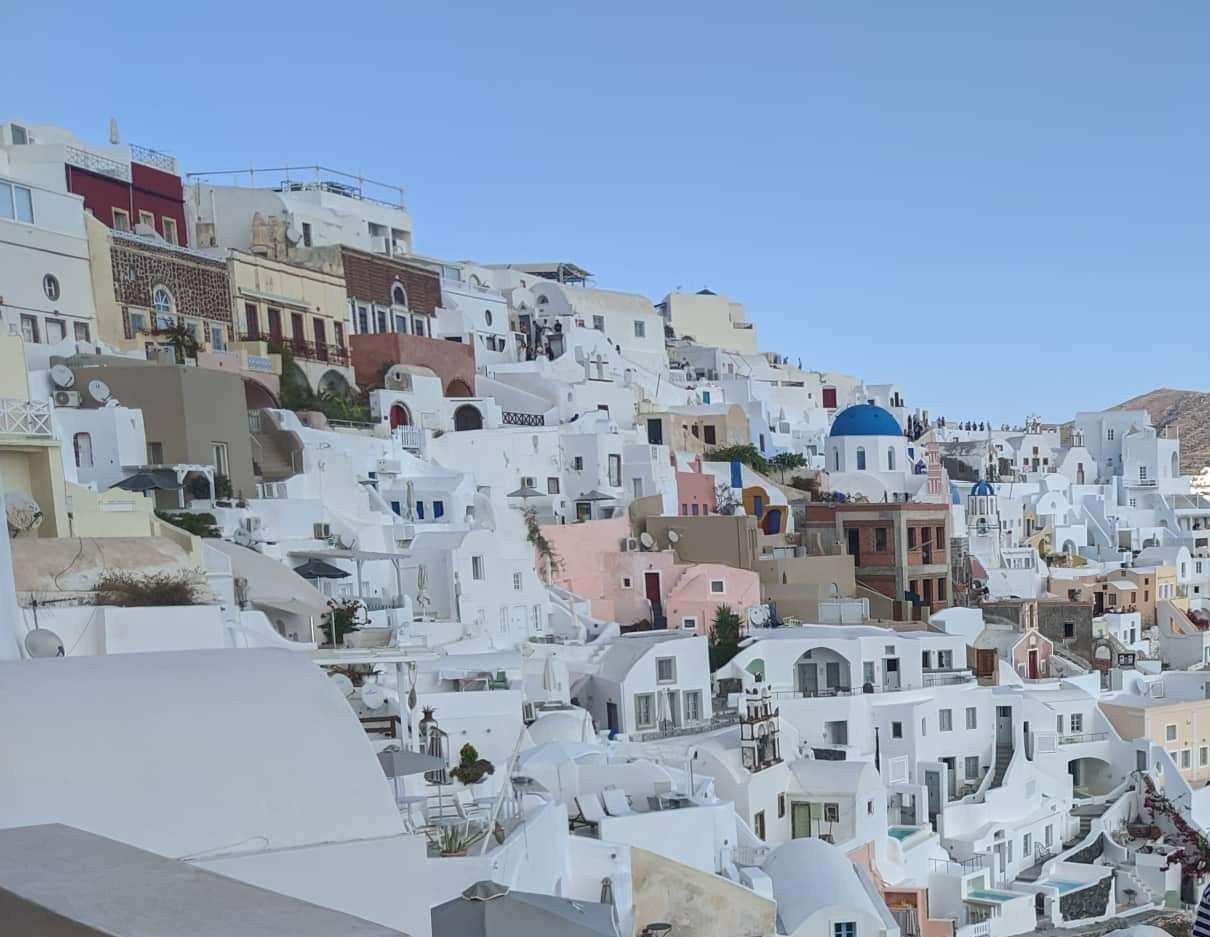
Oia Santorini is the most photographed village in Greece and the one visitors most often describe as both extraordinary and disappointing in the same sentence. Both are correct, and the difference between them is entirely a matter of what time you arrive. At seven in the morning the marble lanes are empty, the light comes over the caldera behind you and there is nowhere better in the Cyclades. At two in the afternoon in August it is a slow-moving queue between souvenir shops. We drive guests here every day of the season, so this page is organised around hours rather than highlights. Our Santorini Tours reach Oia at the hours that work.
The short recommendation: come at dawn, come back for sunset from somewhere other than the castle, and do not base yourself here unless you have a week or a large budget.
The Short Answer
Go before nine in the morning. The single most useful piece of advice about Oia Santorini, and the one almost nobody follows.
The castle at sunset is oversold. Several thousand people watch the same sun that is visible, free and uncrowded, from the rim path further south.
Ammoudi is worth the 300 steps for a late lunch at the waterline.
Do not stay here on a short trip. It is the furthest point on the island from the airport and the port.
Two nights inside a longer stay is the structure we recommend if Oia matters to you.
The Village and Its Caldera
What Is in Oia Santorini
| What | Cost | Best hour | Why | Catch |
|---|---|---|---|---|
| The main street | Free | Before 09:00 | Marble-paved, running the length of the village | Impassable at midday in August |
| The castle ruins | Free | Dawn, or an hour before sunset | The classic sunset viewpoint | Several thousand people at golden hour |
| The windmills | Free | Early morning | The western tip of the village | The most photographed corner on the island |
| Blue domes viewpoint | Free | 07:00 to 08:00 | Three domes stacked above the caldera | A queue of photographers by ten |
| Ammoudi Bay | Free to walk | Late afternoon | Fish tavernas at the waterline | 300 steps down and back up |
| Armeni Bay | Free | Morning | The quieter of the two harbours | Steeper path, fewer people |
| Naval Maritime Museum | Ticketed, modest | Any time, best in wind | Shipping history in a captain’s mansion | Small, and closed some afternoons |
| Finikia | Free | Any time | A traditional village five minutes east | Almost nobody goes |
| Byzantine castle path | Free | Early | Walk from the bus stop to the castle | Steps and cobbles throughout |
| The sunset | Free | The event of the day | Applause, then a mass exit | The single most oversold hour on Santorini |
Every row in that table is free except one museum, and every row has an hour attached. That is Oia Santorini in summary: nothing costs anything, and timing is everything.
Oia Santorini at Dawn
This is the version worth seeing. Between about six and eight in the morning the village is empty, the shops are shut, and the light comes over the caldera from behind the island.
The main street runs the length of the village in marble, and at that hour you can walk it end to end without stopping.
The blue domes viewpoint is signposted off the main street towards the northern edge. By ten there is a queue for the same photograph; at seven there is nobody.
The castle ruins at the western tip, which at sunset hold several thousand people, are yours alone.
The windmills beyond them catch the first light.
How to manage it. Either stay in Oia Santorini overnight, or drive up from Fira for half past six. Our north part and Oia tour can start early for exactly this reason.
What is open. Very little, and a bakery or two. Bring coffee or accept that you are here for the light rather than breakfast.
Why it matters. Almost every complaint about this village is a complaint about the hours between eleven and six. Arrive before them and the complaints do not apply.
The Main Street and the Lanes
The spine. A marble-paved pedestrian street runs from the bus stop at the eastern end to the castle at the west, and almost everything in Oia Santorini hangs off it.
What is on it. Jewellers, galleries, clothes shops, cafes and a great deal of tourist stock, in restored captains’ houses.
Below it. Stepped lanes drop towards the caldera, past cave hotels, terraces and private pools cut into the cliff.
Above it. A quieter band of ordinary houses, churches and a couple of good tavernas that most visitors never reach.
The architecture. Nineteenth century merchant houses at the top, cave dwellings below, and the contrast between them is the history of the village in one section.
When to walk it. Before nine or after seven. In between it is a queue.
Shoes. Polished marble and steps. Grip matters here more than anywhere else on the island.
The Oia Santorini Sunset, Honestly
The Oia Santorini sunset is the most famous hour in the Aegean and the most oversold. Here is what actually happens.
The crowd builds from about an hour before. People fill the castle ruins, the main street west of it and every wall, step and rooftop with a westward view.
At peak in July and August several thousand people are watching the same sun from a village designed for a few hundred.
The sun goes down behind Thirassia, there is applause, and within ten minutes the entire crowd tries to leave through one marble street.
The bus stop afterwards is the worst queue on the island, and taxis are not a realistic alternative.
Is it beautiful? Genuinely, yes. The light on the white village and the caldera behind it is extraordinary.
Is the castle the place to see it from? No, and it is the only spot most visitors ever try.
Better places to watch it
The path east of the castle, five minutes back towards the village centre, with the same sun and a fraction of the crush.
A terrace with a booking. Reserve days ahead in season and you watch it sitting down.
Ammoudi Bay, below the village, where the sun sets over the water rather than behind a headland and there are tables at the edge of the sea.
Imerovigli, twenty-five minutes south, which has the same sunset from higher ground and perhaps two hundred people rather than three thousand.
Firostefani and the rim path, for the same reason.
From the water, on a sunset cruise, which is the best version of all.
Our sunset guide lists them properly, and the sunset tour avoids the scrum entirely.
If you insist on the castle
Arrive ninety minutes early in high season to get a wall to sit on.
Bring water and something to sit on.
Plan the exit before the sun goes down. Walk east into the village rather than joining the funnel, have dinner, and leave an hour later.
Do not drive. Parking in Oia Santorini at sunset is close to impossible and leaving afterwards is worse.
Have transport booked for a fixed time an hour after sunset. This one arrangement transforms the evening.
Ammoudi Bay and Armeni
Ammoudi is the old harbour directly below the castle, reached by roughly three hundred wide steps or by road from the northern edge of the village.
What is there. A short quay of fish tavernas with tables almost in the water, small boats, and red cliffs rising behind.
Swimming. Off the rocks past the last taverna, and out to the small islet of Agios Nikolaos for confident swimmers.
When to go. Late afternoon, so you eat as the light goes and climb back up in the cool.
The steps. Wide, shallow, and shared with donkeys, which we ask you not to ride. Going down takes ten minutes; coming up takes twenty and is genuinely hard in August heat.
The alternative. A taxi or a booked car by the road, which many visitors use for the return leg.
Armeni, the other harbour, is south-east below the village down a steeper path, quieter, with a taverna and boats to Thirassia.
Which to choose. Ammoudi for dinner and the view; Armeni for quiet and for the crossing to Thirassia.
Eating in Oia Santorini
Expect caldera prices. This is the most expensive village on the island and the restaurants know exactly what the view is worth.
Terraces with a view need booking days ahead for sunset in season, and the good ones are booked weeks ahead in August.
One street back from the rim, prices fall noticeably for comparable cooking, exactly as they do in Fira.
Above the main street, in the ordinary part of the village, there are a couple of tavernas that cook for residents.
Ammoudi is the best value serious meal in Oia Santorini: fresh fish, at the waterline, at prices below the clifftop.
Breakfast. Bakeries on the main street open early and are a fraction of hotel rates.
Finikia, five minutes east, has tavernas at ordinary prices with no view at all and considerably better value.
What to drink. Assyrtiko, and buy a bottle at an estate rather than paying restaurant mark-up; see our wine tour.
Staying in Oia Santorini
The most common question we are asked about this village, and the one where our answer surprises people.
The case for
You get the village at dawn and after ten at night, which is when it is genuinely extraordinary and when day visitors are gone.
Sunset from your own terrace rather than from a crowd.
The best hotels in Greece. The cave suites cut into the cliff below the main street are the properties that put this island on luxury lists.
Ammoudi below for dinner without a transfer.
The case against
It is the furthest point on the island from everything. Thirty-five minutes to the airport, forty-five to Athinios port, twenty-five to Fira, forty-five or more to the beaches.
Every transfer is the longest available, at both ends of your trip and every day in between.
It is the most expensive village in Greece for accommodation.
The steps. Most cliffside properties are reached by long stepped alleys, and luggage has to be carried.
Day crowds. Between eleven and six you share your village with several thousand visitors.
Nothing late. Oia Santorini is asleep by half past midnight, so anyone wanting a night out is looking at a taxi to Fira that will not be there.
Our recommendation
Under four nights on the island: do not stay here. The transfers eat too much of a short trip.
Five nights or more: two nights here, the rest elsewhere. You get the dawn and the terrace sunset without paying for either all week.
Honeymoons: yes, for part of the stay, and Imerovigli for the rest.
Families with young children: no. Steps, crowds, cliffs and prices all work against you.
Budget travellers: Finikia, five minutes east, at a fraction of the rate.
Our accommodation guide compares every village on the island.
Getting to Oia and Away Again
By bus. Frequent from Fira, twenty-five minutes, and cheap. The last services back leave earlier than most visitors expect, and the sunset bus queue is severe.
By car. Twenty-five minutes from Fira on the rim road. Parking is at the edges of the village and full from mid-morning through sunset.
By ATV or scooter. Popular and the parking problem is smaller. See our ATV guide.
By taxi. In theory. The island’s fleet is tiny and after sunset in Oia Santorini it is effectively unavailable. See our taxi guide.
By private transfer. Booked for a fixed time, which is what we would do for the evening. Our Oia and Finikia transfers run all season.
On foot from Fira. The rim path, three to four hours, best started at sunrise. See our hiking guide.
By boat. Ammoudi and Armeni both have small boats, including the crossing to Thirassia.
Timing advice. Arrive before nine or after six, and never plan to leave in the fifteen minutes after the sun goes down.
The Crowds, and the Hours That Fix Them
Where they come from. Cruise passengers bussed up from the old port, coach tours from the hotels, day trippers from other islands, and everyone on Santorini who has come for the sunset.
The daily shape. Quiet until nine, filling from ten, heavy from eleven to five, peaking hard in the ninety minutes before sunset, and empty again by half past ten at night.
The bottleneck. One marble street the width of two people carrying everything.
August is the worst, then July, then September and June.
What actually works. Be in Oia Santorini before nine, leave by eleven, and come back at seven if you want the evening.
What does not work. Arriving at one in the afternoon and expecting the photographs you have seen.
Check the cruise schedule. Your hotel knows which days are heavy, and a light day here is a completely different village.
Photographing Oia Santorini
The blue domes. Signposted off the main street towards the northern side. Three domes stacked with the caldera behind. Empty at seven, queued by ten.
From the castle, looking back east along the village at dawn, with the whole cascade of white houses lit from the side.
The windmills at the western tip, best in early light.
From Ammoudi, looking up at the village on the cliff, which almost nobody shoots.
From the water, on a boat, for the shot the postcards use.
Blue hour, twenty minutes after the crowd leaves, when the village lights come on and the sky is still deep blue. The best photograph in Oia Santorini and the one that requires staying.
What to avoid. Midday, when the light is flat and the lanes are full.
Our photography tour guide covers the practicalities.
Oia Santorini Season by Season
April. Green surroundings, cool air, some businesses still closed, and the village genuinely quiet. Excellent for walking and photographs.
May. Everything open, comfortable temperatures, manageable crowds. One of the two best months.
June. Warm and busy, with the sunset crowd building.
July and August. Peak. Hot, crowded from eleven to seven, and the sunset a genuine crush. Come at dawn or not at all.
September. Still busy and noticeably easier, with the best sea temperatures for Ammoudi.
October. Winding down, cooler evenings, and one of the loveliest months here.
November to March. Most of Oia Santorini closes. A handful of places stay open, the light is dramatic, and you may have the castle to yourself. See our winter guide.
A Day in Oia Santorini, Hour by Hour
06:30. Arrive. The village is silent and the light is coming up behind you.
07:00. The main street end to end, without stopping for anyone.
07:30. The blue domes viewpoint, alone.
08:00. The castle ruins and the windmills at the western tip.
08:30. Coffee at a bakery as the first shops open.
09:30. Down the steps to Ammoudi before the heat, and a swim off the rocks.
11:00. Leave. This is when Oia Santorini stops being enjoyable and does not start again for seven hours.
Elsewhere. Akrotiri, a winery, a beach, or the caldera path further south.
18:30. Come back. The light is turning and the coaches have started to thin.
19:00. A booked terrace, or the path east of the castle with a bottle.
20:15. Sunset, applause, and the crowd draining away.
20:45. Dinner, unhurried, while everyone else queues for the bus.
22:30. The village nearly empty again, the lights on, and the best photograph of the day.
Mistakes People Make
Arriving at midday. The single most common one, and it defines most people’s opinion of the village.
Watching sunset from the castle in August without arriving early enough to sit down.
Not booking a terrace and expecting a table with a view at eight in the evening.
Joining the bus queue immediately after sunset. Have dinner instead and leave an hour later.
Driving in for sunset. Parking is full and leaving is worse.
Basing a three night trip here. Transfers consume the trip.
Booking a cliffside room without asking about steps. Ninety of them with a suitcase is a real thing.
Riding a donkey up from Ammoudi.
Skipping Ammoudi because of the climb, and missing the best meal in Oia Santorini.
Expecting nightlife. There is none; that is Fira. See our nightlife guide.
Beliefs Worth Correcting
“Oia is the main town.” Fira is. Oia is a village at the northern tip.
“You have to see the sunset from the castle.” You do not, and it is the worst place to see it from.
“It is always crowded.” It is empty before nine and after ten at night.
“The blue domes are a viewpoint you pay for.” They are visible free from a public lane.
“You can walk to a beach.” You cannot. The nearest proper beaches are forty-five minutes away.
“There will be taxis after sunset.” There will not.
“Staying here means avoiding crowds.” It means avoiding them at dawn and after dark, and living in the middle of them from eleven to six.
“Oia Santorini is expensive because of the hotels.” It is expensive because of the view, which is free from the public path.
The Village Behind the Photographs
A merchant town. In the nineteenth century Oia was home to one of the largest merchant fleets in the Aegean, trading between Alexandria and Russia. The captains built the tall neoclassical houses along the upper street.
The cave houses below belonged to the crews and to poorer families, dug into soft volcanic rock because it was cheap and cool.
The class division is still visible in the architecture: mansions above, caves below, and the two now command similar prices as hotels.
The 1956 earthquake devastated the village and emptied it. For decades Oia Santorini was semi-abandoned, its houses ruined and its population gone to Athens.
Restoration began in the 1970s, much of it careful, and tourism followed.
The castle at the western tip is the ruin of a Venetian fortress, Agios Nikolaos, and the sunset crowd stands on what is left of it.
The Naval Maritime Museum in a restored captain’s mansion tells the shipping half of the story: figureheads, instruments, photographs and ship models. Forty-five minutes, and the best thing to do here when the wind is up.
Why this matters. The village is not a film set; it is a working town that nearly died and was rebuilt, and knowing that changes how the upper street reads.
Finikia, Five Minutes East
What it is. A small traditional village in a shallow valley just outside Oia, largely untouched by tourism.
What is there. Old houses, a couple of tavernas, cats, and almost no visitors.
Why it matters. Rooms cost noticeably less than in Oia Santorini and you can walk into the village for dinner and sunset, then walk back out of the crowd.
The trade. No caldera view from most properties.
Who it suits. Anyone who loves the village but not its prices.
Getting between them. Five to ten minutes on foot, or one stop on the bus.
Who Oia Santorini Suits
Honeymooners. The obvious audience, and the village is built for them. Two or three nights, then somewhere else.
Photographers. Stay overnight or you will never see it empty.
Second-time visitors. You already know the island; a couple of nights here is a treat rather than a base.
Luxury travellers. The cave suites are genuinely world-class.
Day trippers from elsewhere on the island. Perfectly sensible, at the right hours.
Cruise passengers. You will be bussed in at the worst hour; manage expectations accordingly.
Families with young children. Difficult. Steps, cliff edges, crowds and prices.
Travellers with limited mobility. Much of Oia Santorini is stepped and impractical; see our accessibility guide.
Budget travellers. Visit, do not stay. See Santorini on a budget.
Oia Santorini Compared With the Other Villages
Fira. The capital, twenty-five minutes south. Less beautiful, far more practical: the bus hub, the museums, the nightlife and a full range of prices. Our Fira guide covers it.
Imerovigli. The quietest rim village, with arguably the better view and a fraction of the crowds. Our first choice for a calm caldera stay.
Firostefani. The practical compromise: the view, ten flat minutes from Fira.
Pyrgos and Megalochori. Inland, cheap, no crowds, superb food, and no caldera.
Where Oia Santorini wins. Beauty, hotels, and the dawn hour. Nothing else on the island looks like it.
Where it loses. Distance, price, crowds, steps and the complete absence of anything after midnight.
The honest verdict. Visit always; stay sometimes; base yourself here rarely.
Oia Santorini: Common Questions
Is Oia worth visiting?
Yes, without qualification, provided you arrive before nine in the morning or after six in the evening.
What time should I go to Oia?
Before nine, or after six. Between eleven and five in high season the main street is a slow-moving queue.
Is the Oia sunset worth it?
The sunset is beautiful and the castle is the worst place to watch it from. The path east of it, a booked terrace, Ammoudi or Imerovigli are all better.
How far is Oia from Fira?
Twenty-five minutes by bus or car along the rim road.
How far is Oia from the airport?
Thirty-five minutes, and about forty-five from Athinios port. It is the furthest point on the island from both.
Should I stay in Oia Santorini?
On a trip of five nights or more, two nights here works well. On a short trip the transfers cost too much of the holiday.
Where are the blue domes?
Signposted off the main street towards the northern side of the village. Free, public, and empty before eight in the morning.
How many steps down to Ammoudi?
Roughly three hundred wide steps, ten minutes down and twenty back up.
Is there a beach in Oia?
No. There is swimming off the rocks at Ammoudi and Armeni; the nearest proper beaches are forty-five minutes away.
Is there nightlife in Oia?
Effectively none. The village is asleep by half past midnight; Fira has the late bars.
Can I get a taxi after sunset?
Realistically no. Book a transfer for a fixed time or take the bus and expect a queue.
Is Oia suitable for families?
It is difficult with young children: steps, cliff edges, crowds and high prices. Kamari is far easier.
Oia Santorini: Key Points
- Oia Santorini sits at the northern tip of the island, twenty-five minutes from Fira.
- It is the furthest village from the airport and the port.
- The village is empty before nine in the morning and after ten at night.
- Between eleven and six in season the main street is a queue.
- The castle is the most crowded and least comfortable sunset spot.
- The path east of the castle, Ammoudi and Imerovigli are all better.
- Ammoudi Bay is roughly three hundred steps below the village.
- The blue domes viewpoint is free and public.
- There is no beach and no real nightlife in the village.
- Accommodation here is the most expensive in Greece.
- Finikia, five minutes east, costs considerably less.
- Book any evening transfer for a fixed time; taxis are not available.
- Two nights inside a longer stay is the structure we recommend.
Quick Answers on Oia Santorini
Where is it? On the northern tip of the island, at the end of the caldera rim.
From Fira? Twenty-five minutes by bus or car.
From the airport? Thirty-five minutes, the longest transfer on the island.
Best hour? Before nine in the morning, without question.
Worst hour? One in the afternoon in August.
Sunset spot? Not the castle. The path east of it, or Ammoudi.
Beach? There is none in Oia Santorini; the nearest are forty-five minutes away.
Nightlife? Effectively none; that is Fira.
Steps to Ammoudi? About three hundred wide ones.
Stay here? Two nights inside a longer trip, not as your base.
Cheaper neighbour? Finikia, a five minute walk east of the village.
Taxi after sunset? No. Book a car for a fixed time.
Walks From Oia Santorini
The rim path to Fira. Ten kilometres along the caldera edge through Imerovigli and Firostefani, three to four hours, and the best walk in the Cyclades. Start at sunrise from Oia Santorini and you finish before the heat. Our hiking guide has the detail.
Down to Ammoudi and along the shore. Three hundred steps, then a path south along the water to a small chapel and swimming spots.
Out to Armeni. Steeper, quieter, and the boats to Thirassia leave from there.
To Finikia. Five to ten minutes east on the flat, into a village nobody visits.
The lighthouse road. Not from Oia; that is the far south of the island.
Around the castle at dawn. Fifteen minutes, and the whole village to yourself.
What to wear. Real shoes. The marble is polished and the paths beyond the village are volcanic gravel.
Water. There is nowhere to buy it once you leave the main street.
Shopping in Oia Santorini
What is genuinely good. A handful of jewellers working in gold and silver, several galleries showing Greek artists, and one or two ceramicists.
What is not. A great deal of imported tourist stock at Oia Santorini prices.
Books. Atlantis Books, a small English-language bookshop in a cave on the main street, is a genuine oddity worth twenty minutes.
Art. The galleries here are the best on the island, and prices reflect the address.
Food and wine. Buy Assyrtiko at an estate rather than in a village shop; the difference is substantial.
When to browse. Early evening, once the coach crowd has thinned and before the sunset crush.
Bargaining. Not the custom in fixed-price shops here.
Cave Houses, Explained
What they are. Rooms excavated horizontally into the soft volcanic rock of the caldera cliff, originally homes and storerooms for the village’s poorer families.
Why they were built that way. The rock is easy to cut and stays cool, which mattered before air conditioning.
What they are now. The most expensive hotel rooms in Greece, with plunge pools cut into terraces on the cliff face.
The catch nobody mentions. Many have small windows or none at all, because they are literally inside a rock. If daylight matters to you, ask before booking in Oia Santorini.
The other catch. They are reached by stepped alleys, sometimes long ones, and your luggage goes down them too.
Privacy. Terraces are stacked, so one guest’s plunge pool is another’s view. Ask.
Worth it? For two or three nights of a honeymoon, genuinely yes.
Honeymoons, Proposals and Weddings
Why it works. The combination of the caldera, the cave terraces and the sunset is genuinely without equal, and Oia Santorini has built an industry on it.
Proposals. Extremely common here, and the castle at sunset is the least private place on the island to attempt one. A booked terrace, Ammoudi at dusk or a boat are all better.
Photographers. Widely available and booked months ahead for peak dates. Dawn shoots produce far better results than sunset ones for the simple reason that nobody else is in the frame.
Weddings. Held here constantly through the season, mostly at private venues along the rim. Our article on weddings on the island covers the wider picture.
Honeymoon structure. Two or three nights in a cave suite here, then somewhere quieter such as Imerovigli, is what we suggest most often. See our honeymoon guide.
What to avoid. Planning the romantic evening around the castle at sunset in August, which is the opposite of romantic.
The unglamorous detail. Ask how many steps lie between the road and the suite before you book, because carrying luggage down ninety of them starts a honeymoon badly.
Visiting Oia Santorini as a Day Trip
Most visitors see the village as a day trip rather than staying, and the practical questions are always the same.
From Fira. Twenty-five minutes by bus, frequent all day. The easiest version.
From Kamari or Perissa. Change in Fira, so allow an hour each way by bus, or drive in forty minutes.
From the inland villages. Thirty to forty minutes by car.
From a cruise ship. Tender, cable car, then a bus or a booked car. Tight, and the reason so many cruise passengers see only the crowded hours.
How long to allow. Two hours for the village at a good hour, four if you are adding Ammoudi and lunch.
The best structure. Early morning in Oia Santorini, back out by eleven, and a second visit for the evening if the day allows.
With a guide. Our north part tour pairs the village with Firostefani, Imerovigli and a winery.
Churches and Blue Domes
Why there are so many. Santorini has hundreds of churches and chapels, many built privately by families as votive offerings, and Oia Santorini has its share stacked along the cliff.
The domes. Painted blue against whitewash, and the reason for the most reproduced photograph in Greece.
The famous viewpoint. Off the main street towards the northern side, where three domes line up above the caldera. Free, public, and signposted.
Agios Nikolaos and the other churches along the rim, most small, most locked outside services.
Panagia Platsani, the main church of the village, in the square at the eastern end near the bus stop, with a blue dome and a bell tower.
Etiquette. Shoulders covered, quiet, no flash, and do not climb on roofs or terraces for a photograph. People live behind those walls.
A practical note. Several of the viewpoints people crowd onto are private property, and the residents of Oia Santorini have grown understandably tired of it.
Finding Quiet in a Crowded Village
Even in August there are corners of this village that are empty, and they are rarely more than two minutes from the crowd.
Above the main street. The ordinary residential band, with churches, gardens and no shops.
The eastern end. Around Panagia Platsani and the bus square, which most visitors walk straight through.
The path to Armeni. Steep, unshaded and almost always empty.
Finikia. Five minutes east, and a different world.
The rim path south. Walk fifteen minutes towards Imerovigli and the crowd simply stops.
Early and late. The reliable answer, and worth repeating: Oia Santorini before nine and after ten belongs to the people who live there and the guests who stayed.
Off-season. April, May, October and the winter months, when the village returns to itself.
What to Combine It With
The north of the island. Firostefani, Imerovigli and a winery make a natural half day around a visit to Oia Santorini. Our north part tour does exactly that.
Thirassia. Boats leave from Ammoudi and Armeni for the island across the caldera. See our Thirassia guide.
A sunset cruise. Many leave from Ammoudi, and watching the village from the water beats standing in it.
The rim walk. Fira to Oia, or the reverse, three to four hours.
Akrotiri and the south. A different half day entirely, and the historical counterweight to the village. See our Akrotiri guide.
What not to combine. Oia and a beach in the same afternoon, because the beaches are forty-five minutes away.
What It Costs
Prices move every season, so this is the shape rather than the figures.
Accommodation in Oia Santorini is the most expensive in Greece, and cave suites on the rim are a multiple of an equivalent room inland.
Dinner with a caldera view is several times dinner in an inland village for comparable cooking.
Ammoudi is meaningfully cheaper than the clifftop for better fish.
The village itself is free. The street, the castle, the domes, the sunset and the views cost nothing.
The museum is a few euro.
The bus from Fira is a couple of euro.
Where the money actually goes. On sleeping and eating within sight of the caldera, exactly as in Fira and Imerovigli. Step back one street, or one village east to Finikia, and the same island costs a fraction. Our budget guide works through it.
Month by Month in Oia Santorini
January and February. Most of the village is shut. A handful of places open, the light is extraordinary and the caldera is often stormy. You will share the castle with nobody.
March. The island greens up, walking is superb, and the first properties reopen towards the end of the month.
April. Cool, bright and quiet, with businesses reopening through the month. One of our favourite times in Oia Santorini.
May. Everything open, comfortable temperatures, manageable crowds and prices well below summer.
June. Hot and busy, with the sunset crowd building to full size by mid-month.
July. Peak heat and peak crowds. Dawn or nothing.
August. The busiest weeks of the year, with Greek holidaymakers added to the international crowd. The village between eleven and seven is genuinely unpleasant.
September. The best month overall: warm sea, softer light, thinning crowds and everything still open.
October. Lovely and quietening, with closures beginning late in the month.
November and December. Winding down to winter, with Christmas lights strung across the lanes and almost nobody about.
Practical Cautions
The steps. Polished marble, and slippery when wet. The Ammoudi descent is the one that catches people out.
Cliff edges. Many terraces and viewpoints in Oia Santorini have low walls or none at all. Watch children constantly.
Heat. There is almost no shade on the main street and none on the castle.
Crowd pressure. The sunset exit through one street is genuinely tight; hold on to children and bags.
Private property. A great many photogenic terraces are people’s homes. Do not climb.
Donkeys. Offered on the Ammoudi steps, and we ask guests not to ride. Our article explains why.
Scooters and quads on the rim road after dark are the most common cause of serious injury on this island.
Arriving With Luggage
Ask the hotel two questions before you book: where can a vehicle stop, and how many steps from there to the room.
Vehicle access is limited to a few points at the edges of the village; the main street is pedestrian.
Porters. Most cliffside hotels in Oia Santorini provide help with bags, and it is worth confirming rather than assuming.
Arriving from the airport. Thirty-five minutes, and the transfer should be booked; see our Oia transfers.
Arriving from Athinios. Forty-five minutes, with several hundred people leaving each ferry at once.
Travel light if you can. This is the village where suitcase size matters most.
If This Is Your First Visit
Set expectations correctly. The photographs you have seen were taken at dawn or from a hotel terrace. The village at one in the afternoon looks nothing like them.
Plan two visits, not one. Morning for the village, evening for the light. They are different places.
Do not make sunset the whole point. It is one hour, it is crowded, and the rest of Oia Santorini is better.
Walk the whole street. Most visitors turn back halfway; the western end towards the castle and windmills is the better half.
Go down to Ammoudi. The single most skipped worthwhile thing here.
Look up at the architecture. Captains’ mansions above, cave houses below, and the whole social history of the island in one hillside.
Then leave and see the rest of the island. Oia is one village of many, and the ones nobody photographs are where most of our guests end up happiest.
If You Have Been Before
Come at dawn and skip the sunset entirely.
Walk the rim path from Oia Santorini towards Imerovigli, which almost no repeat visitor does.
Cross to Thirassia from Ammoudi or Armeni for the view back at the village.
Eat in Finikia rather than on the rim.
Stay inland and treat the village as a morning trip.
Come out of season. April, May, October or winter, when it belongs to itself again.
For Cruise Passengers
The hard truth. Ships tender between roughly eight and six, which means you will be in Oia Santorini during exactly the hours we advise avoiding.
Make the best of it. Go straight there on arrival rather than lingering in Fira, and you gain an hour of relative calm.
Skip the main street if it is packed, and walk the upper residential band instead.
Ammoudi is usually far quieter than the clifftop even at midday.
Watch the clock. Getting back to the old port from Oia takes longer than people expect, and the cable car queue before sailing is severe.
A private car removes most of this. See our shore excursion and cruise port guide.
Why the Village Looks Like That
It is built on the rim of a volcano. The cliff below Oia Santorini is the inner wall of a caldera that collapsed in the Minoan eruption around 1600 BC, and the sea in front of you fills the crater.
The rock is soft. Compacted volcanic ash, easy to cut, which is why the cave houses exist and why terraces are carved rather than built.
The layers are visible. Look at the cliff face below the village and you can read the eruptions: pale pumice, dark lava, red scoria.
The whitewash is practical as well as beautiful: lime reflects heat and disinfects.
The blue came later than the tourism myth suggests, and it stuck.
Why the village faces west. Because that is where the cliff is, which is also why the sunset became the event it is.
Thirassia opposite is the other surviving piece of the same rim, and the volcanic islets in the middle are the youngest part of the system. See our volcano guide.
Names and Spellings
Oia is pronounced roughly “ee-a”, which catches out almost every visitor asking for a bus ticket.
Ia is the alternative transliteration and appears on some signs.
Apano Meria is the older local name for the village and its area.
Thira is the island’s official name, and Santorini the Venetian one.
Why it matters. Bus destination boards, ferry tickets and maps use several of these, and people searching for Oia Santorini frequently find themselves reading about Ia or Apano Meria and wondering if it is somewhere else. It is not.
Our Verdict
The most beautiful village in the Cyclades. That is not in question.
The least practical place to base a short trip. Also not in question.
Best hour: seven in the morning.
Most overrated hour: sunset from the castle.
Best meal: Ammoudi, at the waterline.
Best decision: two nights here inside a longer stay elsewhere.
Biggest regret we hear: people who only saw Oia Santorini between eleven and five, and left thinking the island was overrated.
Fitting Oia Santorini Into Different Trips
Three nights on the island. One morning visit at dawn, and the sunset from Imerovigli instead. Do not stay in Oia Santorini on a trip this short.
Four or five nights. A dawn visit, and a separate evening with a booked table and a booked car home.
A week. Two nights here inside the week, and the rest at a beach or inland.
Ten days or more. Three nights here is defensible, and you will still be glad to move.
A honeymoon. Two or three nights in a cave suite, then Imerovigli or an inland village.
A cruise call. Straight there on arrival, back early for the tender.
An island-hopping stop. One dawn visit is enough to say you have seen it properly.
Our three day itinerary and how many days guide both build around these.
If Oia Santorini Disappoints You
It happens, and usually for one of three reasons.
You came at the wrong hour. Come back at seven in the morning and it will be a different village.
You expected somewhere undiscovered. It is the most visited village in the Cyclades and has been for thirty years.
You wanted a beach holiday. There is no beach here; that is Kamari, Perissa and Perivolos.
Where to go instead. Imerovigli for the view without the crowd, Megalochori or Pyrgos for a real village, Thirassia for what the caldera looked like before tourism.
The general rule. Everything people love about Oia Santorini exists elsewhere on the island with a tenth of the people, except the specific arrangement of white houses on that particular cliff, which exists nowhere else at all.
One Line to Take Away
Set an alarm, arrive in Oia Santorini before nine, and skip the castle at sunset in favour of a wall five minutes east or a table at Ammoudi.
Every Viewpoint, Ranked
1. The castle ruins at dawn. The best view in Oia Santorini and, at seven in the morning, an empty one.
2. The blue domes lane. Three domes stacked above the caldera, free and public, and worth the early alarm.
3. The path east of the castle at sunset. Same sun, a fraction of the people, and somewhere to sit.
4. From Ammoudi looking up. The village on its cliff, from below, which almost nobody photographs.
5. The windmills at the western tip. Best in early light with the whole village behind.
6. A booked terrace. The comfortable option, and it needs reserving days ahead.
7. From a boat. The postcard angle, and the reason sunset cruises sell out.
8. Panagia Platsani square. Not a caldera view, and the prettiest ordinary corner of the village.
9. The rim path south. Fifteen minutes towards Imerovigli, looking back at Oia Santorini on its headland.
10. The castle at sunset in August. Last, and the one everybody does.
How Long Do You Need
Ninety minutes. The main street, the castle and the windmills, at a brisk pace. Enough to say you have seen it.
Three hours. Add the blue domes lane, the upper village and a coffee.
Half a day. Add Ammoudi, the steps and a swim.
A full day. Morning in the village, out of it at midday, back for the evening. This is the correct way to do Oia Santorini as a visitor.
Two nights. The only way to see it empty at both ends of the day.
Longer than that and you are paying a premium to sleep somewhere you cannot easily leave.
What to Eat While You Are Here
Fresh fish at Ammoudi, chosen from the ice and grilled whole. The signature meal of Oia Santorini and the one worth the steps.
Tomatokeftedes, fritters made from the small intense Santorini tomato, which grows on volcanic ash with almost no water.
Fava, the yellow split pea puree that is a protected product of this island and nothing like the bean dish of the same name elsewhere.
White aubergine, a local variety, sweeter than the purple kind.
Capers and caper leaves, which grow wild on the cliffs below the village.
Chloro cheese, fresh, soft and local, often served with the tomato fritters.
Assyrtiko, the island’s white wine, bone dry and mineral, grown in woven baskets on the ground.
Vinsanto, the sweet dessert wine made from sun-dried grapes.
Where to eat it cheaply. Finikia, or the tavernas above the main street, rather than the rim terraces. Our food experience visits the producers.
What to Bring for a Day in Oia
Shoes with grip. Polished marble everywhere, and three hundred steps if you go down to Ammoudi.
Water. There is nowhere to fill up once you leave the main street, and no shade on the castle.
A hat. The village is white and reflects heat back at you.
A layer for the evening. The rim catches the wind after dark even in July.
Cash for the bus and small tavernas.
A booking if you want a table with a view, made days ahead.
A plan for getting home, which in Oia Santorini after sunset is the single most useful thing in this list.
Patience, or an early alarm. Preferably the alarm.
Oia Santorini by Question
Best time of day to visit Oia Santorini? Before nine in the morning.
Best time of year for Oia Santorini? May, September or October.
Where to watch sunset instead of the castle? The path east of it, Ammoudi, or Imerovigli.
Is Oia Santorini walkable? Yes, end to end in twenty minutes, all of it stepped or marble.
Is Oia Santorini expensive? The most expensive village in Greece to sleep and eat in.
Is Oia Santorini worth staying in? For two nights inside a longer trip, yes.
Can you swim in Oia Santorini? Off the rocks at Ammoudi and Armeni, not from a beach.
How do you get to Oia Santorini? Bus from Fira in twenty-five minutes, or a booked car.
How do you leave Oia Santorini after sunset? With a car booked for a fixed time, or a long bus queue.
What is the best photograph in Oia Santorini? The blue domes at seven in the morning, or the village lit at blue hour.
What do most people get wrong about Oia Santorini? They arrive at one in the afternoon.
What is the cheapest way to enjoy Oia Santorini? Walk it at dawn, eat in Finikia, and take the bus.
Closing Thought
The village has been photographed so relentlessly that people arrive with a picture in their head and measure the real place against it. That picture was taken at dawn, from a hotel terrace, with nobody in the frame.
You can have exactly that, and it costs an early alarm rather than a suite. Everything else about Oia Santorini follows from being willing to set one.
What Our Guests Actually Ask
“Can we do Oia and the sunset on the same day as Akrotiri?” Yes, comfortably. Akrotiri in the morning, lunch inland, Oia Santorini from six.
“Is it worth going twice?” Yes, and it is the single best piece of advice on this page: once at dawn, once in the evening.
“Will we get a table with a view?” Not without booking, in season.
“Are the donkeys OK?” We ask guests not to ride them and explain why on the way.
“Can my mother manage the steps to Ammoudi?” Down usually; up rarely. Book a car for the return leg.
“Is it safe at night?” Very. The hazards in Oia Santorini are cliff edges and steps, not people.
“What if it is windy?” The village is exposed, the terraces are difficult and the museum is the answer.
“Can we get married there?” Constantly, and it needs booking a year ahead for peak dates.
“Is there anywhere to leave bags?” Not reliably. Plan around it on a departure day.
“How early is early enough?” In August, before eight. In May, before nine.
The Short Version
Come to Oia Santorini at dawn, walk the whole street to the castle and the windmills, find the blue domes lane while it is empty, and go down to Ammoudi before the heat.
Leave by eleven. Come back at six, watch the sunset from anywhere except the castle, eat late, and walk the lanes again at half past ten when the village is quiet and lit and yours.
That is the whole guide. Everything else on this page is detail hanging off those two visits.
Walking the Main Street End to End
Twenty minutes at a stroll, and worth doing properly rather than in fragments.
Start at Panagia Platsani, the church in the square by the bus stop at the eastern end. Blue dome, bell tower, and the least photographed corner of Oia Santorini.
West along the marble. The street narrows and the shops begin: jewellers, galleries, a bookshop in a cave.
Watch the right-hand side for the captains’ mansions, tall and ochre and Italianate, quite unlike the cave houses below.
Take the first lane down towards the caldera to see how the village is stacked, then come back up.
The blue domes lane is signposted about two thirds of the way along, dropping right towards the north side.
The Naval Maritime Museum sits a little inland, in a restored mansion.
Past the last shops the street opens onto the castle ruins, and the crowd either stops here or stops you.
Beyond the castle, the windmills and the western tip, with the whole rim of the island stretching away south.
Turn around and walk it back the other way. It looks completely different in the opposite direction, which is the part most visitors miss.
Down to Armeni
The other harbour, south-east below the village, reached by a steep stepped path from near the church.
Quieter than Ammoudi by a wide margin, with a single taverna and fishing boats.
The crossing to Thirassia leaves from here as well as from Ammoudi.
The climb back is steeper than Ammoudi’s and less shaded.
Who should go. Anyone who wants the harbour experience without the crowd, and anyone catching a boat.
Who should not. Anyone unsure about a hard climb in the heat, in which case take a car round.
Overtourism, Plainly
We are a tour operator on this island, so treat this section with whatever scepticism you think it deserves. We would still rather say it.
The numbers are real. A village of a few hundred residents receives thousands of visitors a day through the summer.
The pressure is concentrated. One street, one castle, one hour at sunset.
What it does. Wears the marble, crowds the residents out of their own lanes and turns a working village into a queue for half the day.
What visitors can actually do. Come outside the peak hours, stay overnight rather than day-tripping, spend money in the village rather than only photographing it, keep off private terraces, and consider April, May or October instead of August.
What we do. Take guests early, keep groups small and per-vehicle, and tell people honestly when a different village would serve them better.
The wider picture is covered in our article on whether the island is a victim of over-tourism.
The honest summary. Oia Santorini is not ruined; it is oversubscribed for six hours a day, and the fix is entirely within a visitor’s control.
Being a Good Guest
Those are homes. Terraces, roofs and courtyards along the lanes belong to people who live there.
Do not climb onto walls or domes for a photograph.
Keep the noise down in the residential band above the main street, particularly early.
Do not block the lane for a photo while forty people wait.
Spend locally. A coffee, a meal or a piece of work by a local maker does more than an entry fee would.
Do not ride the donkeys.
Take your rubbish with you from the castle and the paths, where bins are few.
Oia in the Wind
The village is exposed. It sits on the northern tip of the island with nothing between it and the meltemi.
What that means in practice. Terraces become difficult at dinner, hats leave, and the boats from Ammoudi to Thirassia stop running.
Sunset in a strong northerly is still beautiful and considerably less comfortable, and the castle is the most exposed point of all.
What to do instead. The Naval Maritime Museum, the lanes on the sheltered side of the ridge, or a long lunch somewhere with walls.
When it blows. Hardest in July and August, and present either side of them. Our weather guide explains the pattern.
The upside. A windy day in Oia Santorini is far less crowded than a calm one, and the light after a blow is exceptional.
Oia in Winter
Most of it closes. Hotels, restaurants and shops shut from November, with a handful open through the season.
What stays. The village itself, the castle, the lanes and the view, all free and all empty.
The light is the best of the year: low, clear and gold on white walls.
Christmas brings lights strung across the lanes and church services that are entirely local.
Storms are dramatic from the rim and occasionally close the roads.
Who should come. Photographers, writers, and anyone who has seen Oia Santorini in August and wants to know what it is like without anybody in it.
Practicalities. Stay in Fira, hire a car for the day, and check what is open before travelling. See our winter guide.
Sunset Times Through the Season
Useful for planning, because the whole evening in Oia Santorini hangs off this one moment.
April. Around eight in the evening, with a mild crowd and comfortable temperatures.
May. Around half past eight, and the crowd building.
June. Close to nine, the latest of the year, and dinner afterwards runs very late.
July. A little before nine, with the largest crowds of the season.
August. Drawing back towards half past eight, and still extremely busy.
September. Around eight, and noticeably easier.
October. Nearer seven, with a smaller crowd and lovely light.
Winter. Around five or half past five, and you may well be alone.
Practical use. Arrive at least an hour before if you want a good spot, or ninety minutes in July and August. Book dinner for an hour after.
Seeing It Without Anyone Else
Four reliable ways, in order of effort.
1. Set an alarm. Before eight in summer, before nine in spring and autumn. Free, and it works every single time.
2. Stay overnight. The village empties after ten at night and stays empty until nine.
3. Come out of season. April, May, October or winter.
4. Walk away from the street. The upper village, the path to Armeni or the rim path south are empty at any hour.
What does not work. Hoping the crowd will thin at midday, or trying to find a quiet corner of the castle at sunset in August.
The reward. Oia Santorini with nobody in it is genuinely one of the most beautiful places in Europe, and almost everyone who visits misses it by about four hours.
The Bus, in Detail
The route. Fira to Oia along the rim road, roughly twenty-five minutes, running frequently through the day in season.
Where it stops. The square at the eastern end of the village, by Panagia Platsani.
Tickets. Bought on board or at the Fira station, and cheap.
The catch. Everything on the island routes through Fira, so coming from Kamari or Perissa means a change and roughly an hour.
The sunset problem. Several hundred people want the same buses within twenty minutes of sunset, and the queue in Oia Santorini is the worst on the island.
The fix. Stay for dinner and take a later service, or book a car for a fixed time.
Last services leave earlier than most visitors expect, particularly outside July and August. Check on the day.
Our bus guide covers the whole network.
Driving and Parking
Twenty-five minutes from Fira on the rim road, which is scenic and narrow.
Parking is in lots at the edges of the village, and they fill from mid-morning.
At sunset parking is effectively unavailable and leaving afterwards is slow.
The main street is pedestrian, so wherever you park you walk.
ATVs and scooters park more easily, and our ATV guide is candid about the risks on this road after dark.
Hire car for the day works well if you arrive early and leave before six, and badly if you plan around the sunset.
Our advice. Drive in the morning; be driven in the evening.
With Children
The honest position. Oia Santorini is difficult with young children and perfectly manageable with older ones.
Buggies do not work. The main street is marble and the lanes are stepped.
Cliff edges. Many terraces and viewpoints have low walls or none, and the castle at sunset is crowded and unfenced in places.
The Ammoudi steps are fine going down with children and hard coming back up in the heat.
Food. Expensive, and the tavernas are welcoming.
What works. An early morning visit, a swim at Ammoudi, and out before the crowds.
What does not. Sunset at the castle with a tired four-year-old.
The better base. Kamari or Perissa, and visit Oia for a morning. See our family tours and large families guide.
Accessibility
Much of the village is stepped, and the parts that are not are polished marble on a slope.
The main street is broadly level along its length and is the accessible part.
The castle is reached over uneven ground and steps.
Ammoudi is three hundred steps, or a road for a vehicle.
Hotels vary enormously; ask specifically how many steps from vehicle access to the room, because listings routinely describe stepped properties as accessible.
A private car can reach the edges of the village, which makes a short visit workable.
The wider picture is in our accessibility guide, and the flat side of the island is far easier throughout.
Alone, and With a Group
Solo travellers. Oia Santorini is easy alone and expensive alone, because almost nothing here is priced per person. Come for the day from Fira, where the hostels are, and see our solo travel guide.
Couples. The obvious audience, and the village knows it.
Groups of four or more. Per-vehicle transfers make the evening far cheaper per head than four bus fares and a wait, and a shared villa inland beats four rooms on the rim.
Older travellers. The main street is manageable; Ammoudi and the cliffside hotels are not, for many. Ask about steps before booking anything.
Photographers. Stay overnight or arrive at dawn, and give the castle a miss at sunset.
Anyone celebrating something. Book the terrace, book the car home, and go at dawn as well.
The Three Things We Repeat Most
One: go early. Everything good about Oia Santorini happens before nine in the morning and after ten at night.
Two: not the castle. The sunset is free and beautiful from a dozen better places.
Three: book the way home. The bus queue after sunset is the single most common bad memory people take away from this village.
Every other piece of advice on this page is a variation on those three.
Planning Checklist
Decide which two visits you are making. Dawn and evening is the pairing that works.
Book a table if you want a caldera view for dinner, days ahead in season.
Book the car home for a fixed time after sunset.
Check the cruise schedule so you know which mornings are heavy.
Pack shoes with grip and a layer for the evening wind.
Decide about Ammoudi before you go: down the steps and back by car is the usual compromise.
Leave the sunset flexible if the forecast is windy.
Do not schedule a beach on the same afternoon; they are forty-five minutes away.
If you are staying, confirm the step count and where a vehicle can stop.
If you are not staying, plan to be out of Oia Santorini between eleven and six.
Is It Worth It?
Yes, unequivocally, at the right hours.
No, if your only visit is at one in the afternoon in August.
Yes for a honeymoon, for two or three nights.
No as the base for a three night trip.
Yes for the walk down to Ammoudi and a meal at the waterline.
No for a beach holiday, nightlife or a budget week.
The verdict. Oia Santorini is the most beautiful village in the Cyclades and the one most easily spoiled by bad timing, and timing is the only part of it you actually control.
Two Perfect Visits, Written Out
The dawn visit
06:15. Leave Fira. Twenty-five minutes on an empty rim road.
06:45. Park at the eastern edge and walk in past Panagia Platsani.
07:00. The main street, end to end, alone.
07:20. The blue domes lane, with nobody waiting behind you.
07:45. The castle ruins and the windmills, the whole western tip to yourself.
08:15. Coffee at the first bakery to open.
08:45. Down the steps to Ammoudi while the cliff is still in shade.
09:30. A swim off the rocks.
10:30. Out, before the coaches. This is Oia Santorini at its best and it costs nothing but the alarm.
The evening visit
18:00. Arrive as the light starts to turn and the day crowd thins.
18:30. Walk the street again; it is a different colour now.
19:15. Take a position on the path east of the castle, or sit down at a booked table.
20:15. Sunset, applause, and several thousand people beginning to leave.
20:30. Stay exactly where you are. Let the funnel clear.
21:00. Dinner, unhurried.
22:30. The lanes again, lit and nearly empty, which is the best photograph of the day.
23:00. Your car, booked, at a fixed time and place.
More Questions We Are Asked
Is Oia Santorini bigger than it looks?
No. The whole village is a twenty minute walk end to end, which is part of why it feels so full.
Can you see the volcano from Oia Santorini?
Yes, the two black islets sit in the middle of the caldera in front of you, with Thirassia beyond.
Is the water below swimmable?
At Ammoudi and Armeni, off rocks. It is deep and clear and there is no sand.
Are there supermarkets?
Small ones only. The proper shops are in Fira and on the ring road.
Is there a pharmacy?
Yes, in the village, and the medical centre is in Fira.
Can you drink the tap water?
No, as everywhere on the island. Buy large bottles rather than small ones.
Is Oia Santorini quiet at night?
Very. It is asleep by half past midnight, which is either the appeal or the problem depending on the traveller.
What is the best month?
September, then May, then October.
How early do the shops open?
Most from about ten, bakeries earlier.
Is it worth going in the rain?
Rain here is brief and rare in season, and the light afterwards is extraordinary.
Can I leave luggage anywhere?
Not reliably, so plan a departure day around that.
Do I need to book anything?
A dinner table with a view and a car home after sunset. Everything else in Oia Santorini is free and unbookable.
The Northern End of the Island
Oia Santorini is the anchor of a corner of the island that is worth more than a single visit.
Finikia. Five minutes east, traditional, cheap and empty.
Baxedes and Kolumbo. The north coast beaches below the village, dark sand, wild, and often windy. Almost nobody goes.
Paradisos and Tholos. Small settlements on the road in from Fira.
The Kolumbo volcano lies offshore to the north east, underwater, and is the reason the sea there is unusual.
Ammoudi and Armeni. The two harbours below.
Thirassia. Across the water, reached from either harbour, and the best half day from Oia Santorini for anyone who has already walked the street twice.
The rim path south. Towards Imerovigli, and the finest walk on the island.
Last Word
Everything difficult about this village happens between eleven and six. Everything remarkable about it happens outside those hours, and both versions are free.
Set the alarm, walk the street while it is empty, take the steps down to the water, and come back when the light turns. Done that way Oia Santorini is exactly the place the photographs promised, and almost nobody else will be in it.
A Short Glossary
Caldera. The flooded volcanic crater the village looks out over.
Skaros. The rock below Imerovigli, a former Venetian fortress, visible from the rim path south of Oia Santorini.
Kameni. The two black islets in the middle of the caldera, Nea and Palea, the youngest land in Greece.
Thirassia. The island opposite, the other surviving piece of the volcanic rim.
Yposkafo. A cave house, excavated horizontally into the cliff.
Kanava. An old winery, several of which have been converted into hotels and galleries.
Assyrtiko. The island’s white grape, grown in woven baskets on the ground.
Meltemi. The summer northerly that makes the terraces difficult and stops the boats.
Apano Meria. The old name for Oia Santorini and its surrounding area.
What to Remember
Dawn beats sunset.
The castle is the worst viewpoint at the best hour.
Ammoudi is worth the steps.
Finikia is worth the five minute walk.
The bus queue after sunset is avoidable.
Two nights here, not five.
Everything worth seeing in Oia Santorini is free.
Oia Santorini Against the Alternatives
| Village | Strength | Weakness | Best for | In a phrase |
|---|---|---|---|---|
| Oia | Beauty and hotels | Distance, price, crowds | Two nights inside a longer stay | The most photographed village in Greece |
| Fira | Transport, choice, nightlife | Noise and daytime crowds | A first visit without a car | The practical capital |
| Firostefani | The view and quiet | Few restaurants | Couples wanting calm and convenience | The best compromise |
| Imerovigli | The finest view, very quiet | Steps, nothing late | Honeymoons and second visits | The calmest rim village |
| Kamari | Flat, beach, near the airport | No caldera view | Families and early flights | The easy holiday |
| Perissa | Cheap, long beach, beach bars | Far from the caldera | Budget travellers and groups | The value coast |
| Megalochori | Food, quiet, real village | Needs a car | Second visits and slow travel | The inland favourite |
| Finikia | Oia at a discount | No view, same distances | Anyone priced out of the rim | The quiet neighbour |
Read across the Oia Santorini row and the pattern of this whole page is there in one line: unmatched on beauty, beaten on everything practical, and best taken in two nights rather than seven. Our accommodation guide works through all eight in detail.
Oia Santorini Hour by Hour, as a Table
| Hours | Crowd | Verdict | What it is good for | Catch |
|---|---|---|---|---|
| 06:00 to 09:00 | Empty | Perfect | The village at its best | Almost nothing open |
| 09:00 to 11:00 | Filling | Good | Shops opening, still walkable | Coaches arriving |
| 11:00 to 15:00 | Packed | Poor | Avoid | Heat, crowds, no shade |
| 15:00 to 18:00 | Heavy | Fair | Thinning slowly | Still busy in August |
| 18:00 to 19:30 | Building | Very good | Golden light, crowd gathering | Tables need booking |
| 19:30 to 20:30 | Peak | Mixed | The sunset itself | Several thousand people |
| 20:30 to 21:30 | Emptying fast | Good | Dinner while others queue | Bus queue at its worst |
| 21:30 to 00:00 | Quiet | Excellent | Lit lanes, few people | Most shops shut |
If you take one thing from this page, take that table. The difference between the best and worst rows is four hours of clock, and it decides almost everything about how Oia Santorini feels.
Everything in One Paragraph
Oia Santorini is a village of a few hundred residents on the northern tip of the island, twenty-five minutes from Fira, thirty-five from the airport and forty-five from Athinios port, built along a marble street that runs from a blue-domed church at the eastern end to a ruined Venetian castle and a row of windmills at the west. It is the most photographed village in Greece, it is empty before nine in the morning and after ten at night, and it holds several thousand visitors between eleven and six in high season. The sunset is genuinely beautiful and the castle is the worst place to watch it from; the path east of it, a booked terrace, the fish tavernas three hundred steps below at Ammoudi and the village of Imerovigli twenty-five minutes south are all better. Accommodation here is the most expensive in Greece, there is no beach and no nightlife, and the two nights most people should spend here belong inside a longer stay somewhere cheaper and better connected.
The Last Line
Set an alarm. Everything else about Oia Santorini follows from that.
Good Half Days That Include Oia
Dawn village, then the wineries. Out of Oia Santorini by ten and into the vineyards of the interior while it is still cool.
Dawn village, then Akrotiri. Two opposite ends of the island and of its history, in one morning.
Dawn village, then a beach. Kamari or Perissa for the middle of the day, forty-five minutes away.
Village, then Thirassia. Boat from Ammoudi, lunch on the clifftop opposite, back in the afternoon.
Rim walk, then the village. Fira to Oia on foot from sunrise, arriving late morning, which is hard work and worth it once.
Evening village, then dinner in Finikia. The sunset without the restaurant prices.
Sunset cruise from Ammoudi. The village behind you rather than around you.
Our north part tour and full day tour both build around these pairings.
Ten Things We Would Tell a Friend
1. Go at dawn. Everything else is negotiable.
2. Do not watch the sunset from the castle unless you arrive ninety minutes early.
3. Walk the whole street, then walk it back the other way.
4. Take the steps down to Ammoudi and a car back up.
5. Book a table if you want a view, days ahead.
6. Book a car home for a fixed time after sunset.
7. Eat in Finikia at least once instead of on the rim.
8. Do not base a short trip in Oia Santorini; visit it twice from Fira instead.
9. Ask any hotel here how many steps lie between the road and the room.
10. If it is August and midday, go somewhere else and come back at six.
Why We Send People Early
Every operator on this island runs an Oia sunset trip, and most of them run it because it sells rather than because it is the best hour to be there.
What we do instead. Offer the early departure to anyone willing to take it, and say plainly why.
What guests say afterwards. Almost without exception, that the empty village at seven was the highlight of the week and the sunset was the part they were glad they had not queued for.
What we still do. Take people at sunset if that is what they want, and put them somewhere better than the castle.
What we always do. Book the return leg for a fixed time, because the alternative in Oia Santorini is a bus queue in the dark.
The commercial admission. Early trips are less popular and harder to fill, and we recommend them anyway because they are simply better.
If You Read Nothing Else
Oia Santorini before nine: empty marble street, blue domes with nobody in front of them, the castle to yourself, and the light coming over the caldera behind you.
Oia Santorini at one in the afternoon: a queue.
Oia Santorini at sunset from the castle: beautiful, and shared with several thousand people and a bus queue afterwards.
Oia Santorini at half past ten at night: lit, silent, and almost yours.
Three of those four are wonderful, they are all free, and only one of them is the version most visitors ever see.
What the People Who Live There Would Say
Nobody local walks the main street between eleven and six. They use the roads above it.
The sunset is a working event, not a spectacle, for everyone employed in Oia Santorini.
August is endured. Ask anyone behind a counter which month they prefer and they will say May or October.
The terraces people climb on are gardens. That is the complaint you hear most often.
Winter is when the village is itself, and residents will tell you so with some feeling.
The donkeys divide opinion locally too, and the practice is slowly declining.
The village is proud of being beautiful and tired of being treated as scenery, which is a fair position and an easy one to respect.
Before You Go
Decide your two hours. Dawn and evening, and build the day around them.
Reserve the table if a caldera dinner matters.
Reserve the car home. The one arrangement that fixes the worst part of an evening in Oia Santorini.
Check the wind if you are planning a boat from Ammoudi.
Pack grip and a layer. Marble underfoot, wind on the rim.
Take cash for the bus and small places.
Set the alarm. Still the whole answer.
Too Long, Did Not Read
Go twice: once before nine in the morning, once from six in the evening.
Skip the castle at sunset and stand five minutes east of it instead.
Walk down to Ammoudi and take a car back up.
Book the table and the ride home.
Sleep somewhere else unless you have a week or a honeymoon.
Everything worth seeing in Oia Santorini costs nothing, which is the last and most useful thing on this page.
One More Thing About the Light
Morning light comes from behind you as you look west over the caldera, which is why the village photographs so well at dawn and so flatly at midday.
Evening light comes at you, which is dramatic and much harder to shoot.
Blue hour after the sun has gone is when Oia Santorini looks like a strand of lamps hung on a black cliff, and almost every visitor has left by then.
After rain the air clears completely and Thirassia looks close enough to touch.
In winter the sun sits low all day and the whole village is lit sideways from morning to evening.
Sign Off
We have driven guests into Oia Santorini at every hour of the day for years, and the pattern never changes: the people who go early come back delighted, and the people who only went at midday come back unconvinced.
The village has not changed. The clock has. Everything on this page comes down to that one fact, and to the alarm you are willing to set for it.
Tell us your dates and we will build the day around the good hours rather than the busy ones.
A Note on Expectations
The photographs are real. Nothing in them is staged or enhanced beyond the ordinary.
They were taken at a specific hour that almost no visitor troubles to match.
The gap between the picture and the disappointment is roughly four hours of clock, and nothing else at all.
Close that gap and Oia Santorini delivers exactly what it promised.
Booking With Us
We take guests to Oia at the hours that work rather than the hours the coaches use, and we collect afterwards at a fixed time so nobody queues for a bus in the dark. Per vehicle rather than per person, no deposit, free cancellation.
Tours
- full day tour
- half day tour
- north part and Oia tour
- south part and Akrotiri tour
- sightseeing tour
- historical tour
- wine tour
- food experience
- sunset tour
- shore excursion
- small group tour
- black sand beach tour
- horse riding tour
- custom tour
- coach tours
Transfers
- island transfers
- VIP chauffeur service
- transfer to Oia and Finikia
- transfer to Fira and the villages
- choosing a private transfer
Book directly
- Full Day Tour
- Half Day Tour
- North Part and Oia Tour
- South Part and Akrotiri Tour
- Sightseeing Tour
- Small Group Tour
- Wine Tour
- Food Experience
- Historical Tour
- Sunset Tour
- Shore Excursion
- Black Sand Beach Tour
- Horse Riding Tour
- Personalised Tour
Further reading
- Fira Santorini
- Every village on the island
- Where to stay in Santorini
- Where to watch the sunset
- Things to do in Santorini
- A three day itinerary
- Santorini museums
- Akrotiri
- Red Beach
- Thirassia
- The volcano tour
- The hot springs
- Santorini hiking
- The best beaches
- Santorini nightlife
- Santorini weather
- Santorini in winter
- Santorini airport
- The cruise port explained
- The public bus explained
- Taxis on Santorini
- Should you hire a car?
- Santorini on a budget
- Santorini for honeymooners
More from this site
- All tours and prices
- About Santorini Impressive Tours
- Photo gallery
- Pictures from our private tours
- Useful links for travellers
- Full site map
- All our Santorini articles
- Terms of use
- Privacy policy
Tell us your dates and we will get you there before the coaches.
