
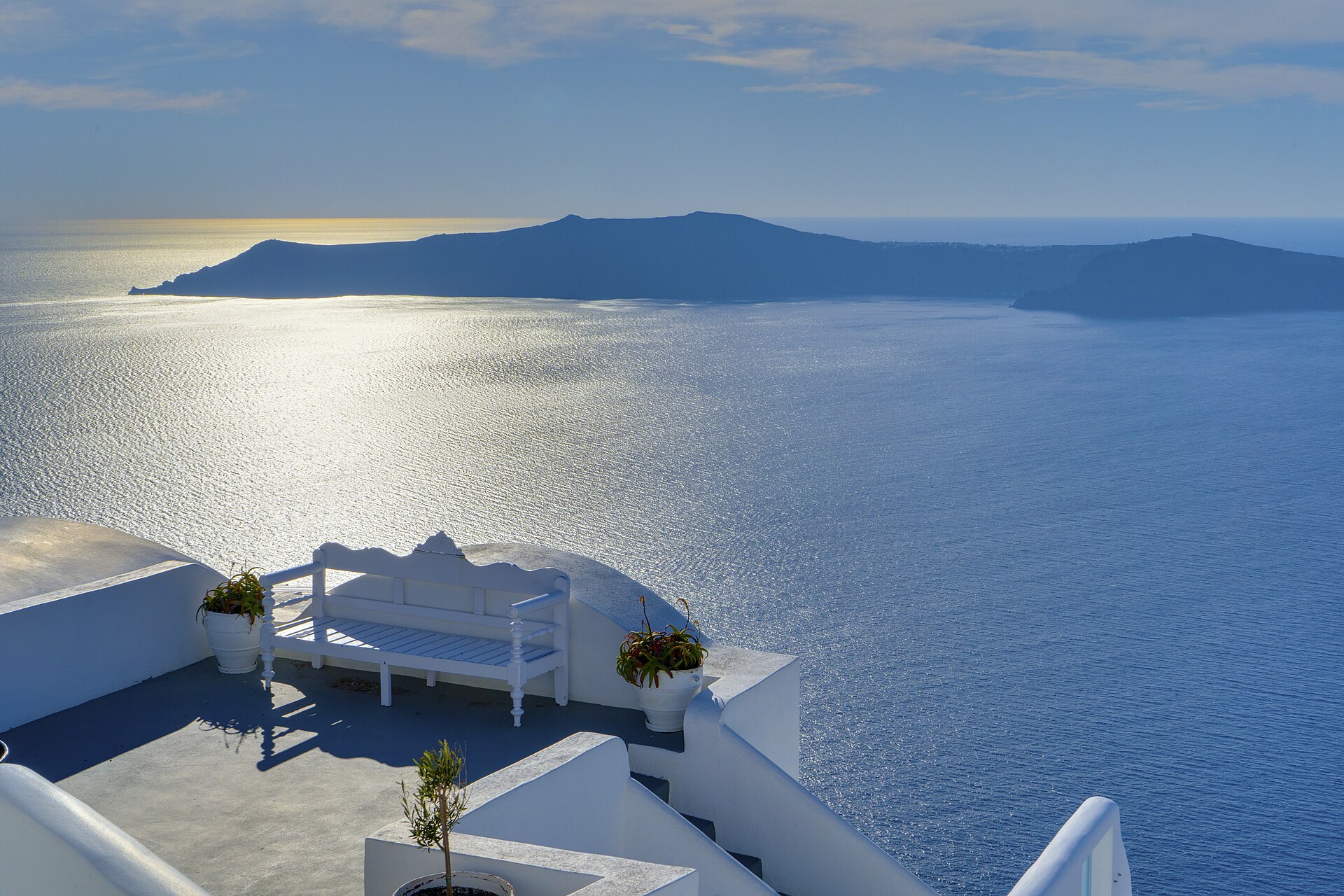
Every Greece itinerary eventually runs into the same fork in the road. You have two weeks, or ten days, or one week, and you cannot fit both islands in without spending half the holiday in transit. So the question becomes Santorini vs Crete, and it is genuinely a hard one, because the two islands are not competing versions of the same thing. They are different countries wearing the same flag. If you want the short version before the detail, our Santorini Tours team has driven visitors around this island for two decades and hears the comparison every week.
Here is the honest framing. Santorini vs Crete is not a contest between a good island and a bad one. It is a choice between a small, spectacular, intensely photographed volcanic rim that you can see properly in three days, and a vast island with mountains, gorges, four cities and a Minoan civilisation underneath it that you could explore for a month and still miss things. Whichever way you settle Santorini vs Crete, you are not making a mistake. You are choosing which kind of holiday you actually want.
Santorini vs Crete at a Glance
Before the detail, the shape of the decision. This table is the whole Santorini vs Crete argument compressed into one screen, and for a lot of readers it settles the matter before they get any further down the page.
| Santorini | Crete | |
|---|---|---|
| Size | 76 sq km | 8,336 sq km |
| Drive end to end | 40 minutes | 5 hours |
| Days to see it properly | 3 to 4 | 7 to 14 |
| Signature view | The caldera | Gorges and the White Mountains |
| Beaches | Volcanic, black and red, few | Hundreds, several world class |
| Archaeology | Akrotiri, Ancient Thira | Knossos, Phaistos, Malia, museums |
| Car needed | Optional | Essential |
| Airport connections | Seasonal, mostly summer | Two airports, year round |
| Peak crowding | Severe in Oia | Spread out, easy to escape |
| Best for | Short, scenic, romantic trips | Long, varied, exploratory trips |
If that table already told you the answer, trust it. Most people who settle Santorini vs Crete quickly do so on one line of it, usually the number of days or the beaches.
Size and Getting Around: Santorini vs Crete
The single biggest practical difference in the Santorini vs Crete comparison is scale, and it drives almost everything else. Santorini is 76 square kilometres. Crete is 8,336. That is not a difference of degree. Crete is larger than several European countries, and it takes about five hours to drive from Kissamos in the far west to Sitia in the far east without stopping.
On Santorini you can stand at one end of the island and see the other end. The drive from Oia to Akrotiri takes forty minutes on a bad day. You can base yourself anywhere and reach anywhere, which is why so many visitors here never rent a car at all and use taxis, the local bus network or a private guided tour instead.
Crete does not work that way. On Crete you will make a base, explore a region, then move base. A common mistake is to book one hotel in Chania for ten days and then discover that Elafonissi is a two hour drive each way and Knossos is close to three. Whichever side of Santorini vs Crete you land on, the transport implication is the real difference: on one island a car is optional, on the other it is close to mandatory.
This matters for cost as much as convenience. A week on Crete usually means a hire car for the full week, fuel across long distances, and parking. A short stay on Santorini can be done entirely without one. When people run the Santorini vs Crete numbers and Crete looks cheaper per night, the car is often what closes the gap.
How Many Days Each Island Needs
This is where a lot of Santorini vs Crete decisions are actually made, and it is the most reliable single test. Ask yourself how many days you have, and the answer often chooses for you.
Santorini rewards a short, dense stay. Three full days is enough to see the caldera villages, Akrotiri, a beach or two, a winery and a sunset without rushing. Four is comfortable. Our three day Santorini itinerary covers exactly that shape of trip. Beyond five days most visitors start repeating themselves, which is fine if you came to slow down and swim, and frustrating if you came to explore.
Crete punishes a short stay. Three days on Crete means you see one corner of it and spend a disproportionate share of the time driving. To do Crete justice you want seven days minimum, and ten to fourteen if you want both the west and the east. Anyone weighing Santorini vs Crete for a long trip should notice that this asymmetry is the strongest argument Crete has.
So the practical rule reads like this. Under five days, Santorini vs Crete resolves towards Santorini. Over eight days, it resolves towards Crete. Between five and eight, you are in genuinely contested ground, and the rest of this page is about how to break the tie.
Beaches: Santorini vs Crete
If beaches are the reason you are going to Greece, the Santorini vs Crete question has a clear winner, and it is not the island we live on. Crete wins on beaches, comfortably, and pretending otherwise would be dishonest.
Crete has hundreds of them, several of which are genuinely world class. Elafonissi and Balos in the west have pink tinged sand and shallow turquoise lagoons. Preveli has a palm gorge running down to the sea. Vai in the east has a natural palm forest behind it. Falassarna is a long sunset facing sweep of pale sand. These are destination beaches that people plan whole holidays around.
Santorini’s beaches are a different proposition. They are volcanic: black, grey and in one case red, backed by cliffs rather than dunes, and there are perhaps six of any size. Perissa and Kamari are long, organised black sand strips with tavernas and sunbeds. Red Beach is spectacular to look at and awkward to sit on. The sand gets genuinely hot underfoot by midday, and none of them have the postcard turquoise shallows that Crete does.
So on beaches, Santorini vs Crete is not close. What Santorini offers instead is a different kind of swimming: dramatic, volcanic, backed by cliff faces, and a short walk from wherever you are staying. If you want a fortnight of beach hopping, that is a Crete holiday. If you want three swims between other things, Santorini handles it fine.
Landscape and Scenery
Scenery is where the Santorini vs Crete comparison stops being a matter of size and becomes a matter of taste, because both islands are beautiful in ways that have almost nothing in common.
Santorini is one view, repeated and perfected. The caldera is the flooded crater of a volcano that erupted in the Bronze Age, and the western rim of the island sits on top of it, three hundred metres above the water. Every village on that rim, from Oia through Imerovigli to Fira, is a variation on the same theme: white cubes stacked on a cliff over deep blue water, with the volcano islets in the middle distance. It is genuinely one of the great views in Europe, and it is also the only view Santorini really has.
Crete has no single defining image, and that is the point. It has the White Mountains, which hold snow into June. It has the Samaria Gorge, sixteen kilometres of limestone walls that narrow to three metres at the Iron Gates. It has the Lasithi Plateau, high inland farmland ringed by mountains. It has palm forests, high plains, olive terraces and a south coast that in places is genuinely remote. Where Santorini gives you one spectacular thing, Crete gives you twenty different ones spread over a long drive.
So the honest way to frame Santorini vs Crete on scenery is this. Santorini is more photogenic. Crete is more varied. If you want the shot everybody recognises, that is Santorini. If you want to walk through a gorge in the morning and swim off a lagoon in the afternoon, that is Crete.
Villages, Towns and Atmosphere
Santorini’s settlements are small and concentrated. Fira is the capital and the busiest; Oia is the famous one and the most crowded at sunset; Pyrgos and Megalochori are the quiet inland alternatives that most first time visitors miss entirely. You can walk between several of them. Nothing here is a city.
Crete has real cities. Chania has a Venetian harbour and a working old town where people actually live. Rethymno has a Venetian fortress and a long sandy strip. Heraklion is a proper regional capital with an outstanding archaeological museum and, frankly, not much charm. Agios Nikolaos sits around a lake. These are places with year round populations, university students, markets and traffic.
The atmospheric difference in the Santorini vs Crete question is roughly this: Santorini feels like a resort island that happens to be inhabited, and Crete feels like a place that happens to have tourists. Neither is a criticism. It depends entirely on whether you want to be somewhere beautiful and geared to visitors, or somewhere ordinary and self sufficient with beautiful parts.
Archaeology and History: Santorini vs Crete
Both islands sit on the same story, which is one of the more interesting things about the Santorini vs Crete comparison. The Minoan civilisation had its capital on Crete and a major settlement here, and the eruption that made Santorini’s caldera is tangled up in the decline of Minoan Crete.
On Santorini the headline site is Akrotiri, a Bronze Age town buried under volcanic ash and preserved to a level that invites the Pompeii comparison, except that Akrotiri is older by more than a millennium and there are no bodies. It is roofed, walkable and remarkable. Above Kamari, Ancient Thira occupies a ridge with Hellenistic and Roman remains and a view down both coasts. Our historical private tour covers both with a guide qualified to explain them properly.
Crete’s archaeology is deeper and broader. Knossos is the largest Minoan palace and the most visited site on the island, controversially reconstructed in places but unmissable. Phaistos, Malia and Zakros give you three more palaces without the crowds. The Heraklion Archaeological Museum holds the finds, including the frescoes and the Phaistos Disc, and it is one of the best museums in Greece.
On archaeology, Santorini vs Crete goes to Crete on volume and to Santorini on singular impact. Akrotiri is more astonishing per hour spent. Crete gives you a fortnight of sites if you want it.
Food, Wine and Produce
Food is where Crete makes its strongest cultural case, and where the Santorini vs Crete comparison surprises people who assumed the famous island would win.
Cretan cooking is a genuine regional cuisine with its own dishes, its own cheeses and one of the most studied diets in the world. Dakos, staka, gamopilafo, apaki, kalitsounia and an enormous quantity of very good olive oil. Crete grows most of what it eats, and eating well there is easy and cheap.
Santorini’s food story is narrower but unusually distinctive, because almost nothing here is irrigated. The island grows white aubergine, caper leaves, fava, and the famous small intense tomato that tastes of nothing else. The wine is the real headline: Assyrtiko grown in basket shaped vines pruned low against the wind, on ungrafted vines in volcanic soil. Our private wine tour and food experience are built around exactly that.
Call it a draw with different reasoning. Crete wins on breadth, value and everyday eating. Santorini wins on wine and on the strangeness of what grows in volcanic ash. Anyone deciding Santorini vs Crete on food alone should probably go to Crete; anyone deciding on wine alone should come here.
Nightlife and Evenings
Neither island is Mykonos, and that is worth saying plainly before anyone books on the strength of a video.
Santorini’s evenings are expensive, scenic and fairly civilised. Cocktails on a caldera terrace, a long dinner, a few late bars in Fira, and a beach club scene at Perissa and Perivolos in high summer. Our nightlife guide covers where each of those sits. It is romantic rather than raucous, and it closes earlier than you would expect.
Crete’s nightlife depends entirely on where you are. Malia and Hersonissos in the north have a package resort club scene with a reputation to match. Chania and Rethymno have relaxed old town bars and live rembetiko. Most of the rest of Crete is quiet after eleven. So the Santorini vs Crete answer on nightlife depends on which Crete you mean, and for most travellers the honest comparison is between Santorini’s scenic drinking and Chania’s easy old town evenings.
Hotels and Where to Stay: Santorini vs Crete
Accommodation is one of the sharpest contrasts in the whole Santorini vs Crete comparison, and it is where the price gap opens widest.
Santorini’s signature stay is the cave hotel: a room carved into the caldera cliff with a private terrace and an infinity pool hanging over the drop. These are extraordinary and they are priced accordingly. Our cave hotel guide explains what you actually get for the money and which villages are worth the premium. Away from the rim, in Kamari, Perissa and the inland villages, prices fall sharply and you can stay here on a normal budget. Our where to stay guide and villa guide break down the trade offs.
Crete has the full range and far more of it: family run studios, large all inclusive resorts on the north coast, agrotourism farmhouses inland, boutique conversions in Chania’s old town, and quiet apartments on the south coast. Because supply is enormous and the season is longer, the same money buys considerably more room on Crete than it does here.
Put bluntly, if the hotel is the holiday and you want the caldera terrace, Santorini vs Crete resolves to Santorini and you pay for it. If you want a good base at a fair price with a car outside, Crete wins on value by a distance.
Costs and Budget
Money settles more Santorini vs Crete decisions than any single scenic argument, so it is worth being specific rather than vague.
Santorini is expensive in high season, and the reason is simple: limited land, limited beds, and a very short peak. Caldera view rooms in August run into serious money. Restaurants with a caldera terrace charge for the terrace. Transfers, sunbeds and boat trips all sit above the Greek average.
What is often missed is that Santorini has a cheap version. Staying inland or at the beach resorts, eating where the crews eat, using the bus and travelling in May or October brings the island close to normal Greek prices. Our budget guide and free things to do page exist for precisely that trip.
Crete is cheaper across almost every line: rooms, tavernas, fuel per night of stay, and especially food. Car hire is the one budget line that runs the other way, because on Crete it is compulsory and on Santorini it is optional. The offsetting cost is the car, which you will need for the whole stay, and the distances you will drive with it. On a like for like basis over a week, most couples find Crete lands ten to thirty per cent below Santorini, and that gap widens in August and narrows in the shoulder months.
Crowds and Over-tourism
This is the argument that has changed the most in recent years, and any current Santorini vs Crete comparison that ignores it is out of date.
Santorini is small and receives a very large number of visitors, many of them from cruise ships that arrive and leave the same day. In July and August, Oia at sunset is genuinely uncomfortable, the cable car queue can run to an hour, and the main street in Fira is shoulder to shoulder by late morning. We have written about that pressure honestly in our piece on over-tourism here.
The mitigation is real, though. Crowds on this island are concentrated in two villages and in a four hour window. Go to sunrise instead of sunset, use the inland villages, visit sites at opening time, and Santorini in August is manageable. Off season it is a different island entirely, as our winter guide describes.
Crete absorbs its visitors because it is enormous. The north coast strip gets busy, Knossos gets very busy, and Balos and Elafonissi are heaving in August. Everywhere else, you can drive twenty minutes and be effectively alone. On crowd pressure the Santorini vs Crete verdict is straightforward: Crete is easier, and it is easier by a lot.
Best Time to Visit Each Island
Seasonality affects the two islands differently, which means the right answer to Santorini vs Crete can change depending on when you are travelling.
Santorini’s season runs roughly from April to early November. May, June, September and early October are the sweet spot: warm sea, long light, and a fraction of the August pressure. July and August are hot, windy with the meltemi, and crowded. Winter is quiet and many businesses close, though the island is still beautiful and considerably cheaper. Our weather guide has the month by month detail.
Crete has a longer usable season because it is further south and much larger. The south coast is swimmable well into October, the mountains are pleasant in high summer when the coast is baking, and the cities stay open all year. Crete in April, when the wildflowers are out and the gorges are running, is arguably better than Crete in August.
So if you are travelling in the shoulder months, Santorini vs Crete is close and personal preference decides. If you are travelling in deep winter, Crete is the more functional choice. If you are locked into August, Crete’s ability to spread the load counts for a great deal.
Getting There: Flights and Ferries
Access is a quietly decisive factor in the Santorini vs Crete choice, especially for anyone flying in from outside Greece.
Crete has two international airports, Heraklion and Chania, both with heavy direct traffic from across Europe through the season and reliable year round links to Athens. Getting to Crete is easy and usually cheap.
Santorini’s airport is small and its direct international traffic is concentrated in summer. Out of season you will usually connect through Athens. Our airport guide and Athens to Santorini page cover both routes, and ferries are a genuine alternative in summer.
The two islands are also connected to each other, which matters for the do both question further down. Ferries run between Santorini and Heraklion in season in about two hours on the fast boat and closer to four and a half on the conventional one, and our Crete to Santorini page has the practical detail. That route is the reason Santorini vs Crete does not have to be a permanent decision.
Santorini vs Crete for Couples and Honeymoons
For honeymoons the Santorini vs Crete question usually resolves quickly, and it resolves here. Santorini was built for this trip, whether or not anyone intended it that way.
The reasons are concrete rather than sentimental. The island is small enough that you never spend a day driving. The signature accommodation is a private terrace over a three hundred metre drop. Dinner with that view is a five minute walk rather than an expedition. And the whole thing can be done properly in four days, which fits the way most couples structure a honeymoon around a longer trip. Our honeymoon guide and sunset tour are built for exactly that.
Crete’s romantic case is quieter and, for some couples, better. A farmhouse in the hills above Rethymno, a gorge walk, an empty south coast beach and a long dinner in a village where nobody is photographing anything. It is less spectacular and more private. Couples who dislike being surrounded by other people’s cameras often find Crete the more romantic of the two, which is a real answer to Santorini vs Crete even if it is not the common one.
Santorini vs Crete for Families
With children the Santorini vs Crete comparison flips, and it flips hard.
Crete is the better family island by almost every practical measure. Shallow sandy beaches instead of hot black sand and sudden shelves. Space in the rooms. A car boot for the paraphernalia. Water parks, aquariums and archaeological sites with room to run. Short drives between things once you have picked a base, and food that children actually eat.
Santorini with children is entirely possible and we take families out every week, but it takes planning. The cliff villages have stairs everywhere and few of them are pushchair friendly, the caldera drop demands attention with toddlers, and the black sand at Perissa gets genuinely too hot to walk on barefoot in July. Our pages on Santorini with a baby, large families and family tours deal with all of it honestly.
So for a two week family beach holiday, Santorini vs Crete goes to Crete without much argument. For three or four days with older children who want the volcano, the boat trip and the ancient town, Santorini holds up well.
Santorini vs Crete for First-Time Visitors to Greece
If this is your first trip to Greece, the Santorini vs Crete decision often comes down to what you want to be able to say you saw.
Santorini is the image most people carry of Greece before they arrive, and there is no substitute for standing on the caldera rim the first time. It is also easy: small, well served, English spoken everywhere, and impossible to get lost in. For a first trip built around Athens plus one island, Santorini is the conventional answer for good reason.
Crete asks more of a first time visitor and gives more back. You will need to drive, plan a route and accept that you cannot see it all. What you get is a much fuller picture of what Greece actually is outside the postcard, and one of the strongest arguments in favour of Crete in the whole Santorini vs Crete debate is that it does not feel curated.
Can You Do Both Islands in One Trip?
Yes, and for a lot of travellers this is the right resolution to Santorini vs Crete: refuse the question.
The route works because the ferry does. In season, high speed boats run between Heraklion and Santorini in around two hours, and conventional ferries take about four and a half. That makes a combined trip realistic on ten days or more. The usual shape is Crete first for the exploring, then Santorini at the end for the scenery and the slowdown, flying home from either island or via Athens.
What does not work is trying it on a week. Two islands in seven days means two hotel changes, a ferry day that eats most of a day at each end, and no time on either island. If you have a week, settle Santorini vs Crete properly and pick one. If you have ten days or more, take both and stop agonising.
A useful split on a fortnight is nine days on Crete and four on Santorini, with the ferry in between. Crete needs the volume; Santorini does not. Reversing that ratio is the most common planning mistake we see.
The Verdict on Santorini vs Crete
There is no universal winner, but there are clear answers to specific versions of the question, and after two decades of being asked this, these are ours.
- Short trip, under five days. Santorini. Crete cannot be done justice in the time.
- Long trip, over eight days. Crete. Santorini will run out before you do.
- Honeymoon or a romantic few days. Santorini, comfortably.
- Family beach holiday with young children. Crete, comfortably.
- Beaches as the main event. Crete. It is not close.
- The view as the main event. Santorini. Also not close.
- Tight budget in high season. Crete.
- Wine. Santorini.
- Archaeology in depth. Crete, with Akrotiri as Santorini’s one unanswerable card.
- Hate crowds, travelling in August. Crete.
- First trip to Greece, one island only. Santorini.
- Ten days or more. Both, Crete first.
If you are still genuinely torn on Santorini vs Crete after that list, the tiebreaker we suggest is simple: decide whether you want to explore or to arrive. Crete is for exploring. Santorini is for arriving.
Planning Mistakes We See Every Season
Most of the regret we hear about is not caused by picking the wrong island. It is caused by picking the right island and then planning it as though it were the other one.
Booking one base for all of Crete. Ten days in Chania sounds relaxing until you work out that Knossos is nearly three hours away. Crete needs two or three bases.
Booking a week on Santorini and expecting variety. After four days here you will have seen the island. That is a fine holiday if you came to swim and eat, and a long one if you came to explore.
Renting a car on Santorini for the whole stay and then parking it. Parking in Fira and Oia is genuinely difficult in season. Our car rental guide and ATV guide explain when a vehicle is worth it and when it is a liability.
Not renting a car on Crete. The reverse mistake, and worse. Without a car on Crete you will see the strip your hotel sits on.
Trying both islands in five days. The single most common way people ruin a Santorini vs Crete trip is refusing to choose when the calendar has already chosen for them.
Building the Santorini day around sunset in Oia. It is beautiful and it is also the most crowded hour on the island. Sunset from Imerovigli, the lighthouse or a boat is better and emptier.
What a Good Santorini Trip Looks Like
If Santorini vs Crete has landed on Santorini, here is the shape that works, and it is the one our drivers set up most often.
Day one, arrive and walk the caldera path from Fira towards Imerovigli in the late afternoon. Day two, the south of the island: Akrotiri, Red Beach, a winery and the lighthouse. Day three, the volcano and hot springs by boat, or Thirassia if you want the version without the crowd. Day four, the inland villages and a long lunch.
Our full day private tour compresses most of that into eight hours with a driver and guide, which is the right answer for anyone who has three days and does not want to spend one of them working out bus timetables. Prices and durations for every itinerary are on our tours and prices page.
Santorini vs Crete: Common Questions
Is Santorini or Crete better?
Neither is better outright. Crete is better for long trips, beaches, families and value; Santorini is better for short trips, scenery, honeymoons and wine. The Santorini vs Crete answer depends almost entirely on how many days you have.
Should I choose Santorini or Crete for a week?
For seven days, pick one. Crete is the stronger choice for a full week because it can absorb the time; Santorini starts repeating itself after four or five days.
Is Crete cheaper than Santorini?
Yes, generally by ten to thirty per cent on accommodation and food, with the gap widest in August. The offset is that Crete requires a hire car for the whole stay.
Which island has better beaches, Santorini or Crete?
Crete, clearly. It has hundreds of beaches including Elafonissi, Balos and Vai. Santorini has around six, all volcanic, dramatic rather than idyllic.
Can you visit Santorini and Crete in the same trip?
Yes. Ferries run between Heraklion and Santorini in about two hours on the fast boat in season. Allow ten days or more, and do Crete first.
Which is better for a honeymoon?
Santorini, for most couples. The caldera hotels, the short distances and the sunset are hard to match. Crete suits couples who want privacy over spectacle.
Which is better with young children?
Crete. Sandy shallow beaches, more space, easier logistics and lower prices. Santorini works with children but needs more planning.
Do I need a car on either island?
On Crete, effectively yes. On Santorini, no. Buses, taxis and private tours cover the island comfortably, and parking in the cliff villages is difficult.
Is Santorini too crowded to enjoy?
Not if you plan around it. The pressure is concentrated in Oia and Fira in a four hour window. Early starts, inland villages and the shoulder months make it comfortable.
Which island is better in winter?
Crete. It has two year round airports, cities that stay open and a longer swimming season. Much of Santorini closes between November and March.
How many days do I need on each?
Three to four on Santorini, seven to fourteen on Crete. That asymmetry is the most useful fact in the whole Santorini vs Crete comparison.
Which has better food?
Crete for everyday eating, breadth and value. Santorini for wine, and for produce that grows nowhere else, including the fava, the caper leaves and the tomatoes.
Santorini vs Crete on a Cruise Stop
A large share of visitors never face the Santorini vs Crete choice as a holiday decision at all, because a cruise itinerary has made it for them and given them seven or eight hours ashore. The two islands behave very differently in that window.
Santorini is the better cruise call, and it is one of the few categories where it wins outright. Tenders come into the old port below Fira, the cable car or the road takes you up in minutes, and everything worth seeing is within a short drive of the rim. In one shore day you can do Oia, a winery, Akrotiri and be back with time to spare, which is exactly what our shore excursion is built around. Our cruise port guide covers the tender process and the timings honestly, including how long that cable car queue really gets.
Crete on a cruise day is harder. Ships dock at Heraklion, and Heraklion is not the reason anybody wants to see Crete. You can reach Knossos in twenty minutes and the archaeological museum on foot, which is a genuinely excellent half day, but the gorges, the western beaches and the mountain villages are all far out of reach. Crete needs days, not hours, and a shore stop shows you the least representative part of it.
So for a single day off a ship, Santorini vs Crete resolves firmly towards Santorini. For a fortnight, the same logic runs the other way.
Santorini vs Crete for Photographers
Photographers ask this more precisely than most, because the two islands demand different equipment and different hours.
Santorini is a compressed, high contrast, blue and white subject shot mostly at wide angle from a fixed set of positions. The rim path between Fira and Oia, the windmills, the blue domes at Oia, the cliffs from the water. The light is best at either end of the day and brutally flat at noon. The difficulty is not finding the shot; it is finding it without forty other people in the frame, which is why the useful hours here start before six in the morning.
Crete gives you landscape, texture and people rather than one iconic composition. Gorges, mountain light, Venetian harbours, working villages, olive groves and long empty beaches. You will use a longer lens more often and you will drive a great deal further between frames. For anyone building a portfolio rather than a set of postcards, Crete is the richer subject, and that is a real answer to Santorini vs Crete even though the famous photographs all come from here.
What Each Island Genuinely Does Better
Strip out the marketing on both sides and the Santorini vs Crete comparison reduces to a short list of things each island does better than almost anywhere else in Greece.
Santorini does the caldera, the sunset, Assyrtiko wine, Akrotiri, cave hotels and the sense of arriving somewhere unlike anywhere you have been. It does short trips exceptionally well, and it does them without a car. It does honeymoons, anniversaries and the once in a lifetime week better than any island in the country.
Crete does scale, variety, beaches, mountains, food, value, year round life and the feeling of a real place rather than a destination. It does two week holidays, families, repeat visits and the kind of trip where you come home with a region you want to go back to rather than a photograph you wanted to take.
Neither list is a rebuttal of the other, which is why Santorini vs Crete stays a live argument in a way that most island comparisons do not. They are both right answers to different questions, and the only wrong move is to choose one and then plan it as though you had chosen the other.
What We Tell Guests Who Ask Us Directly
We get the Santorini vs Crete question in the car several times a week, usually from people already sitting in Santorini and wondering whether they picked wrong. The answer we give has not changed in twenty years.
If you came for four days, you picked right. There is no version of Crete that works properly in four days, and you would have spent two of them on a motorway. If you came for twelve days and you are on day six with everything already seen, you picked the smaller island for a longer holiday, and next time do it the other way round or split the trip.
The people who most often regret the Santorini vs Crete decision are not the ones who chose wrong. They are the ones who chose well and then booked the wrong length of stay for the island they chose. Match the days to the island and the choice largely takes care of itself.
When you get here, whichever way the comparison went, we are happy to build the days around what you actually want rather than a fixed route. That is what a private tour is for.
Reading That Will Help You Decide
Whichever way your own Santorini vs Crete decision goes, these are the pages our guests use most when they plan the Santorini half of the trip.
Places on the island
- Oia
- Fira
- Imerovigli
- Pyrgos
- Megalochori
- Akrotiri
- Ancient Thira
- the Akrotiri lighthouse
- Amoudi Bay
- Thirassia
- Red Beach
- Kamari
- Perissa
- the best beaches
- the cable car
- the hot springs
- the museums
- the volcano
Planning your days
- weather month by month
- a three day itinerary
- what to pack
- SIM cards and data
- Santorini on a budget
- free things to do
- Santorini in winter
- the best time to visit
- how many days you need
- things to do
- day trips
- sunrise spots
- hiking routes
- diving
- shopping
- nightlife
- our full travel guide
- photogenic spots
- cultural experiences
- the cliffside villages
Where to stay and who you are travelling with
- where to stay
- cave hotels
- villas
- honeymoon ideas
- getting married here
- travelling with a baby
- large families
- older travellers
- solo travel
- travelling with a dog
- accessible Santorini
Getting here and getting around
- the airport
- the bus network
- taxis
- car rental
- ATV rental
- the cruise port
- ferry tickets
- Athens to Santorini
- Crete to Santorini
- Santorini to Mykonos
- Santorini to Naxos
- Santorini to Paros
- Santorini to Ios
- Santorini to Milos
- Santorini to Folegandros
- Santorini vs Mykonos
- Santorini vs Rhodes
Our private tours
- full day private tour
- famous sights tour
- sightseeing tour
- north part and Oia tour
- south part and Akrotiri tour
- historical tour
- wine tour
- food experience
- sunset tour
- shore excursion
- small group tour
- caldera tour with local snacks
- horse riding tour
- personalised tour
- coach tours
Book direct
- Full Day Tour
- Famous Sights Tour
- Sightseeing Tour
- North Part Tour
- South Part Tour
- Historical Tour
- Wine Tour
- Food Experience
- Sunset Tour
- Shore Excursion
- Small Group Tour
- Caldera Tour
- Horse Riding Tour
- Personalised Tour
About us
- all tours and prices
- private transfers
- transfers to Fira and the villages
- transfers to Oia and Finikia
- choosing a transfer service
- about our company
- photo gallery
- pictures from our tours
- all our articles
- the full site map
- useful links
- contact us
Santorini vs Crete: See the Island First
Reading a Santorini vs Crete comparison only takes you so far. This is the island the argument is about, filmed from the places this page describes.
Still Deciding?
If you have read this far and the Santorini vs Crete question is still open, that usually means you have between five and eight days, which is the genuinely contested range. In that case the tiebreaker is what you want to be doing on day four. If the answer is driving somewhere new, go to Crete. If the answer is sitting somewhere beautiful with nowhere to be, come here.
And if you are coming here, talk to us before you build the days around bus timetables. We are a licensed local operator, we run our own vehicles and guides, we quote per vehicle rather than per person, and we do not resell anyone else’s tour. Whatever you decided about Santorini vs Crete, the days you spend on this island should be worth the choice.
