
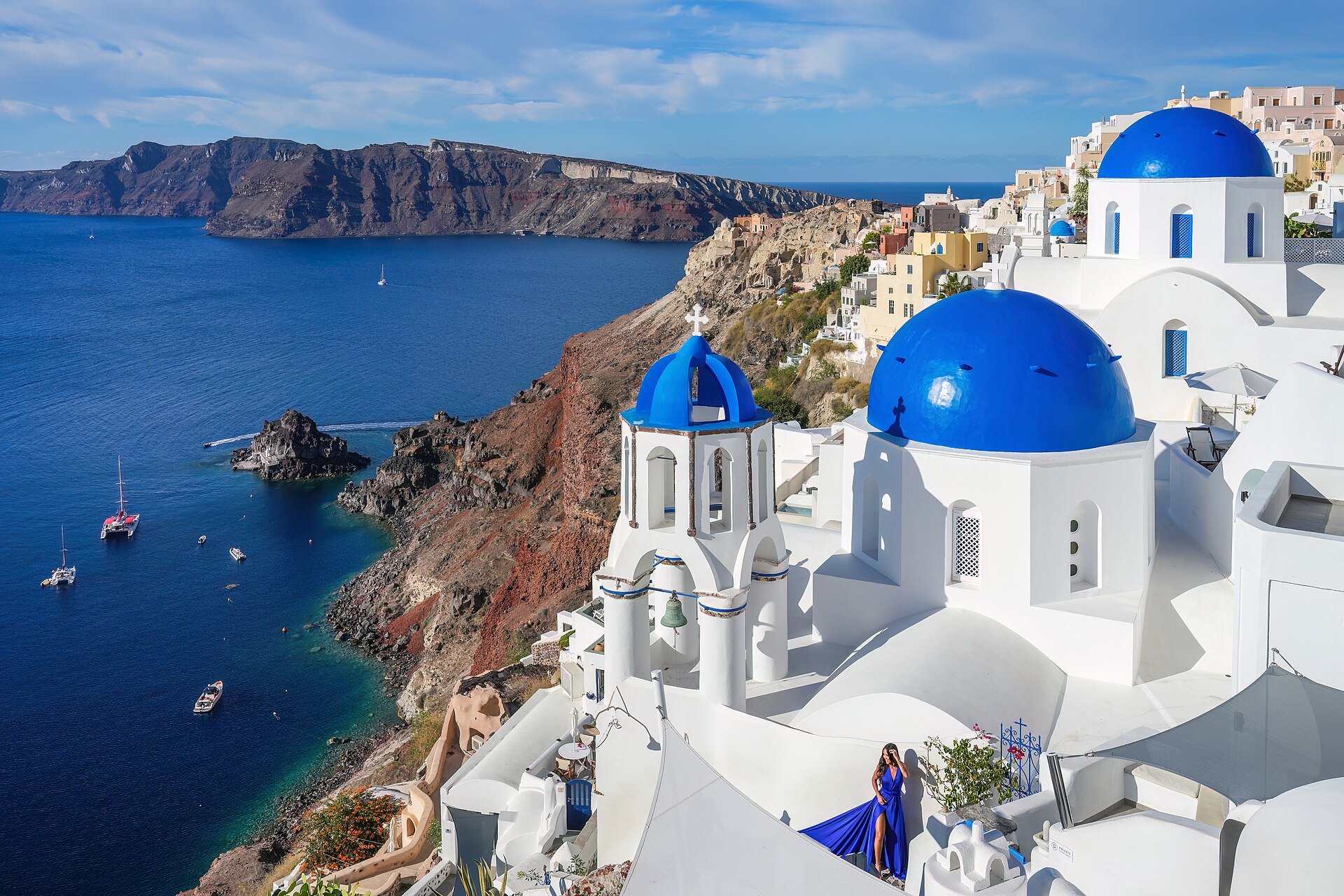
There is one photograph almost everybody arrives here wanting: white walls, three blue domes stacked one behind the other, and the sea beyond. The Santorini blue domes are the most recognisable thing on this island and, for something so photographed, they are surprisingly hard to find on the ground. People walk past the viewpoint twice before they realise where it is. Our Santorini Tours drivers are asked for directions to it more often than for anything else.
This page tells you exactly where the Santorini blue domes are, which church is which, what time to go, how to get the shot without forty people in it, and how to behave once you are there. These are working churches with congregations, not a set, and that part matters more than any camera setting.
What the Santorini Blue Domes Actually Are
They are Greek Orthodox churches. Not decoration, not a design scheme, and not built for photographs. The island has hundreds of churches and chapels, many of them private, built by families and by ships’ crews as offerings, and a proportion of them carry a painted dome over the nave.
The classic blue dome form is a whitewashed cubic or barrel vaulted body with a shallow hemispherical dome on a low drum, a small bell tower or a wall belfry beside it, and a blue door. Some are large enough for a congregation; a great many are chapels that hold six people and open once a year on their saint’s day.
What makes the Santorini blue domes photograph so well is the geometry rather than the colour on its own. The rim villages are stacked vertically on a cliff, so from the right position you look down onto the roofs and the domes line up one behind another with the caldera behind them. Almost nowhere else in Greece gives you that layering.
It is worth saying clearly that not every dome here is blue. Plenty are white, terracotta or bare. The blue ones are a minority, which is part of why the specific viewpoints matter.
Why the Santorini Blue Domes Are Blue
The usual explanation, that the colours are the Greek flag, is at best half true and mostly a modern story told to visitors.
The practical explanation is better. Whitewash on these islands was lime, cheap, plentiful and antibacterial, and it was applied to almost every surface for hygiene as much as appearance. For the blue, the traditional pigment was a laundry blue that households already had, mixed into the lime wash. It was the cheapest colour available, it held up in salt air, and it did not fade to something unpleasant. So the Santorini blue domes are blue for the same reason the doors and the window frames are: it was what people had.
The uniformity came later. After tourism arrived in earnest, the white and blue palette was formalised and in places enforced, which is why the island now looks more consistently blue and white than it did in photographs from the nineteen fifties. That is not a scandal, but it is worth knowing that the Santorini blue domes you photograph are partly a preserved tradition and partly a curated one.
The domes themselves are a Byzantine architectural inheritance, and the shape has structural sense in a place with earthquakes and very little timber. The colour is local. The combination is what people came for.
Where to Find the Santorini Blue Domes in Oia
This is the one everybody means. The famous shot, the one on the postcards and on roughly half the travel accounts on Instagram, is taken in Oia, and knowing exactly where to find it saves an hour of wandering.
The viewpoint. There is only one photo spot that gives the classic composition. Walk the main pedestrian street north west through the village towards the castle end. Roughly two thirds of the way along, on the seaward side, the lane opens and you look down and to the right across a run of rooftops. Two blue domes sit one behind the other with a white bell tower beside them and the sea beyond. The two are usually identified as Agios Spyridon in front and the church of Anastasi, the Resurrection, behind it. Agios Spyridon is a common dedication on this island and there is another blue domed church of the same name at Firostefani, so do not be surprised to see the name attached to both.
How you know you are there. There will be a small queue of people taking turns on the same two metres of wall, which is the most reliable landmark on the island. If nobody is there, you are either in the wrong place or you have done something right with the timing.
What most people get wrong. They stand too far back. The composition only works from close to the low wall on the right hand side, where the two domes stack and the third element, the bell tower, lines up. A step to the left and the domes separate and the shot falls apart.
The other Oia angle. From further along, near the castle ruins, you get the domes with the whole village behind them rather than the sea. Fewer people shoot this and it is the better photograph on a cloudy day.
These are the Santorini blue domes that made the island’s reputation, and they are genuinely worth the walk. They are also, at six in the evening in August, one of the most congested two metres of ground in Greece.
The Three Bells of Fira
The second most photographed of the Santorini blue domes is not in Fira at all. It is in Firostefani, the village immediately north along the rim, and it is usually called the Three Bells of Fira after the three bell openings in its wall belfry.
It is a blue domed church built into the cliff on the caldera side, so the composition is completely different from Oia. Here you shoot from above and slightly behind, looking down over the dome and the bells with the caldera, the volcano islets and the water directly beyond. There is no village clutter in the frame at all.
How to get there. Walk the caldera path north from Fira for about fifteen minutes, or drive to Firostefani and walk down. The church sits below the level of the path and there are signposts once you are close. Our taxi guide and bus guide cover getting to Firostefani.
Why it is the better photograph. Fewer people, a cleaner background, and the light works in the afternoon rather than only at one moment. Of all the Santorini blue domes this is the one professional photographers tend to prefer, and it is the one most visitors never find.
Santorini Blue Domes in Imerovigli, Fira and Inland
Beyond the two famous ones there are blue domes all along the rim, and several are worth a detour.
Imerovigli. The highest of the rim villages, with several blue domed chapels scattered down the cliff and Skaros Rock in the background. Quieter than both Oia and Fira and, in the late afternoon, the best light on the rim.
Fira itself. The Orthodox cathedral and a run of smaller churches along the caldera edge, best shot from the path south of the cable car station.
The inland villages. Pyrgos, Megalochori and Emporio all have blue domed churches with no crowd whatsoever. You lose the caldera behind them and gain a village that is not performing. Our page on Emporio covers a village with over thirty churches and no queue at any of them.
The chapels in the fields. Driving between Pyrgos and Akrotiri you will pass a dozen small blue domed chapels standing alone in the vineyards. These are the honest version of the Santorini blue domes, and nobody photographs them.
Best Time of Day to Photograph the Santorini Blue Domes
Timing matters more than equipment here, and it matters more at Oia than anywhere else on the island.
Sunrise, from about half an hour before the sun comes up. This is the answer. The Oia viewpoint faces roughly north west, so at sunrise the light is soft and behind you, the domes are lit rather than silhouetted, and there is almost nobody there. Between six and seven in the morning in July you can have the wall to yourself. Our sunrise guide covers the whole island at that hour.
Mid morning, from eight to ten. Second best. Good light, the first coaches have not arrived, and the shops are opening. Perfectly workable.
Midday. Flat, harsh and busy. The white blows out and the domes lose their shape.
Late afternoon and sunset. The most crowded time of the entire day and the reason most people go home disappointed. The Santorini blue domes are between you and the sunset, which sounds ideal and in practice means you are shooting into the light with several hundred people around you. Watch the sunset from the castle instead and shoot the domes the following morning.
Season. May, June, September and October give better light and a fraction of the people. In winter the village is empty and the domes are still there, as our winter guide describes.
Crowds at the Santorini Blue Domes, and How to Avoid Them
Being blunt about this saves the most disappointment. In August the Oia viewpoint has a queue, an unofficial rotation, and people asking each other to move. The Santorini blue domes are a small physical space with an enormous number of people wanting the same two metres.
Three things work.
Go early. Not fashionably early. Six in the morning. This single decision changes the experience completely and it is what we tell every guest who asks.
Go to Firostefani instead. The Three Bells has a fraction of the traffic and arguably the better composition.
Go in the shoulder season. The same viewpoint in mid October is a pleasant five minutes rather than a scrum.
What does not work is arriving at seven in the evening in August and hoping. Our page on over-tourism here takes the wider question seriously, and the practical version of it is this viewpoint.
Photographing the Santorini Blue Domes: Lenses, Tripod and Drone
Lens. Something in the short telephoto range compresses the domes and stacks them, which is what makes the classic shot work. A wide angle pushes them apart and includes a great deal of roof you do not want. A phone at two or three times zoom does the job.
Tripod. Legal but antisocial at the Oia viewpoint in season, where you will be occupying space several other people are queueing for. At sunrise, when there is nobody there, a tripod is fine and useful. At Firostefani it is rarely a problem.
Drone. Do not. Flying a drone over the villages here is restricted, it is intrusive over people’s homes, and the authorities take a dim view of it around churches and crowds. Every good photograph of the Santorini blue domes on this page’s subject was taken from the ground.
Exposure. Whitewash fools automatic metering. Expose for the white walls and let the sky go, or bracket. The domes are a mid tone and will look right if the whites do.
People in frame. Almost unavoidable in season. Either wait for a gap, which can take twenty minutes, or include them deliberately for scale, which is often the more honest picture. Our photogenic spots guide and photography tour page cover the rest of the island.
Etiquette and Respect at the Santorini Blue Domes
This is the part that gets left out of every other guide to the Santorini blue domes, and it is the part that matters.
These are working churches. They hold services, funerals and weddings. If something is happening, put the camera down and walk on.
The rooftops are not viewing platforms. The terraces you can see from the viewpoint belong to hotels and to houses. People climb onto private roofs for a better angle several times a week and it is trespassing.
Do not go inside for a photograph. If a church is open, you may enter respectfully, with shoulders covered, and you should not photograph the interior or the iconostasis without asking. Many are locked, and that is not an invitation.
Keep the noise down. Several of these lanes have residents a metre away on either side.
Do not block the path. The lane at the Oia viewpoint is also how people get to work.
Simple respect costs nothing and it is why the Santorini blue domes are still accessible at all. Our cultural experiences page covers the wider etiquette around churches and monasteries on the island.
A Walking Route: All the Santorini Blue Domes in One Morning
You do not need a map so much as an order. This route takes about three hours with stops and covers everything worth seeing.
Start in Firostefani at first light. Walk down to the Three Bells while the caldera is still in shadow and the water is silver. Nobody will be there.
Walk north along the caldera path to Imerovigli. Twenty minutes, with blue domed chapels on the way down the cliff and Skaros Rock ahead of you.
Take a bus or a taxi to Oia. The rim path continues but it is a two hour hike from here and you want to arrive before the coaches. Our hiking guide covers the full walk if you want it.
Do the Oia viewpoint before nine. Two thirds along the main street, seaward side, close to the wall.
Finish at the castle end for the wider composition, then have breakfast before the village fills.
That is every one of the famous Santorini blue domes in a morning, in good light, with almost no crowd. Anyone who would rather not manage the timings and the transport between villages can have it driven, which is what our north part tour and sightseeing tour do.
Santorini Blue Domes: Common Questions
Where are the Santorini blue domes?
The famous ones are in Oia, about two thirds along the main pedestrian street on the seaward side, where Agios Spyridon and the church of Anastasi stack one behind the other. The second best known is the Three Bells of Fira, in Firostefani.
Which church is in the famous Santorini blue domes photograph?
Two churches, usually identified as Agios Spyridon in front and the church of Anastasi, the Resurrection, behind it, with a white bell tower alongside. The same dedication appears on another blue domed church at Firostefani.
What are the Three Bells of Fira?
A blue domed church built into the caldera cliff at Firostefani, named for the three bell openings in its belfry. It is shot from above with the caldera behind and is far quieter than Oia.
Why are the Santorini blue domes blue?
Because blue laundry pigment mixed into lime wash was the cheapest durable colour available, not because of the flag. The palette was formalised later as the island became a destination.
What is the best time to photograph the Santorini blue domes?
Sunrise, or before nine in the morning. The Oia viewpoint faces north west, so the light is behind you early and into your lens at sunset, when the crowd is also at its worst.
Are the Santorini blue domes free to visit?
Yes. All the viewpoints are on public streets and paths, and there is no charge. The churches themselves are often locked.
Can you go inside the churches?
Sometimes. If a church is open you may enter respectfully with shoulders covered. Do not photograph the interior without asking, and do not enter during a service.
Can I fly a drone over the blue domes?
No. Drone flying over the villages is restricted and intrusive over homes and churches, and you will be challenged.
How long does it take to see them all?
About three hours on foot with a short bus or taxi hop between Imerovigli and Oia, taking in Firostefani, Imerovigli and Oia in that order.
Are there Santorini blue domes outside Oia and Fira?
Yes, throughout the inland villages and standing alone in the vineyards between Pyrgos and Akrotiri. Those have no crowds at all.
More Santorini Reading
The Santorini blue domes take a morning. These are the pages our guests use for the rest of the island.
Places on the island
- Oia
- Fira
- Imerovigli
- Pyrgos
- Megalochori
- Emporio
- Akrotiri
- Ancient Thira
- the Akrotiri lighthouse
- Amoudi Bay
- Thirassia
- Red Beach
- Kamari
- Perissa
- Vlychada
- the best beaches
- the cable car
- the hot springs
- the museums
- the volcano
- diving
Planning your days
- weather month by month
- a three day itinerary
- what to pack
- SIM cards and data
- Santorini on a budget
- free things to do
- Santorini in winter
- the best time to visit
- how many days you need
- things to do
- day trips
- sunrise spots
- hiking routes
- shopping
- nightlife
- where to eat
- catamaran cruises
- our full travel guide
- cultural experiences
- the cliffside villages
Where to stay and who you are travelling with
- where to stay
- cave hotels
- villas
- honeymoon ideas
- getting married here
- travelling with a baby
- large families
- older travellers
- solo travel
- travelling with a dog
- accessible Santorini
Getting here and getting around
- the airport
- car rental
- ATV rental
- the cruise port
- ferry tickets
- Athens to Santorini
- Crete to Santorini
- Santorini to Mykonos
- Santorini to Naxos
- Santorini to Paros
- Santorini to Ios
- Santorini to Milos
- Santorini to Folegandros
- Santorini vs Mykonos
- Santorini vs Rhodes
- Santorini vs Crete
Our private tours
- full day private tour
- famous sights tour
- south part and Akrotiri tour
- historical tour
- wine tour
- food experience
- sunset tour
- shore excursion
- small group tour
- caldera tour with local snacks
- horse riding tour
- personalised tour
- coach tours
Book direct
- Full Day Tour
- Famous Sights Tour
- Sightseeing Tour
- North Part Tour
- South Part Tour
- Historical Tour
- Wine Tour
- Food Experience
- Sunset Tour
- Shore Excursion
- Small Group Tour
- Caldera Tour
- Horse Riding Tour
- Personalised Tour
About us
- all tours and prices
- private transfers
- transfers to Fira and the villages
- transfers to Oia and Finikia
- choosing a transfer service
- the bus network
- taxis
- about our company
- photo gallery
- pictures from our tours
- all our articles
- the full site map
- useful links
- contact us
The Island Behind the Photograph
The Santorini blue domes sit on a cliff above a flooded volcano, which is the part the photographs crop out. This is the whole thing.
Before You Go
Three things decide whether this works. Go at sunrise, because the Oia viewpoint faces north west and everything about the light and the crowd is better at six in the morning than at six in the evening. Find the Three Bells at Firostefani, because it is the better composition and almost nobody looks for it. And remember that the Santorini blue domes are churches with congregations rather than a photo set, so behave accordingly on somebody’s doorstep.
If you would rather have the villages, the timings and the driving handled, that is what we do. We are a licensed local operator with our own guides and vehicles, we quote per vehicle rather than per person, and an early start is exactly the kind of thing a driver makes easy.
