
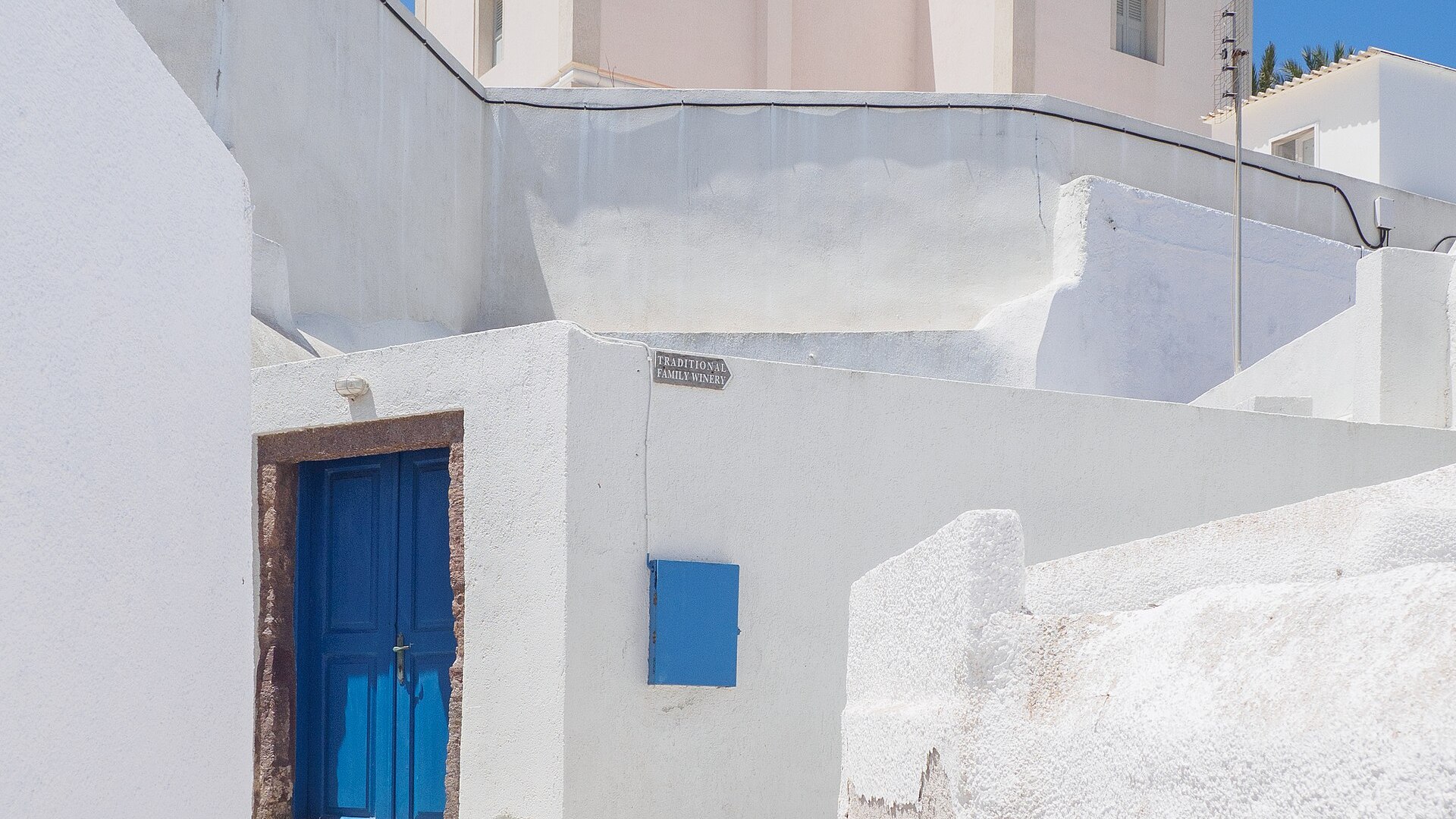
Megalochori Santorini is the prettiest village on this island and the one almost nobody stops in. It sits inland in the south west, ten minutes from Fira on the road towards Akrotiri, and it is a small tangle of white lanes and vaulted cellars built by wine merchants who were rich enough to put grand doorways on modest streets. In the middle of it is a shaded square with a free-standing bell tower you walk underneath, and around that square there are cafes with tables under trees and almost nobody sitting at them. Our Santorini Tours pass through most days, and this is where we stop when a guest says they want to see the island rather than the postcard.
The honest framing. Megalochori Santorini has no caldera view, no beach in the village and nothing at all to do after about ten at night. What it has is the loveliest square in the Cyclades, the best wineries on the island within ten minutes, and a quiet that the rim villages lost forty years ago.
The Short Answer
Ten minutes from Fira, which makes Megalochori Santorini the easiest inland village to reach and the least visited of the three.
The square and its bell tower are the point: shaded, small, and unaltered, with an arch you pass under to reach it.
The mansions and the canava. Wine merchants built the houses and cut the cellars, and both are still here.
The wineries are on the doorstep. Three of the island’s best are within ten minutes of the village.
An hour is enough for the village, and an evening is better.
Two quiet beaches below it, Mesa Pigadia and Kampia, ten to fifteen minutes down towards the coast.
The Island Around the Village
Megalochori Santorini at a Glance
| Detail | Reality | Notes | Watch for |
|---|---|---|---|
| Where | Inland in the south west of the island | Ten minutes from Fira | On the road towards Akrotiri |
| Size | A few hundred residents | You cross it on foot in fifteen minutes | Smaller than Pyrgos and much smaller than Emporio |
| The square | Shaded, with cafes and a free-standing bell tower | An arch you walk through under the bells | The best village square on Santorini |
| What built it | Wine money | Merchant mansions from the 18th and 19th centuries | Grand doors on ordinary lanes |
| Canava | The old vaulted wine cellars | Cut back into the volcanic rock | Several now restaurants and tasting rooms |
| Churches | Panagia Eisodion and a scatter of chapels | Blue domes and painted bell towers | Most photographed at the top of the village |
| Wineries | Boutari, Gavalas and Venetsanos nearby | Five to ten minutes by road | Among the best on the island |
| Beaches | Mesa Pigadia and Kampia below | Ten to fifteen minutes down to the coast | Black sand and pebble, quiet |
| Crowds | Very few | A trickle of visitors at midday | Effectively empty by evening |
| Who it suits | Photographers, couples, slow travellers | Quiet, pretty, walkable, cheap to eat in | No caldera view and nothing to do after ten |
The last row is the trade and it is a mild one, because everything the village lacks is within twenty minutes of it by road.
Why the Village Looks Like This
Santorini’s inland villages were built where pirates could not easily reach them, and Megalochori grew up around a small fortified core in the same period as Pyrgos and Emporio. What made it different came later, and it came from wine.
The Vinsanto trade. From the eighteenth century the island’s sweet wine was shipped to Russia and to the Orthodox churches of the Black Sea in enormous quantity, and the merchants who ran that trade lived here.
The mansions. They spent the money on their houses. Walk the lanes of Megalochori Santorini and you keep passing carved doorways, neoclassical facades and courtyards that belong to a far grander place than a village of a few hundred people.
The canava. Beneath and behind those houses are the vaulted wine cellars, cut back into the soft volcanic rock so that the temperature stayed constant without any machinery. Several are now restaurants, tasting rooms and small hotels.
The bell towers. Built as statements as much as for the bells, which is why a village this size has so many of them and why they are the thing everybody photographs.
The 1956 earthquake damaged the village as it damaged the whole island, and much of what stands is careful repair.
Why it stayed quiet. No caldera view, no beach in the village, and no room for a hotel of any size. The same three absences that keep the coaches away kept Megalochori Santorini intact.
What to See
The main square. Small, shaded by trees, ringed with cafe tables and closed to traffic. You reach it by walking under an arch with a bell tower on top of it, which is the image most people take away from Megalochori Santorini.
The bell tower over the arch. Free-standing, whitewashed, with the bells hanging in openings above the passage. There is nothing else quite like it on the island.
Panagia Eisodion. The main church, with a blue dome and a painted campanile, at the upper end of the village.
The merchant mansions. Carved stone doorways, iron balconies and painted facades on lanes barely wide enough for two people. Look up, and look at the doors. They are the domestic version of the grand Gyzi Megaron in Fira, built by the same class of people out of the same trade, and here they are still lived in rather than curated.
The list of things to do is short and that is the point. Walk, look, drink, eat. Anybody arriving with a checklist will be finished in fifteen minutes; anybody arriving without one will lose an afternoon.
The canava. Vaulted cellars cut into the rock behind the houses. Several are open as restaurants and tasting rooms and are worth going inside for the architecture alone.
The hidden squares. There are three or four smaller ones besides the main square, each with a tree and a couple of chairs, and finding them is the pleasure of the place.
The cave houses. Dug back into the soft rock rather than built out from it, and still lived in. Some are now small guesthouses.
La Ponta. A restored Venetian tower housing a workshop and small museum devoted to the tsampouna, the Greek island bagpipe, with performances in season. It is the most unexpected thing in Megalochori Santorini.
The bell towers plural. A village this size has an improbable number of them, and photographing them against a blue sky is why photographers come here at all.
The lanes at night. Lit, silent and completely empty after about nine.
Below and Beyond the Village
Mesa Pigadia. A small black sand and pebble beach under the cliffs south west of the village, reached down a rough track. Quiet, with a taverna or two in season.
Kampia. Smaller still, and often deserted. Neither of these is a resort beach; our beaches guide covers the organised ones.
The Venetsanos winery, cut into the cliff above Athinios port five minutes away, with the most dramatic terrace on the island.
Boutari and Gavalas, both within a few minutes of Megalochori Santorini and both serious estates rather than sunset bars.
Akrotiri, ten minutes south, for the excavated Bronze Age town and the Red Beach afterwards. See our Akrotiri guide and Red Beach guide.
Pyrgos, five minutes east and uphill, for the castle and the two-sea view. Our Pyrgos guide has it.
Emporio, ten minutes south east, the biggest and least visited village on the island.
Athinios port, five minutes down the switchbacks, which makes this village a very easy arrival by ferry. Our ferry guide explains the port.
The Wine Village
If you are doing one wine day on this island, base it here. The vineyards around Megalochori Santorini are among the oldest worked land on Santorini and three of the island’s most serious estates are within ten minutes of the square.
Why the wine is unusual. Volcanic soil, no meaningful rainfall, ungrafted vines older than most European vineyards, and the kouloura training method that coils the vine into a low basket to shelter the fruit from the wind.
Assyrtiko. Dry, mineral, high in acid, and nothing like a warm-climate white anywhere else in Greece.
Vinsanto. The sweet wine from sun-dried grapes that built the mansions in this village. Ask for an old one.
Nykteri. The barrel-aged traditional style, harder to find and worth the asking.
Boutari. The large modern winery on the edge of the village, with a domed tasting room and a full programme of tastings.
Gavalas. A family estate in the village itself, small, unhurried and the one we send guests to when they want to talk to a winemaker rather than a host.
Venetsanos. Five minutes away above Athinios, built into the cliff so that the wine moved downhill by gravity, with a terrace over the caldera.
Santo Wines. Ten minutes towards Pyrgos, the cooperative, the biggest terrace and the busiest sunset on the island. Book ahead.
How many. Three estates in an afternoon works. Four does not.
Do not drive. This is the one day where a driver pays for itself. Our private wine tour runs from wherever you are staying.
Eating and Evenings
The square. A handful of cafes and tavernas with tables under the trees, and the best place on the island to spend an hour doing nothing.
The canava restaurants. Two or three of the old vaulted cellars are now kitchens, cool in August without air conditioning and genuinely atmospheric.
What to order. Fava, tomatokeftedes, white aubergine, chloro cheese, slow-cooked pork or goat, and a local Assyrtiko.
Prices. Ordinary Greek prices. A dinner for two in Megalochori Santorini costs roughly half what the same meal costs on the caldera and is usually better.
Booking. Worth doing for the canava restaurants in August, unnecessary otherwise.
Breakfast. There is a bakery and a couple of cafes, and they open early.
Nightlife. None. Two bars at most, and the village is silent by ten. Our nightlife guide points at Fira and Perivolos for anything else.
The wider food picture is in our Greek food guide and the food experience tour.
Megalochori, Pyrgos or Emporio?
Three inland villages within ten minutes of one another, all worth an hour, and constantly confused. Here is how we separate them for guests on the phone.
Megalochori is the prettiest and the smallest of the three. It has the best square, the merchant mansions, the canava cellars and the wineries on its doorstep. It has no view to speak of.
Pyrgos is bigger, higher and has the castle, more churches, more restaurants and the only viewpoint on the island that sees both coasts at once.
Emporio is the largest village on Santorini and the least visited, with a darker and more intact medieval core than either, and almost no facilities.
For photographs. Megalochori Santorini, comfortably. The bell towers and the doorways are the reason photographers come inland at all.
For the view. Pyrgos.
For atmosphere with nobody else in it. Emporio.
For a long lunch. Megalochori, in the square or in a canava.
For wine. Megalochori, by a distance, because three good estates are within ten minutes.
For an evening. Pyrgos has more restaurants; Megalochori has more charm and less choice.
Doing all three takes an afternoon and is one of the best days on the island. Our villages guide adds Exo Gonia and Vothonas.
Staying in Megalochori
What is available. Restored cave houses, a handful of small boutique hotels built into the canava, and villas on the edge of the village. There are no large hotels.
The price. Well below the caldera for a comparable standard, and often below Fira.
The quiet. Absolute. If you have stayed in Fira and found it noisy, Megalochori Santorini is the corrective.
The catch. No caldera view, no beach within walking distance, and you will need a car or a driver for almost everything.
Who it suits. Couples, second visits, photographers, anyone hiring a car, and anybody who wants to be in a real village rather than a resort.
Who it does not. First-timers on three nights who want the famous view, families who want a beach outside the door, and anyone without transport.
Position. Ten minutes from Fira, five from Athinios port, fifteen from the airport and ten from Akrotiri. As a base it is more central than anywhere on the rim.
Parking is free and straightforward, which is not true anywhere on the caldera.
Steps. Fewer than Pyrgos or the rim villages, though the lanes are uneven. Ask where the room actually is before booking.
Our view. For a week with a hire car, Megalochori Santorini is one of the two or three best value bases on the island. Our where to stay guide and villas guide compare everything.
Getting There and Around
From Fira. Ten minutes by road, and the bus towards Akrotiri and Perissa passes the village.
From the airport. Fifteen minutes, which makes Megalochori Santorini an easy arrival. See our airport guide.
From Athinios port. Five minutes up the switchbacks, the shortest port transfer of any village on the island.
From Oia. Half an hour by road, or an hour by bus changing in Fira.
To Akrotiri and Red Beach. Ten minutes south.
To Pyrgos. Five minutes east and uphill.
To the beaches. Mesa Pigadia and Kampia are ten to fifteen minutes down rough roads; Perissa and Perivolos are twenty minutes east. Our Perissa guide covers that coast.
The bus. Runs, but not usefully after dinner. Our bus guide has the network.
Taxis. Around forty serve the whole island, so book rather than hope; the taxi guide explains.
Parking. Free at the edge of the village. Do not drive into the lanes.
Car hire. The inland half of Santorini is the reason to hire a car, and Megalochori Santorini sits in the middle of it. See our car hire guide and ATV guide.
Season by Season
April. Green, cool and empty, with Greek Easter often falling in it and the village lit with candles on Good Friday.
May and June. Warm, quiet and fully open. The best months here.
July and August. Hot but shaded in the square, and busy only between noon and three when the coaches pass through on the way to Akrotiri.
September. Harvest. The wineries around Megalochori Santorini are working and the light softens.
October. Beautiful and very quiet, with places closing steadily through the month.
November to March. The village lives on because people live in it, but most restaurants close. Our winter guide explains what stays open.
The wind. Inland and low, the village is more sheltered than the rim, which makes an August evening here far more comfortable than one on the cliff. Our weather guide and the month by month guide have the rest.
An Afternoon and Evening Here
16:00. Park at the edge and walk in under the bell tower arch.
16:30. The lanes, the doorways and the smaller squares, with no plan and no map.
17:30. A winery on the edge of the village for a tasting.
19:00. Sunset from Venetsanos or Santo Wines, five to ten minutes away, over the caldera.
20:30. Dinner in a canava cellar or under the trees in the square.
22:30. The lit lanes with nobody in them, which is the part of Megalochori Santorini almost no visitor stays for.
Practical Tips
Come at five, not at one. The coaches pass through at midday on the way to Akrotiri and the village is entirely different two hours later.
Park outside and walk in. The lanes are not driveable and the arch is not passable by car.
Look up and look at the doors. The mansions are the whole story of Megalochori Santorini and they are easy to walk past.
Go inside a canava. Even if you are not eating, the vaulted cellars are worth stepping into.
Book a winery, not three. One good tasting close by beats a rushed circuit.
Do not drive after tasting. This is the one day a driver earns the fee.
Stay for dinner. The square after dark is the reason to be here rather than in Pyrgos.
Pair it with Akrotiri. Ten minutes apart, and they make a natural half day.
Bring a camera with a wide lens. The lanes are narrow and the bell towers are tall.
Do not expect a view. Megalochori Santorini is a village, not a balcony, and people who arrive expecting a caldera panorama leave puzzled.
Megalochori Santorini: Common Questions
Where is Megalochori Santorini?
Inland in the south west of the island, ten minutes from Fira on the road towards Akrotiri, and five minutes above Athinios port.
Is Megalochori Santorini worth visiting?
Yes. It has the best village square on Santorini, the wine merchants’ mansions, the old canava cellars, and three of the island’s best wineries within ten minutes.
How long do you need in Megalochori Santorini?
An hour for the village itself, a half day with a winery, and an evening if you stay for dinner.
What is there to see in Megalochori Santorini?
The square and its free-standing bell tower, Panagia Eisodion church, the merchant mansions and doorways, the vaulted canava cellars, and the La Ponta tower.
Is there a caldera view from Megalochori Santorini?
No. It is inland and low. The nearest caldera views are from the wineries five to ten minutes away.
Is there a beach at Megalochori Santorini?
Not in the village. Mesa Pigadia and Kampia are ten to fifteen minutes below it, both small and quiet.
How far is Megalochori Santorini from Fira?
About ten minutes by road, and the bus towards Akrotiri and Perissa passes through.
How far is Megalochori Santorini from the airport and the port?
Fifteen minutes from the airport and five from Athinios port, which is the shortest port transfer of any village on the island.
Megalochori Santorini or Pyrgos?
Megalochori is prettier, smaller and better for wine and photographs. Pyrgos is bigger, higher and has the only view of both coasts at once.
Are there wineries in Megalochori Santorini?
Yes. Boutari and Gavalas are in or beside the village, and Venetsanos and Santo Wines are five to ten minutes away.
Is Megalochori Santorini expensive?
No. Rooms and meals are well below caldera prices and generally below Fira too.
Is there nightlife in Megalochori Santorini?
Effectively none. The village is silent by ten. Fira is ten minutes away.
Can you stay in Megalochori Santorini?
Yes, in cave houses, canava conversions, small boutique hotels and villas. You will want a car.
Is Megalochori Santorini good for families?
Fine for a visit, and quiet as a base. There is no beach within walking distance and nothing organised for children.
Is Megalochori Santorini accessible?
The square is level and reachable, and the lanes beyond are uneven with some steps. It is easier than Pyrgos and much easier than the rim villages.
Myths About Megalochori Santorini
“There is nothing there.” There is a square, a bell tower arch, forty carved doorways, a set of vaulted wine cellars and three of the best estates on the island. What Megalochori Santorini does not have is a view, and people mistake that for nothing.
“It is a five minute stop.” Five minutes gets you a photograph of the arch. The village rewards an hour and repays an evening.
“It is only worth it for the wineries.” The wineries are the excuse. The lanes are the reason, and the lanes are free.
“It is too far from everything.” It is ten minutes from Fira, five from the port and fifteen from the airport. Megalochori Santorini is more central than any village on the caldera rim.
“It is expensive because it is pretty.” It is one of the cheapest places on the island to eat well, and rooms cost a fraction of the rim.
“It is a museum village.” A few hundred people live here, the cafes in the square serve them as much as they serve visitors, and the doors you are photographing are front doors.
“You need a guide.” You need fifteen minutes and no plan. Megalochori Santorini is small enough that getting lost in it is the entire activity.
“The beaches below are worth a day.” They are worth an hour. Mesa Pigadia and Kampia are small, rough and quiet, and that is their whole appeal.
Our Verdict
If a guest tells us they have one afternoon left and they have already done Oia, this is where we take them. Megalochori Santorini is what the island looked like before the caldera became a photograph, and it is ten minutes from the middle of Fira.
What you give up is the view, and it is a real thing to give up on an island famous for one. There is no caldera from these lanes, no sunset over the volcano, and no beach at the bottom of the village.
What you gain is a square with trees in it, a bell tower you walk underneath, doorways built with money made shipping sweet wine to Russia, cellars cut into the rock that are cool in August without a machine, and dinner at half the price of the rim with nobody queueing for a table. Add three serious wineries within ten minutes and you have the best value half day on Santorini.
The people who are disappointed here are the ones who arrive at one o’clock in August with fifteen minutes, walk to the square, find it small, and leave. Come at five instead, stay for dinner, and Megalochori Santorini will be the part of the week you describe when you get home.
Photographing the Village
The arch and the bell tower. The single most photographed thing in Megalochori Santorini, and it works best from the lane approaching it rather than from directly beneath.
Best light. Early morning or the hour before sunset. At midday the contrast between whitewash and shadow is brutal and the lanes photograph flat.
The doorways. Carved stone frames, painted timber, iron knockers. Shoot them square on, and remember they are front doors.
Blue domes. Panagia Eisodion and the chapels at the upper end of the village give the classic dome-and-sky composition without any of the crowd you would fight for in Oia.
The canava interiors. Vaulted, low-lit and hard to shoot handheld. Brace against a wall and expose for the arch.
The square at night. Lamps under the trees, empty tables, nobody about. This is the picture almost nobody has from Megalochori Santorini because almost nobody stays past nine.
A wide lens helps. The lanes are narrow and the bell towers are tall.
From the road above, approaching from Pyrgos, the whole village sits in its bowl of vineyards with the sea beyond.
Manners. Courtyards, roof terraces and washing lines belong to households. Ask, or shoot the street.
Where else on the island is in our photogenic spots guide and our piece on choosing a photography tour.
Megalochori Santorini: Key Points
- Megalochori Santorini is a small inland village in the south west, ten minutes from Fira.
- Its shaded main square, entered under a free-standing bell tower arch, is the best village square on the island.
- The neoclassical mansions were built with money from the Vinsanto trade to Russia and the Black Sea.
- The canava, vaulted cellars cut into the volcanic rock, are now restaurants, tasting rooms and hotels.
- Boutari and Gavalas are in or beside the village; Venetsanos and Santo Wines are five to ten minutes away.
- Panagia Eisodion and a scatter of painted bell towers are the photographic subjects here.
- La Ponta, a restored Venetian tower, houses a workshop and museum of the Greek island bagpipe.
- There is no caldera view from the village and no beach within walking distance.
- Mesa Pigadia and Kampia are small quiet beaches ten to fifteen minutes below.
- Athinios port is five minutes away and the airport fifteen, making it the most central base on the island.
- Prices for rooms and meals are well below the caldera and generally below Fira.
- The village is effectively silent after ten at night, which is either the point or the problem.
Booking With Us
Megalochori sits on the road between the port, the airport, Akrotiri and Fira, which means we pass it several times a day. We can build it into a full day tour with Akrotiri and a beach, make it the base of a wine afternoon, or simply take you there for dinner and bring you back so nobody has to think about the drive. Prices are per vehicle rather than per person, there is no deposit and cancellation is free.
The half day guests thank us for most: the lanes of Megalochori Santorini at five, a tasting at a winery on the edge of the village at six, sunset from the cliff above Athinios at seven, and dinner in a canava at half past eight. It costs a fraction of an evening on the rim.
Tours
- full day tour
- half day tour
- north part and Oia tour
- south part and Akrotiri tour
- sightseeing tour
- historical tour
- wine tour
- food experience
- sunset tour
- shore excursion
- small group tour
- black sand beach tour
- horse riding tour
- custom tour
- coach tours
Transfers
- island transfers
- VIP chauffeur service
- transfer to Oia and Finikia
- transfer to Fira and the villages
- choosing a private transfer
Book directly
- Full Day Tour
- Half Day Tour
- North Part and Oia Tour
- South Part and Akrotiri Tour
- Sightseeing Tour
- Small Group Tour
- Wine Tour
- Food Experience
- Historical Tour
- Sunset Tour
- Shore Excursion
- Black Sand Beach Tour
- Horse Riding Tour
- Personalised Tour
Further reading
- Pyrgos Santorini
- The cliffside villages
- Oia Santorini
- Fira Santorini
- Imerovigli Santorini
- Amoudi Bay
- Akrotiri
- Thirassia
- Red Beach
- Kamari beach
- Perissa beach
- The best beaches
- Santorini museums
- Cultural experiences
- Greek food on the island
- Santorini hiking
- Things to do in Santorini
- A three day itinerary
- How many days do you need?
- Where to stay in Santorini
- Villas on the island
- The volcano tour
- The hot springs
- Santorini weather
- The best time to visit
- Santorini in winter
- Santorini airport
- The cable car explained
- The cruise port
- Ferry tickets and the ports
- The public bus explained
- Taxis on Santorini
- Should you hire a car?
- ATV and quad hire
- Santorini on a budget
- Santorini nightlife
- Shopping on the island
- Travelling solo
- Santorini for seniors
- Santorini for large families
- Family tours
- Travelling with a dog
- Wheelchair accessible Santorini
- Day trips from Santorini
- Santorini to Ios
- Santorini to Naxos
- Santorini to Paros
- Santorini to Mykonos
- Crete to Santorini
- Athens to Santorini
- Santorini or Mykonos?
- The photogenic spots
- Photography tours
- The full travel guide
- Our ten best tours
- How to choose a tour
- Private sunset tours
- Sunset spots
- For honeymooners
- Weddings on Santorini
- The donkey weight limit
- Over-tourism on the island
- Choosing a private transfer
More from this site
- All tours and prices
- About Santorini Impressive Tours
- Photo gallery
- Pictures from our private tours
- Useful links for travellers
- Full site map
- All our Santorini articles
- Terms of use
- Privacy policy
Tell us your dates and we will build the inland half of the island into your stay.
If This Is Your First Visit
Give it an evening, not a stop. Fifteen minutes in the square at midday is what most people give Megalochori Santorini, and it is why most people leave unimpressed.
Arrive at five. The heat is off the walls, the coaches have gone south to Akrotiri, and the light is starting to work.
Walk without a route. The village is small enough that every wrong turn ends somewhere worth photographing.
Book one winery, not three, and make it one within walking distance of the square.
Eat in a canava. Vaulted, cool and half the price of the same meal on the caldera.
Stay until the lamps come on. Megalochori Santorini after nine is empty, lit and completely silent, and it is the reason we send guests here rather than to the rim for a second evening.
